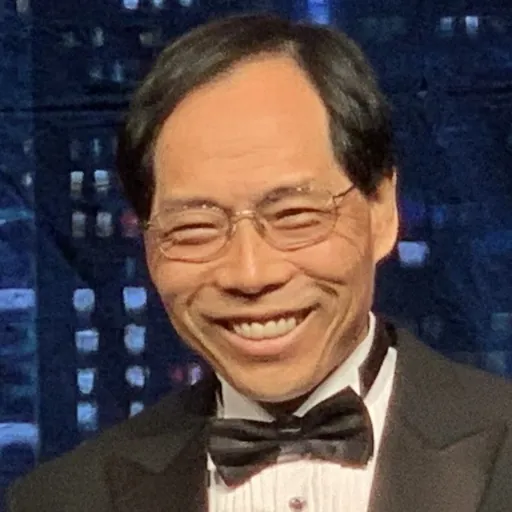
About Lai-Sheng Wang
Born 1961. Lai-Sheng Wang is a Chinese chemist and researcher, known for Borophene and Buckminsterfullerene.
Lai-Sheng Wang (, born 1961) is a Chinese experimental physical chemist currently serving as the chair of the Chemistry Department at Brown University. He is known for his work on atomic gold pyramids and planar boron clusters.
Education Wang obtained a B.S. degree in chemistry from Wuhan University in 1982, and a Ph.D. in chemistry from the University of California, Berkeley in 1990. He completed his postdoctoral stay at Rice University before moving to Richland, Washington in 1993 to accept a joint position between Washington State University and Pacific Northwest National Laboratory.
In 2009, he moved to Brown University, where he teaches physical chemistry and conducts research. He was named the Jesse H. and Louisa D. Sharpe Metcalf Professor of Chemistry in 2015 and chair of the Department in 2019. he has discovered golden bucky-balls and the smallest golden pyramid, as well as aromatic clusters and planar boron clusters. His group has pioneered spectroscopic studies in the gas-phase of free multiply-charged anions and solution-phase molecules, such as metal complexes, redox species, and biologically-relevant molecules. His group has also developed ion-trap techniques to create ultracold anions that allow high resolution photoelectron spectroscopy to be performed on complex molecules.
In 2014, Wang's research team at Brown University showed that the structure of was not only possible but highly stable. Photoelectron spectroscopy revealed a relatively simple spectrum, suggesting a symmetric cluster. Neutral B36 is the smallest boron cluster to have sixfold symmetry and a perfect hexagonal vacancy, and it can be viewed as a potential basis for extended two-dimensional boron sheets.
Wang has published over 530 articles in publications including Nature Magazine, Science, Physical Review Letters, Angewandte Chemie, and the Journal of the American Chemical Society.
Honors and awards 1996 CAREER Award, U.S. National Science Foundation 1997 Westinghouse Distinguished Professor in Materials Science and Engineering, Washington State University 1997 Alfred P. Sloan Research Fellow 2005 Distinguished Faculty Award, Washington State University 2005 Guggenheim Fellowship 2007 Sahlin Faculty Excellence Award for Research, Scholarship and Arts, Washington State University 2007 American Association for the Advancement of Science Fellow 2014 Earle K. Plyler Prize for Molecular Spectroscopy 2021 E. Bright Wilson Award in Spectroscopy 2023 Herbert P. Broida Prize
Affiliations American Association for the Advancement of Science American Chemical Society American Physical Society Materials Research Society
Don’t just read it —
keep it.
Full-length biographies made to live with: read them, listen on the way to work, watch them tonight.
- E-book
- Audio
- Video
Instant download · yours to keep · every purchase keeps this site free
Important facts
Related people
Same field, nearest in time


Contemporaries
People whose lives overlapped Lai-Sheng Wang's


Frequently asked questions
Who is Lai-Sheng Wang?
Chinese chemist
When was Lai-Sheng Wang born?
Lai-Sheng Wang was born in 1961 in Henan.
What is Lai-Sheng Wang's occupation?
Lai-Sheng Wang is a chemist and researcher.
What is Lai-Sheng Wang known for?
Lai-Sheng Wang is known for Borophene and Buckminsterfullerene.
What nationality is Lai-Sheng Wang?
Lai-Sheng Wang is Chinese.
Sources & further reading
Cite this page
APA: Biography.guide. (2026). Lai-Sheng Wang. https://biography.guide/lai-sheng-wang/
MLA: "Lai-Sheng Wang." Biography.guide, https://biography.guide/lai-sheng-wang/.
Chicago: "Lai-Sheng Wang." Biography.guide. https://biography.guide/lai-sheng-wang/.
Data last updated: 2026-09-22 · Spot an error? Report a correction.
Portrait: Wikimedia Commons · author & licence
Page generated 2026-09-27 05:02 UTC