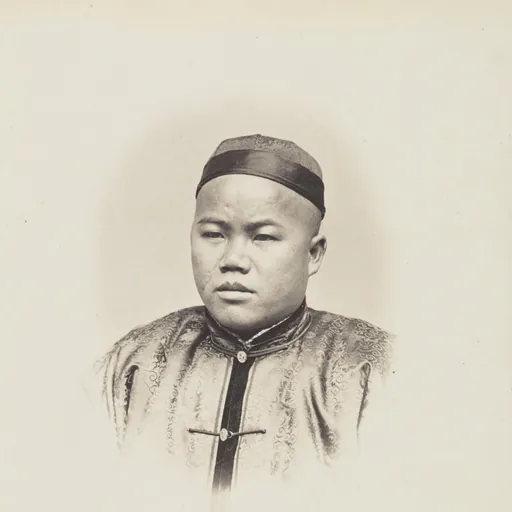
About Lai Afong
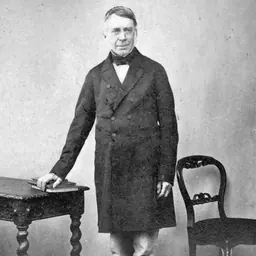
Lived 1839 – 1890 (aged 50–51). Lai Afong was a Chinese photographer and photojournalist.
Early life Lai Fong. "Chinese Performers." 1870s. Albumen silver print. Source: Stephan Loewentheil Photography of China Collection. Lai Afong was born in Gaoming, Guangdong and arrived in Hong Kong in the 1850s as a refugee of the Taiping Rebellion. It is not known how he learned the wet-plate collodion process, but it is said that by as early as 1859, he had learned the art of photography.
Career At some point between 1865 and 1867, Lai Afong worked at the Hong Kong studio of Portuguese photographer José Joaquim Alves de Silveira; by 1870, the earliest known announcement of the Afong Studio was printed as an advertisement in the Hong Kong Daily Press.
Lai Afong traveled through the provinces of Fujian, Guangdong, Hebei, Songjiang (today Shanghai), and Hong Kong, creating photographs. His collection of views included photographs of masterpieces of Chinese architecture such as sites within the Summer Palace and the Fragrant Hills Pagoda in Beijing, the Temple of the Six Banyan Trees in Guangzhou, and numerous others, as well as magnificent panoramas of such locations as Victoria harbor and Gulangyu island. As Lai Afong's reputation quickly grew, both Chinese and foreign clientele flocked to his studio for portrait sessions, including some of China's most important people such as Qing dynasty official Li Hongzhang.
Lai Afong was the most successful of his generation of Chinese photographers in appealing to both a Chinese and foreign cosmopolitan clientele. – and the artist captioned much of his work in both Chinese and English. Afong Studio photographs were sold to both Chinese patrons – both those local to Hong Kong and those visiting from other parts of China – and foreign visitors to China.
Lai Afong seems to have been the only Chinese photographer of his generation to be embraced by his foreign contemporaries. Additionally, Lai Afong favored the panorama more than any other photographer working in China in the 19th century, earning his work a place among the giants of 19th century landscape photography such as Carleton Watkins in America and Gustave Le Gray in France. No other nineteenth-century Chinese photographer offered as extensive and diverse a view of late Qing dynasty China. The majority of the photographs exhibited were on loan from Stephan Loewentheil China Photography Collection, one of the world's foremost collections of Early Chinese Photography. Although in-person viewing was cut short by the COVID-19 pandemic, the exhibition received praise from international news outlets such as China's largest newspaper, People's Daily for "truly [showing] the life of Chinese society in the 19th century, telling the story of China in that era" and in Fine Books and Collections for showcasing "magnificent views of a rapidly growing Hong Kong, Guangzhou, Beijing, Shanghai, Fuzhou, and Xiamen, and important early portraits of the diverse people of late Qing Dynasty China."
After languishing in near obscurity for decades after his death, the presence of his work in archives such as the Stephan Loewentheil China Photography Collection has helped to expose Lai Afong to a wider contemporary audience. Lai Afong's photographs are currently held in the permanent collections of the Metropolitan Museum of Art, the J. Paul Getty Museum, the National Galleries of Scotland, and several other prominent museum collections.
Identifying Afong Studio photographs Lai Fong. "Portrait of an Official." 1870s. Albumen silver print. Source: Stephan Loewentheil Photography of China Collection.Several obstacles make it difficult to reliably identify the artists who photographed nineteenth-century China: the scarcity of material which is scattered around the world is seldom correctly recorded or catalogued, and the few identifiers and indexes that exist (artist, studio, location, etc.) are often erroneous. When early photographers went out of business or left China, the contents of their studios (including their glass plate negatives) were sold or auctioned off, and were often acquired by other photographers working in China who would then make new prints from the negatives to be incorporated into their own stock. The scarcity of original photographs and absence of archival records make it challenging to identify Lai Afong's work. Although photographs printed from Lai Afong's own negatives dominated his photography studio's production, The Afong Studio was known to occasionally include prints from negatives made by other photographers in albums it produced. This phenomenon extended to other studios as well, and Lai Afong's photographs would often find their way into albums produced by other studios, or into albums assembled by the purchasers of the prints. Since Lai Afong was a "master photographer with a highly attuned artistic sense," he only incorporated work from well-regarded foreign photographers – such as Milton Miller, John Thomson, and Dutton & Michaels. For example, the album People and Views of China, attributed to Lai Afong, contains images from Milton Miller, St. John Edwards, and other unidentified photographers. However, as Lai Fong expanded his collection of views through extensive photographic expeditions, he replaced the negatives by others with his own views. Afong Studio albums created after circa 1880 appear to contain few or no images from other photographers.
Gallery
Albums Album of photographs of Peking and its environs An album mainly of landscape photographs of China From Afong, Photographer Images related to Shanghai and other Chinese cities People and views of China
Don’t just read it —
keep it.
Full-length biographies made to live with: read them, listen on the way to work, watch them tonight.
- E-book
- Audio
- Video
Instant download · yours to keep · every purchase keeps this site free
Important facts
People in Lai Afong's life
Named in this biography and alive at the same time




Related people
Same field, nearest in time


Contemporaries
People whose lives overlapped Lai Afong's

Frequently asked questions
Who was Lai Afong?
Chinese photographer pioneer in 19th century (1839–1890)
When was Lai Afong born?
Lai Afong was born in 1839 in Gaoming District.
When did Lai Afong die?
Lai Afong died on 19 April 1890 in Hong Kong.
What was Lai Afong's occupation?
Lai Afong was a photographer and photojournalist.
What nationality was Lai Afong?
Lai Afong was Chinese.
Sources & further reading
Cite this page
APA: Biography.guide. (2026). Lai Afong. https://biography.guide/lai-afong/
MLA: "Lai Afong." Biography.guide, https://biography.guide/lai-afong/.
Chicago: "Lai Afong." Biography.guide. https://biography.guide/lai-afong/.
Data last updated: 2026-09-23 · Spot an error? Report a correction.
Portrait: Wikimedia Commons · author & licence
Page generated 2026-09-27 05:08 UTC