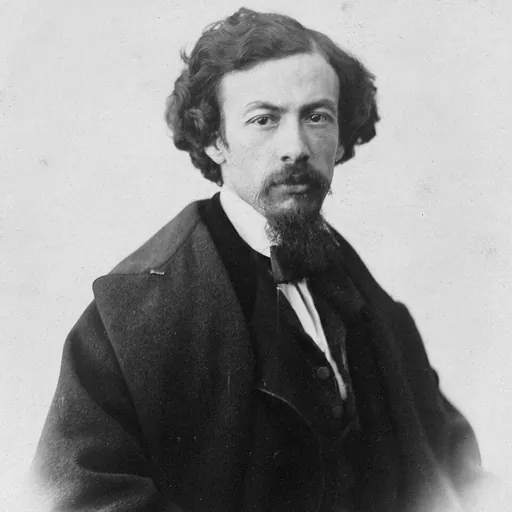
About Gustave Le Gray
Lived 1820 – 1884 (aged 63). Gustave Le Gray was a French photographer, painter and daguerreotypist.
Jean-Baptiste Gustave Le Gray (; August 30, 1820 – July 30, 1884) was a French painter, draughtsman, sculptor, print-maker, and photographer. He has been called "the most important French photographer of the nineteenth century" because of his technical innovations, his instruction of other noted photographers, and "the extraordinary imagination he brought to picture making." He was an important contributor to the development of the wax paper negative.
Biography Gustave Le Gray was born on August 30, 1820 in Villiers-le-Bel, Val-d'Oise. His parents encouraged him to become a solicitor's clerk, but from a young age, he aspired to be an artist. He was originally trained as a painter, studying under François-Édouard Picot and Paul Delaroche. His parents financed a trip to Switzerland and Italy so that he could study art abroad, and he lived in Italy between 1843 and 1846 and painted portraits and scenes of the countryside. In 1844, he met and married Palmira Maddalena Gertrude Leonardi (born March 23, 1823), a laundress who he had six children with, although only two survived into adulthood.
Le Gray exhibited his paintings at the Salon of 1848 and Salon of 1853. His real contributions – artistically and technically – were in the area of paper photography. His early photographs included portraits, scenes of nature such as Fontainebleau Forest, and buildings such as châteaux of the Loire Valley.
He taught photography to students such as Charles Nègre, Henri Le Secq, Nadar, Olympe Aguado, and Maxime Du Camp. In 1851, he became one of the first five photographers hired for the Missions Héliographiques to document French monuments and buildings. In that same year, he helped found the Société Héliographique, the "first photographic organization in the world." He therefore "closed his studio, abandoned his wife and children, and fled the country to escape his creditors."
On 16 January 1883, he had a son with the nineteen-year-old Anaïs Candounia. Registration of their sons birth was voided due to lack of proof of Leonardi's death. Le Gray died on 30 July 1884, in Cairo. A collodion process published in 1850 but which was "theoretical at best". The invention of the wet collodion method to produce a negative on a glass plate is now credited to Frederick Scott Archer who published his process in 1851. At the same auction, an albumen print of "The Great Wave, Sète" by Le Gray was sold for a new world record price of £507,500 or $840,370 to "the same anonymous buyer" who was later revealed to be Sheik Saud Al-Thani of Qatar. The record stood until May 2003 when Al-Thani purchased a daguerreotype by Joseph-Philibert Girault de Prangey for £565,250 or $922,488.
Books A practical treatise on photography, upon paper and glass by Gustave Le Gray, (translated by Thomas Cousins) London : T. & R. Willats, 1850. Photographic manipulation: the waxed paper process of Gustave Le Gray by Gustave Le Gray. Translated from the French. London: George Knight and Sons, 1853.
Gallery
Legacy Caroline Shaw has a piano piece inspired by Le Gray (because of the "blurring of the edges" and "slowly coming into focus", according to Shaw ) and Chopin's Mazurka in A minor, Op. 17, No. 4.
Don’t just read it —
keep it.
Full-length biographies made to live with: read them, listen on the way to work, watch them tonight.
- E-book
- Audio
- Video
Instant download · yours to keep · every purchase keeps this site free
Important facts
more
Jean-Baptiste Gustave Le GrayPeople in Gustave Le Gray's life
Named in this biography and alive at the same time




Related people
Same field, nearest in time


Contemporaries
People whose lives overlapped Gustave Le Gray's


Frequently asked questions
Who was Gustave Le Gray?
French photographer (1820–1884)
When was Gustave Le Gray born?
Gustave Le Gray was born on 30 August 1820 in Villiers-le-Bel.
When did Gustave Le Gray die?
Gustave Le Gray died on 29 July 1884 in Cairo.
What was Gustave Le Gray's occupation?
Gustave Le Gray was a photographer, painter and daguerreotypist.
What nationality was Gustave Le Gray?
Gustave Le Gray was French.
Sources & further reading
Cite this page
APA: Biography.guide. (2026). Gustave Le Gray. https://biography.guide/gustave-le-gray/
MLA: "Gustave Le Gray." Biography.guide, https://biography.guide/gustave-le-gray/.
Chicago: "Gustave Le Gray." Biography.guide. https://biography.guide/gustave-le-gray/.
Data last updated: 2026-09-24 · Spot an error? Report a correction.
Portrait: Wikimedia Commons · author & licence
Page generated 2026-09-27 05:09 UTC