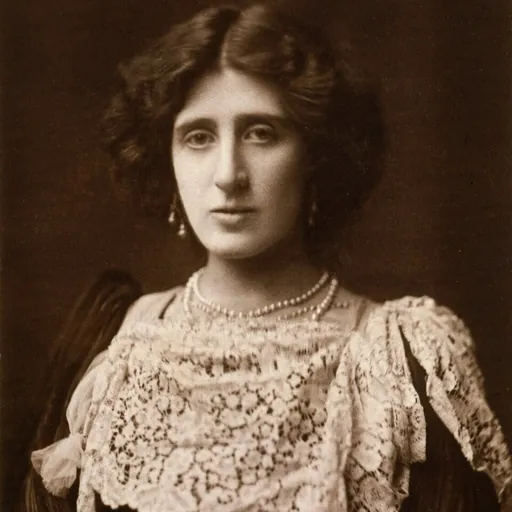
About Lady Ottoline Morrell
Lived 1873 – 1938 (aged 64). Lady Ottoline Morrell was a British painter, aristocrat, photographer, writer, patron of the arts and aristocracy (class).
Portrait of Lady Ottoline Morrell by Adolf de Meyer, c. 1912
Lady Ottoline Violet Anne Morrell (; 16 June 1873 – 21 April 1938) was an English aristocrat and society hostess. Her circle of friends included many authors, artists, sculptors and poets. Lady Ottoline's great-great-uncle (through her paternal grandmother, Lady Charles Bentinck) was the 1st Duke of Wellington. Through her father, Arthur, she was a first cousin once removed of Queen Elizabeth the Queen Mother, and thus a first cousin twice removed of Queen Elizabeth II, both of whom descended from Arthur's brother Charles Cavendish-Bentinck. At Oxford, she met Philip Morrell, who would become a lawyer and a Member of Parliament. They shared a passion for art, a strong interest in Liberal politics, and a determination to rebel against the restraints of their conservative families. They were friends for two years before marrying in 1902 and had an open marriage for the rest of their lives.
After her marriage, Morrell, who was six feet tall with bright red hair, began to dress in fantastic costumes and occasionally dye her hair purple. the painters Augustus John, Henry Lamb and Dora Carrington, the art historian Roger Fry, Morrell's longest affair was with the philosopher Bertrand Russell, with whom she exchanged more than 3,500 letters.
Philip's extramarital affairs produced several children, who were cared for by Ottoline. She also struggled to conceal evidence of his mental instability. The Morrells owned a country house at Peppard, near Henley on Thames. In 1915, while World War I raged, they sold the Peppard house and bought and restored the nearby old farmhouse Garsington Manor, where Ottoline established her talent for garden design and delighted in opening the house as a haven for like-minded people.
During the war, Garsington was more significant. The Morrells and their friends were ardent pacifists; of Garsington she said, "it seemed good to gather round us young and enthusiastic pacifists." Siegfried Sassoon, recuperating at Garsington after an injury, was encouraged to go AWOL as a protest against the war. They invited conscientious objectors such as Duncan Grant, Clive Bell and Lytton Strachey to take refuge at Garsington. Philip, who had lost his seat because of his anti-war stance, represented them at their tribunals. One of Garsington's most faithful visitors was D. H. Lawrence, who, in his 1920 novel Women in Love, mocked Morrell by modelling the character Lady Hermione after her. Morrell had a brief affair with her gardener, Lionel Gomme;
The hospitality offered by the Morrells was such that their guests had no suspicion that they were in financial difficulties. Many of them assumed that Ottoline was a wealthy woman. This was far from the case, and in 1928 the Morrells had to sell Garsington and move to more modest quarters in Gower Street, London. Here, Lady Ottoline remained a regular host to the adherents of the Bloomsbury Group, in particular Virginia and Leonard Woolf and Vanessa Bell, and many other artists and authors, including Henry James, W. B. Yeats, L. P. Hartley and T. S. Eliot.
Ottoline maintained her religious faith, but her contemporaries were fixated on the unofficial religion of 'Life Worship', whereby the cultivated elite focused on the development of close personal relations, cultural pursuits, vivid life experiences and the expansion of consciousness. The Garsington/Bloomsbury set believed that there was a spiritual hierarchy, with the artistic elite at one end and the "moronic masses" at the other. Among Lady Ottoline's friends, this belief was held particularly strongly by Lawrence, Virginia Woolf and Clive Bell. In spite of her strong religious beliefs, in 1907 Ottoline became a co-founder, with Sybil Neville-Rolfe, Henry Havelock Ellis and Leonard Darwin, of the Eugenics Education Society.
Later life and death Soon after moving to Gower Street, Lady Ottoline developed cancer of the jaw and had to have her lower teeth and part of her jawbone removed. In 1937, she suffered a stroke and was admitted to Sherwood Park Clinic, in Tunbridge Wells. The clinic was run by Dr Alexander Cameron (1887–1938), who, in 1924, had been sentenced to nine months' imprisonment for the unlawful killing of a patient at Northampton General Hospital. Cameron injected Lady Ottoline with Prontosil, an untested new drug. Ottoline’s condition worsened and Cameron killed himself. Two days later, on 21 April 1938, Ottoline died of heart failure, at age 64. She was buried at St Winifred's Churchyard in Worksop, Nottinghamshire. When he died, in 1943, Philip Morrell was buried next to her. A blue plaque in her honour was erected at her Gower Street home by the Greater London Council in 1986. A memorial statue, carved by Eric Gill, sits inside the front door of St Mary's Church, Garsington.
Morrell's work as a decorator, colourist and garden designer remains undervalued. The novelist Henry Green wrote to Philip Morrell of "her love for all things true and beautiful which she had more than anyone ... no one can ever know the immeasurable good she did".
Legacy Morrell maintained detailed journals, which, in 2026, remain unpublished. She also wrote her memoirs, which were edited by Robert Gathorne-Hardy and published in three volumes: Ottoline: The Early Memoirs of Lady Ottoline Morrell (1963), Memoirs of Lady Ottoline Morrell: A Study in Friendship 1873–1915 (1963), and Ottoline at Garsington: Memoirs of Lady Ottoline Morrell, 1915–1918 (1974).
Her letters, some manuscripts by Morrell and other authors, and many photographs and sketches provided by the authors to Morrell are collected at the Harry Ransom Center at the University of Texas at Austin.
In literature, Ottoline was the inspiration for the two Lawrence characters, for Mrs Bidlake in Aldous Huxley's Point Counter Point, for Lady Caroline Bury in Graham Greene's It's a Battlefield, and for Lady Sybilline Quarrell in Alan Bennett's Forty Years On. The Coming Back (1933), another novel which portrays her, was written by Constance Malleson, one of Ottoline's many rivals for the affection of Bertrand Russell, as was Pugs and Peacocks (1921) by Gilbert Cannan. In Confidence, a 1917 short story by Katherine Mansfield, portrays the "wits of Garsington". Huxley's 1921 roman à clef Crome Yellow depicts life at a thinly veiled Garsington, with a caricature of Lady Ottoline Morrell for which she never forgave him.
Portraits of Lady Ottoline were painted by, among others, Henry Lamb, Duncan Grant and Augustus John. There are several artistic photographs of her by Cecil Beaton.
In modern media, she is portrayed by Tilda Swinton in Derek Jarman's film Wittgenstein, by Roberta Taylor in Brian Gilbert's film Tom & Viv, by Penelope Wilton in Christopher Hampton's film Carrington and by Suzanne Bertish in Terence Davies's film Benediction.
The first production of a biographical play, Ottoline, by Janet Bolam, took place in the gardens of Garsington Manor in July 2021.
Photography Morrell took hundreds of photographs of the people in her circle. Carolyn Heilbrun edited Lady Ottoline's Album (1976), a collection of snapshots and photographic portraits of Morrell and of her famous contemporaries, mostly taken by Morrell.
Don’t just read it —
keep it.
Full-length biographies made to live with: read them, listen on the way to work, watch them tonight.
- E-book
- Audio
- Video
Instant download · yours to keep · every purchase keeps this site free
Important facts
more
Lady Ottoline (Anne Violet) MorrellPeople in Lady Ottoline Morrell's life
Named in this biography and alive at the same time






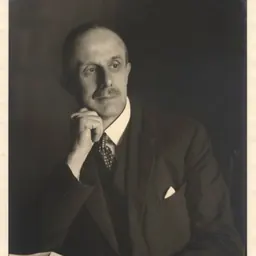
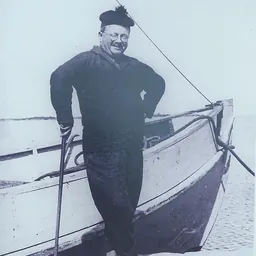
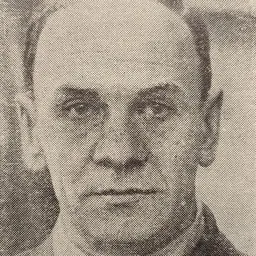
Related people
Same field, nearest in time
Contemporaries
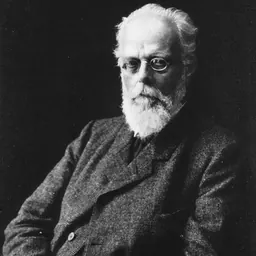
People whose lives overlapped Lady Ottoline Morrell's

Frequently asked questions
Who was Lady Ottoline Morrell?
British noblewoman and aristocrat (1873-1938)
When was Lady Ottoline Morrell born?
Lady Ottoline Morrell was born on 16 June 1873 in Royal Tunbridge Wells.
When did Lady Ottoline Morrell die?
Lady Ottoline Morrell died on 21 April 1938 in London.
What was Lady Ottoline Morrell's occupation?
Lady Ottoline Morrell was a painter, aristocrat, photographer, writer, patron of the arts and aristocracy (class).
What nationality was Lady Ottoline Morrell?
Lady Ottoline Morrell was British.
Sources & further reading
· Wikipedia: Lady Ottoline Morrell
· DBpedia: Lady Ottoline Morrell
Cite this page
APA: Biography.guide. (2026). Lady Ottoline Morrell. https://biography.guide/lady-ottoline-morrell/
MLA: "Lady Ottoline Morrell." Biography.guide, https://biography.guide/lady-ottoline-morrell/.
Chicago: "Lady Ottoline Morrell." Biography.guide. https://biography.guide/lady-ottoline-morrell/.
Data last updated: 2026-09-23 · Spot an error? Report a correction.
Portrait: Wikimedia Commons · author & licence
Page generated 2026-09-27 05:06 UTC