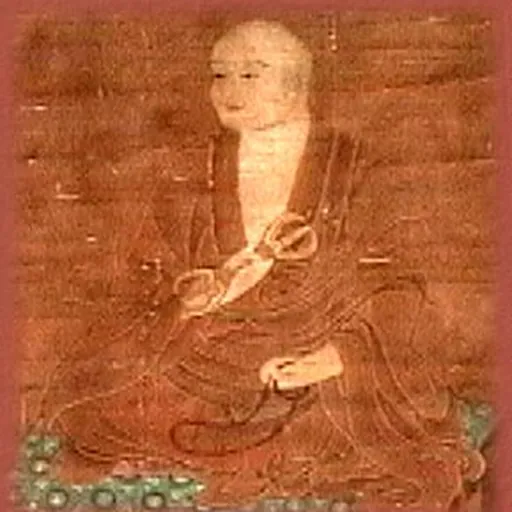
Kūkai
Japanese Buddhist monk and calligrapher, the founder of the Shingon school
About Kūkai
Lived 774 – 835 (aged 60). Kūkai was a Japanese lexicographer, linguist, poet, calligrapher, buddhist monk and philosopher.
Biography
Early years Painting of Kūkai as a boy, posthumously known by the title Chigo Daishi ("The Child Grand Master"). It depicts the young Kūkai flying to heaven on a lotus, where he converses with various Buddhas. Muromachi Period, 15th century.
Kūkai was born in 774 in the precinct of Zentsū-ji temple, in Sanuki province on the island of Shikoku. His family were members of the aristocratic Saeki family, a branch of the ancient Ōtomo clan. In modern scholarship, his first name is generally believed to be Mao ("True Fish"), although one source records his birth name as Tōtomono ("Precious One"). Kūkai was born in a period of important political changes with Emperor Kanmu (r. 781–806) seeking to consolidate his power and to extend his realm, taking measures which included moving the capital of Japan from Nara ultimately to Heian (modern-day Kyoto).
Little more is known about Kūkai's childhood. At the age of fifteen, he began to receive instruction in the Chinese classics under the guidance of his maternal uncle. During this time, the Saeki-Ōtomo clan suffered government persecution due to allegations that the clan chief, Ōtomo Yakamochi, was responsible for the assassination of his rival Fujiwara no Tanetsugu.
During this period of private Buddhist practice, Kūkai had a dream, in which a man appeared and told Kūkai that the Mahavairocana Tantra is the scripture which contained the doctrine Kūkai was seeking. The governor allowed the ship to dock, and the party was asked to proceed to the capital of Chang'an (present day Xi'an), the capital of the Tang dynasty.
After further delays, the Tang court granted Kūkai a place in Ximing Temple, where his study of Chinese Buddhism began in earnest. He also studied Sanskrit with the Gandharan pandit Prajñā (734–810?), who had been educated at the Indian Buddhist university at Nalanda.
Kūkai wards off a demon by reciting the tantra. Painting by Hokusai (1760–1849).
It was in 805 that Kūkai finally met the monk Huiguo (746–805) the man who would initiate him into Chinese Esoteric Buddhism (Tangmi) at Chang'an's Qinglong Monastery . Huiguo came from an illustrious lineage of Buddhist masters, famed especially for translating Sanskrit texts into Chinese, including the Mahavairocana Tantra. Kūkai describes their first meeting: quote|Accompanied by Jiming, Tansheng, and several other Dharma masters from the Ximing monastery, I went to visit him [Huiguo] and was granted an audience. As soon as he saw me, the abbot smiled, and said with delight, "since learning of your arrival, I have waited anxiously. How excellent, how excellent that we have met today at last! My life is ending soon, and yet I have no more disciples to whom to transmit the Dharma. Prepare without delay the offerings of incense and flowers for your entry into the abhisheka mandala".
However, in Kūkai's absence Emperor Kanmu had died and was replaced by Emperor Heizei who exhibited no great enthusiasm for Buddhism. Kūkai's return from China was eclipsed by Saichō, the founder of the Tendai school, who found favor with the court during this time. Saichō had already had esoteric rites officially recognised by the court as an integral part of Tendai, and had already performed the abhisheka, or initiatory ritual, for the court by the time Kūkai returned to Japan. Later, with Emperor Kanmu's death, Saichō's fortunes began to wane.
Saichō requested, in 812, that Kūkai give him the introductory initiation, which Kūkai agreed to do. He also granted a second-level initiation upon Saichō, but refused to bestow the final initiation (which would have qualified Saichō as a master of esoteric Buddhism) because Saichō had not completed the required studies, leading to a falling out between the two that was not resolved; this feud later extended to the Shingon and Tendai sects.
Little is known about Kūkai's movements until 809 when the court finally responded to Kūkai's report on his studies, which also contained an inventory of the texts and other objects he had brought with him, and a petition for state support to establish the new esoteric Buddhism in Japan. That document, the Catalogue of Imported Items, is the first attempt by Kūkai to distinguish the new form of Buddhism from that already practiced in Japan. The court's response was an order to reside in Takao-san temple (modern Jingo-ji) in the suburbs of Kyoto. This was to be Kūkai's headquarters for the next 14 years. The year 809 also saw the retirement of Emperor Heizei due to illness and the succession of the Emperor Saga, who supported Kūkai and exchanged poems and other gifts.
Emerging from obscurity
In 810, Kūkai emerged as a public figure when he was appointed administrative head of Tōdai-ji, the central temple in Nara, and head of the .
Emperor Saga became seriously ill shortly after his enthronement; while he was recovering, Emperor Heizei fomented a rebellion which had to be put down by force. Kūkai petitioned the Emperor to allow him to carry out certain esoteric rituals which were said to "enable a king to vanquish the seven calamities, to maintain the four seasons in harmony, to protect the nation and family, and to give comfort to himself and others". The petition was granted. Prior to this, the government relied on the monks from the traditional schools in Nara to perform rituals, such as chanting the Golden Light Sutra to bolster the government, but this event marked a new reliance on the esoteric tradition to fulfill this role.
With the public initiation ceremonies for Saichō and others at Takao-san temple in 812, Kūkai became the acknowledged master of esoteric Buddhism in Japan. He set about organizing his disciples into an order – making them responsible for administration, maintenance and construction at the temple, as well as for monastic discipline. In 813 Kūkai outlined his aims and practices in the document called The admonishments of Konin. It was also during this period at Takaosan that he completed many of the seminal works of the Shingon School:
Attaining Enlightenment in This Very Existence The Meaning of Sound, Word, Reality Meanings of the Word Hūm
All of these were written in 817. Records show that Kūkai was also busy writing poetry, conducting rituals, and writing epitaphs and memorials on request. His popularity at the court only increased, and spread.
Meanwhile, Kūkai's new esoteric teachings and literature drew scrutiny from a noted scholar-monk of the time named Tokuitsu, who traded letters back and forth in 815 asking for clarification. The dialogue between them proved constructive and helped to give Kūkai more credibility, while the Nara Schools took greater interest in esoteric practice.
Mount Kōya
In 816, Emperor Saga accepted Kūkai's request to establish a mountain retreat at Mount Kōya as a retreat from worldly affairs. The ground was officially consecrated in the middle of 819 with rituals lasting seven days. Kūkai could not stay there, however, as he had received an imperial order to act as advisor to the secretary of state. He therefore entrusted the project to a senior disciple. As many surviving letters to patrons attest, fund-raising for the project now began to take up much of Kūkai's time, and financial difficulties were a persistent concern; indeed, the project was not fully realised until after Kūkai's death in 835.
Kūkai's vision was that Mt. Kōya was to become a representation of the Mandala of the Two Realms that form the basis of Shingon Buddhism: the central plateau as the Womb Realm mandala, with the peaks surrounding the area as petals of a lotus; and located in the centre of this would be the Diamond Realm mandala in the form of a temple which he named . At the center of the temple complex sits an enormous statue of Vairocana, who is the personification of Ultimate Reality.
Public works In 821, Kūkai took on a civil engineering task of restoring Manno Reservoir, which is still the largest irrigation reservoir in Japan. His leadership enabled the previously floundering project to be completed smoothly, and is now the source of some of the many legendary stories which surround his figure. In 822 Kūkai performed an initiation ceremony for the retired emperor Heizei. In the same year Saichō died.
Tō-ji period Monks bringing food to Kōbō Daishi on Mount Kōya, as they believe he is not dead but rather meditating. At his mausoleum in Oku-no-in, food offerings are presented daily to Kōbō Daishi in the early morning and before noon. When Emperor Kanmu had moved the capital in 784, he had not permitted the powerful Buddhists from the temples of Nara to follow him. He did commission two new temples: Tō-ji (Eastern Temple) and Sai-ji (Western Temple) which flanked the road at southern entrance to the city, protecting the capital from evil influences. However, after nearly thirty years the temples were still not completed. In 823 the soon-to-retire Emperor Saga asked Kūkai, experienced in public works projects, to take over Tō-ji and finish the building project. Saga gave Kūkai free rein, enabling him to make Tō-ji the first Esoteric Buddhist centre in Kyoto, and also giving him a base much closer to the court, and its power.
The new emperor, Emperor Junna (r. 823–833), was also well disposed towards Kūkai. In response to a request from the emperor, Kūkai, along with other Japanese Buddhist leaders, submitted a document which set out the beliefs, practices and important texts of his form of Buddhism. In his imperial decree granting approval of Kūkai's outline of esoteric Buddhism, Junna uses the term for the first time. An imperial decree gave Kūkai exclusive use of Tō-ji for the Shingon School, which set a new precedent in an environment where previously temples had been open to all forms of Buddhism. It also allowed him to retain 50 monks at the temple and train them in Shingon. This was the final step in establishing Shingon as an independent Buddhist movement, with a solid institutional basis with state authorization. Shingon had become legitimate.
In 824, Kūkai was officially appointed to the temple construction project. In that year he founded Zenpuku-ji, the second oldest temple of the Edo (Tokyo) region. In 824 he was also appointed to the Office of Priestly Affairs. The Office consisted of four positions, with the Supreme Priest being an honorary position which was often vacant. The effective head of the Sōgō was the . Kūkai's appointment was to the position of . Emperor Ninmyō (r. 833–50) sent a message of condolence to Mount Kōya, expressing his regret that he could not attend the cremation due to the time lag in communication caused by Mount Kōya's isolation. However, Kūkai was not given the traditional cremation, but instead, in accordance with his will, was entombed on the eastern peak of Mount Kōya. "When, some time after, the tomb was opened, Kōbō-Daishi was found as if still sleeping, with complexion unchanged and hair grown a bit longer."
Legend has it that Kūkai has not died, but entered into an eternal samadhi (meditative trance) and is still alive on Mount Kōya, awaiting the appearance of Maitreya, the Buddha of the future.
Kūkai devotion and mantra The Gobyō-bashi bridge. The mausoleum is visible across the bridge in the background. In modern Shingon, Kūkai is seen as a bodhisattva that one can pray and have devotion towards, similar to how the historical figure Padmasambhava became a figure of devotion in Tibet. Pilgrimages and devotional events focused around Kūkai remain a key part of the Shingon faith. The most important Kūkai pilgrimage route is the Shikoku Pilgrimage .
Kūkai's mausoleum (the "Gobyo") at Mount Kōya is at Okunoin temple and it is the main site for devotion to Kūkai. Offerings and prayers to Kūkai are made around the year at this site. He is believed by the faithful to still be alive, having entered a deep samadhi (meditative absorption) until the arrival of the next Buddha Maitreya. There is also a large graveyard at this site, as many individuals throughout Japanese Buddhist history have wished to be buried near Kūkai.
Kūkai also has a popular mantra which is recited in Shingon religious services. It is called the Hōgō (treasure name) and is:
The mantra means "homage (namu) great teacher (daishi) henjō kongō (Vairocana vajra, Kūkai's secret tantric name). It could be rendered in Sanskrit as namo mahāguru vairocana vajra. The modern form of the Hōgō was widely used at least by the Muromachi period (1336–1573). It may have been created by the Shingon priest Dōhan (, 1178–1252) and is found in his .
Another legend tells the story of Emon Saburō, the wealthiest man in Shikoku. One day, a mendicant monk came to his house, seeking alms. Emon refused, broke the pilgrim's begging bowl, and chased him away. After this, his eight sons fell ill and died. Emon realized that Kūkai was the affronted pilgrim and set out to seek his forgiveness. Having traveled round the island twenty times clockwise in vain, he undertook the route in reverse. Finally, he collapsed exhausted and on his deathbed. Kūkai appeared to grant absolution. Emon requested that he be reborn into a wealthy family in Matsuyama so that he might restore a neglected temple. Dying, he clasped a stone. Shortly afterwards a baby was born with his hand grasped tightly around a stone inscribed "Emon Saburō is reborn." When the baby grew up, he used his wealth to restore the , in which there is an inscription from 1567 recounting the tale.
According to one legend, male same-sex love was introduced into Japan by Kūkai. Historians, however, point that this is probably not true since Kūkai was an enthusiastic follower of monastic regulations on chaste behavior. Nonetheless, the legend served to "affirm same-sex relation between men and boys in 17th-century Japan."
In popular culture Junya Sato directed the eponymous 1984 film . Kūkai is played by Kin'ya Kitaōji and Saichō is played by Gō Katō.
The 1991 drama film Mandala , a China–Japan co-production, was based on Kūkai's travels in China. The film stars Toshiyuki Nagashima as Kūkai, also co-starring Junko Sakurada and Zhang Fengyi as Huiguo.
The 2017 fantasy film Legend of the Demon Cat stars Shōta Sometani as Kūkai.
The 2026 docudrama film Kūkai is a Chinese documentary film, presenting Kūkai's travels in China in a dramatised style.
Gallery
Outside Japan
Others
Don’t just read it —
keep it.
Full-length biographies made to live with: read them, listen on the way to work, watch them tonight.
- E-book
- Audio
- Video
Instant download · yours to keep · every purchase keeps this site free
Important facts
more
Hongfa dashi, KonghaiPeople in Kūkai's life
Named in this biography and alive at the same time

Related people
Same field, nearest in time



Contemporaries
People whose lives overlapped Kūkai's




Frequently asked questions
Who was Kūkai?
Japanese Buddhist monk and calligrapher, the founder of the Shingon school (774–835)
When was Kūkai born?
Kūkai was born on 27 July 774 in Zentsū-ji Temple, Kaigan-ji Temple.
When did Kūkai die?
Kūkai died on 22 April 835 in Mount Kōya.
What was Kūkai's occupation?
Kūkai was a lexicographer, linguist, poet, calligrapher, buddhist monk and philosopher.
What nationality was Kūkai?
Kūkai was Japanese.
Sources & further reading
Cite this page
APA: Biography.guide. (2026). Kūkai. https://biography.guide/kukai/
MLA: "Kūkai." Biography.guide, https://biography.guide/kukai/.
Chicago: "Kūkai." Biography.guide. https://biography.guide/kukai/.
Data last updated: 2026-09-22 · Spot an error? Report a correction.
Portrait: Wikimedia Commons · author & licence
Page generated 2026-09-27 05:03 UTC