
Al-Khalil ibn Ahmad al-Farahidi
Iraqi lexicographer, philologist and poet (718 – 786 CE)
About Al-Khalil ibn Ahmad al-Farahidi
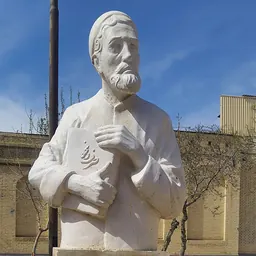
Lived 718 – 786 (aged 67–68). Al-Khalil ibn Ahmad al-Farahidi was an Arab lexicographer, cryptographer, writer, poet, linguist and grammarian.
Life Born in 718 in Oman, southern Arabia, to Azdi parents of modest means, al-Farahidi became a leading grammarian of Basra in Iraq. In Basra, he studied Islamic traditions and philology under Abu 'Amr ibn al-'Ala' Known for his piety and frugality, he was a companion of Jābir ibn Zayd, the founder of ibadism. It was said that his parents were converts to Islam His nickname, "Farahidi", differed from his tribal name and derived from an ancestor named Furhud (Young Lion); plural . He taught linguistics, and some of his students became wealthy teachers. Al-Farahidi's main income was falconry and a garden inherited from his father. Two dates of death are cited, 786 The story goes that a theoretical contemplation brought about his death. On the particular day, while he was deeply absorbed in contemplation of a system of accounting to save his maidservant from being cheated by the green grocer, he wandered into a mosque, and there he absent-mindedly bumped into a pillar and was fatally injured. The governor reacted by rescinding the pension, an act to which al-Farahidi responded with the following lines of poetry:
"He, who formed me with a mouth, engaged to give me nourishment till such a time as He takes me to Himself. Thou hast refused me a trifling sum, but that refusal will not increase thy wealth."
Embarrassed, the governor responded with an offer to renew the pension and double the rate, which al-Farahidi still greeted with a lukewarm reception. Al-Farahidi was distinguished, however, in his view that the Arabic alphabet included 29 letters rather than 28 and that each letter represented a fundamental characteristic of people or animals. His classification of 29 letters was due to his consideration of combining Lām and Alif as a separate third letter from the two individual parts.
Legacy In the Arab world, al-Farahidi had become a household name by the time he died and became the only protégé of Abu al-Aswad al-Du'ali in Arabic philology. He was the first to codify the complex metres of Arabic poetry Ibn al-Nadim, the 10th-century bibliophile biographer from Basra, reports that in fact Sibawayh's "Kitab" (Book) was a collaborative work of forty-two authors, but also that the principles and subjects in the "Kitab" were based on those of al-Farahidi. He is quoted by Sibawayh 608 times, more than any other authority. Throughout the Kitab, Sibawayh says "I asked him" or "he said", without naming the person referred to by the pronoun; however, it is clear that he refers to al-Farahidi.
Al-Farahidi was also well versed in astronomy, mathematics, Islamic law, music theory, and Muslim prophetic tradition. His prowess in Arabic was said to be drawn, first and foremost, from his vast knowledge of Muslim prophetic tradition and exegesis of the Qur'an.
Works Kitab al-'Ayn
Kitab al-Ayn Instead of following the order of the alphabet, al-Farahidi sorted letters according to where the consonants are pronounced in the mouth, from back to front, beginning with the letter ع "ayn", representing the [ʕ] sound formed in the throat. The word ayn may also mean a water source in the desert, perhaps reflecting its author's goal to derive the etymological origins of Arabic vocabulary and lexicography.
Isnad of Kitab al-'Ayn In his (Catalogue), Ibn al-Nadim recounts the various names attached to the transmission of Kitab al-'Ayn, i.e., the isnad (chain of authorities). He begins with Durustuyah's account that al-Kasrawi said that al-Zaj al-Muhaddath had said that al-Khalil had explained the concept and structure of his dictionary to al-Layth b. al-Muzaffar b. Nasr b. Sayyar had dictated edited portions to al-Layth, and they had reviewed their preparation together. Ibn al-Nadim writes that a manuscript in the possession of Da'laj had probably belonged originally to Ibn al-'Ala al-Sijistani, who, according to Durustuyah, had been a member of a circle of scholars who critiqued the book. In this group were Abu Talib al-Mufaddal ibn Slamah, 'Abd Allah ibn Muhammad al-Karmani, Abu Bakr ibn Durayd, and al-Huna'i al-Dawsi.
Other works In addition to his work in prosody and lexicography, al-Farahidi established the fields of ʻarūḍ – rules governing Arabic poetry metre – and Arabic musicology. Often called a genius by historians, he was a scholar, a theorist, and an original thinker. was the first book on cryptography and cryptanalysis written by a linguist. The lost work contains many "firsts," including using permutations and combinations to list all possible Arabic words with and without vowels. His work on cryptography influenced al-Kindi (c. 801–873), who discovered the method of cryptanalysis by frequency analysis.
Diacritic system Al-Farahidi is also credited with the current standard for Arabic diacritics; rather than a series of indistinguishable dots, it was al-Farahidi who introduced different shapes for the vowel diacritics in Arabic, which simplified the writing system so much that it has not been changed since. He also began using a small letter shin to signify the shadda mark for doubling consonants. Al-Farahidi's style for writing the Arabic alphabet was much less ambiguous than the previous system, where dots had to perform various functions, and while he only intended its use for poetry, it was eventually used for the Qur'an.
Prosody Al-Farahidi's first work was studying Arabic prosody, a field for which he is credited as the founder. Reportedly, he performed the Hajj pilgrimage to Mecca while a young man and prayed to God that he would be inspired by knowledge no one else had. He never mandated, however, that all Arab poets must necessarily follow his rules without question, and even he was said to have knowingly broken the rules at times.
Don’t just read it —
keep it.
Full-length biographies made to live with: read them, listen on the way to work, watch them tonight.
- E-book
- Audio
- Video
Instant download · yours to keep · every purchase keeps this site free
Important facts
People in Al-Khalil ibn Ahmad al-Farahidi's life
Named in this biography and alive at the same time
Related people
Same field, nearest in time





Contemporaries
People whose lives overlapped Al-Khalil ibn Ahmad al-Farahidi's




Frequently asked questions
Who was Al-Khalil ibn Ahmad al-Farahidi?
Iraqi lexicographer, philologist and poet (718 – 786 CE)
When was Al-Khalil ibn Ahmad al-Farahidi born?
Al-Khalil ibn Ahmad al-Farahidi was born in 718 in Basra.
When did Al-Khalil ibn Ahmad al-Farahidi die?
Al-Khalil ibn Ahmad al-Farahidi died in 786 in Basra.
What was Al-Khalil ibn Ahmad al-Farahidi's occupation?
Al-Khalil ibn Ahmad al-Farahidi was a lexicographer, cryptographer, writer, poet, linguist and grammarian.
What nationality was Al-Khalil ibn Ahmad al-Farahidi?
Al-Khalil ibn Ahmad al-Farahidi was Arab.
Sources & further reading
· Wikipedia: Al-Khalil ibn Ahmad al-Farahidi
· DBpedia: Al-Khalil ibn Ahmad al-Farahidi
Cite this page
APA: Biography.guide. (2026). Al-Khalil ibn Ahmad al-Farahidi. https://biography.guide/al-khalil-ibn-ahmad-al-farahidi/
MLA: "Al-Khalil ibn Ahmad al-Farahidi." Biography.guide, https://biography.guide/al-khalil-ibn-ahmad-al-farahidi/.
Chicago: "Al-Khalil ibn Ahmad al-Farahidi." Biography.guide. https://biography.guide/al-khalil-ibn-ahmad-al-farahidi/.
Data last updated: 2026-09-26 · Spot an error? Report a correction.
Page generated 2026-09-27 05:13 UTC