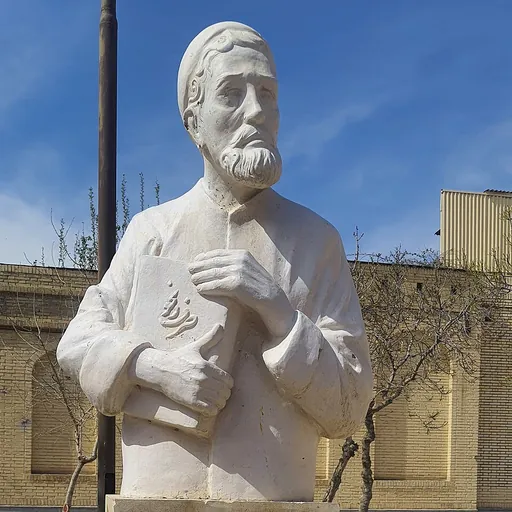
About Sibawayh
Lived 760 – 797 (aged 36–37). Sibawayh was a linguist and grammarian.
Sibawayh ( (also pronounced in many modern dialects) ; ; ), whose full name is Abu Bishr Amr ibn Uthman ibn Qanbar al-Basri (, ), was a Persian leading grammarian of Basra and author of the Third book on Arabic grammar. His famous unnamed work, referred to as Al-Kitāb, or "The Book", is a five-volume seminal discussion of the Arabic language.
Ibn Qutaybah, the earliest extant source, in his biographical entry under Sibawayh simply wrote: He is Amr ibn Uthman, and he was mainly a grammarian. He arrived in Baghdad, fell out with the local grammarians, was humiliated, went back to some town in Persia, and died there while still a young man.
The tenth-century biographers Ibn al-Nadim and Abu Bakr al-Zubaydi, and in the 13th-century Ibn Khallikan, attribute Sibawayh with contributions to the science of the Arabic language and linguistics that were unsurpassed by those of earlier and later times. He has been called the greatest of all Arabic linguists and one of the greatest linguists of all time in any language.
Biography Born between 755 AD and 766 AD, Sibawayh was from Shiraz, in today's Fars province, Iran. Reports vary, some saying he went first to Basra, then to Baghdad, and finally back to the village of al-Baida near Shiraz where he died between 177/793 and 180/796, while another says he died in Basra in 161/777. A protégé of the Banu Harith b. Ka'b b. 'Amr b. 'Ulah b. Khalid b. Malik b. Udad, he learned the dialects (languages) from Abu al-Khattab al-Akhfash al-Akbar (the Elder) and others. He came to Iraq in the days of Harun al-Rashid when he was thirty-two years old and died in Persia when he was over forty.
Debates Despite Sibawayh's renowned scholarship, his status as a non-native speaker of the language is a central feature in the many anecdotes included in the biographies. The accounts throw useful light on early contemporary debates which influenced the formulation of the fundamental principles of Arabic grammar.
The Question of the Hornet In a story from the debate held by the Abbasid vizier Yahya ibn Khalid of Baghdad on standard Arabic usage, Sibawayh, representing the Basra school of grammar, and al-Kisa'i, one of the canonical Quran readers and the leading figure in the rival school of Kufa, had a dispute on the following point of grammar, which later became known as المسألة الزنبورية al-Mas’alah al-Zunbūrīyah ("The Question of the Hornet").
The discussion involved the final clause of the sentence:
"I have always thought that the scorpion was more painful in stinging than the hornet, and sure enough it is."
Both Sibawayh and al-Kisa'i agreed that it involved an omitted verb, but disagreed on the specific construct to be used.
Sibawayh proposed finishing it with fa-'iḏā huwa hiya , literally "and-thus he [is] she", using "he" for the scorpion (a masculine noun in Arabic) and "she" for "stinging, bite" (a feminine noun), arguing that Arabic does not need or use any verb-form like is in the present tense, and that object forms like ('iyyā-)hā are never the main part of a predicate.
Al-Kisa'i argued for fa-'iḏā huwa 'iyyā-hā , literally "and-thus he [does] onto-her", supporting the object pronoun -hā ("her") with the particle 'iyyā-. He believed that both hiya and ‘iyyā-hā were correct. The grammatical constructions of the debate may be compared to a similar point in the grammar of modern English: "it is she" vs. "it is her", which is still a point of some disagreement today.
To Sibawayh's dismay, al-Kisa'i soon ushered in four Bedouins who had "happened" to be waiting near the door. Each testified that huwa 'iyyā-hā was also proper usage and so Sibawayh's was judged incorrect. After this, he left the court,
Legacy
Sibawayh's Al-Kitab was the first formal and analytical Arabic grammar written by a non-native speaker of Arabic, i.e. as a foreign language. His application of logic to the structural mechanics of language was wholly innovative for its time. Both Sibawayh and his teacher al-Farahidi are historically the earliest and most significant figures in respect to the formal recording of the Arabic language. Much of the impetus for this work came from the desire of non-Arab Muslims for correct interpretation of the Quran and the development of tafsir (Quranic exegesis); The poetic language of the Qur'an presents interpretative challenges even to the native Arabic speaker. Abu Turab al-Zahiri was referred to as the Sibawayh of the modern era due to the fact that, although he was of Arab descent, Arabic was not his mother tongue.
Al-Kitāb Al-Kitāb or Kitāb Sībawayh ('Book of Sibawayh'), is the foundational grammar of the Arabic language, and perhaps the first Arabic prose text. Al-Nadim describes the voluminous work, reputedly the collaboration of forty-two grammarians, Al-Farahidi is referenced throughout Al-Kitāb always in the third person, in phrases such as "I asked him", or "he said". Sibawayh transmits quotes, mainly via Ibn Habib and al-Farahidi, of Abu ʻAmr ibn al-ʻAlāʼ 57 times, whom he never met. Sibawayh quotes his teacher Harun ibn Musa just five times.
Grammarians of Basra Probably due to Sibawayh's early death, "no one", al-Nadim records, "was known to have studied Al-Kitāb with Sibawayh," nor did he expound it as was the tradition. Sibawayh's associate and pupil, Al-Akhfash al-Akbar, or al-Akhfash al-Mujashi'i, a learned grammarian of Basra of the Banu Mujashi ibn Darim, transcribed Sibawayh's Al-Kitāb into manuscript form. Al-Akhfash studied Al-Kitāb with a group of student and grammarian associates including Abu 'Umar al-Jarmi and Abu 'Uthman al-Mazini, who circulated Sibawayh's work, Each chapter introduces a concept with its definition. Arabic verbs may indicate three tenses (past, present, future) but take just two forms, defined as "past" (past tense) and "resembling" (present and future tenses).
Sibawayh generally illustrates his statements and rules by quoting verses of poetry, grabbing material from a very wide range of sources, both old and contemporary, both urban and from the desert: his sources range from pre-Islamic Arabian poets, to later Bedouin poets, urban Umayyad-era poets, and even the less prestigious and more innovative rajaz poets of his time.
Although a grammar book, Sibawayh extends his theme into phonology, standardised pronunciation of the alphabet and prohibited deviations. He introduces a discussion on the nature of morality of speech; that speech as a form of human behavior is governed by ethics, right and wrong, correct and incorrect.
Many linguists and scholars highly esteem Al-Kitāb as the most comprehensive and oldest extant Arabic grammar. Abu Hayyan al-Gharnati, the most eminent grammarian of his era, memorized the entire Al-Kitāb, and equated its value to grammar as that of hadiths to Islamic law.
Don’t just read it —
keep it.
Full-length biographies made to live with: read them, listen on the way to work, watch them tonight.
- E-book
- Audio
- Video
Instant download · yours to keep · every purchase keeps this site free
Important facts
People in Sibawayh's life
Named in this biography and alive at the same time
Related people
Same field, nearest in time





Contemporaries
People whose lives overlapped Sibawayh's




Frequently asked questions
Who was Sibawayh?
Persian grammarian from Basra (c.760–796)
When was Sibawayh born?
Sibawayh was born in 760 in Ardakan.
When did Sibawayh die?
Sibawayh died in 797 in Shiraz.
What was Sibawayh's occupation?
Sibawayh was a linguist and grammarian.
Sources & further reading
Cite this page
APA: Biography.guide. (2026). Sibawayh. https://biography.guide/sibawayh/
MLA: "Sibawayh." Biography.guide, https://biography.guide/sibawayh/.
Chicago: "Sibawayh." Biography.guide. https://biography.guide/sibawayh/.
Data last updated: 2026-09-23 · Spot an error? Report a correction.
Portrait: Wikimedia Commons · author & licence
Page generated 2026-09-27 05:06 UTC