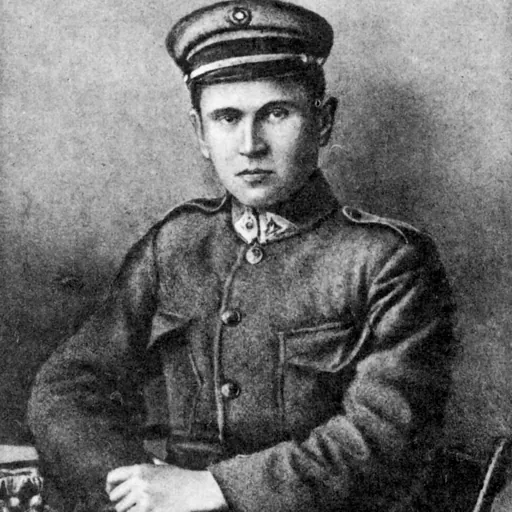
About Konstantinas Žukas
Lived 1884 – 1962 (aged 77). Konstantinas Žukas was a civil servant.
Konstantinas Žukas (6 January 1885 – 22 January 1962) was a Lithuanian colonel who was the Minister of Defence from 19 June 1920 to 7 April 1921. At the same time, he was the chief commander of the Lithuanian Army during the Polish–Lithuanian War.
Žukas learned to operate a telegraph informally and started working as railway telegraphist at the age of 12. He moved to work for the railway in Achinsk and Krasnoyarsk, but lost his job due to his involvement in the Russian Revolution of 1905. He then volunteered to the Russian Imperial Army and attended Vilnius Military School. He served as communications officer in the and the 31st Infantry Division. In 1918, he returned to Lithuania and joined the Lithuanian Army in February 1919. He became commander of the 1st Reserve Battalion and the front between the border with Germany and Merkinė. In this capacity, Žukas dealt with the Sejny Uprising which forced the Lithuanians to retreat behind the Foch Line in September 1919.
In April 1920, Žukas was elected to the Constituent Assembly of Lithuania as a member of the Lithuanian Popular Peasants' Union. Žukas became the minister of defence in the government of Prime Minister Kazys Grinius in June and supreme commander of the Lithuanian Army in July 1920. Žukas negotiated with the Soviets regarding their withdrawal from Vilnius which was recognized to Lithuania by the Soviet–Lithuanian Peace Treaty. He also negotiated with Poland in an attempt at preventing hostilities in the Polish–Lithuanian War. The Lithuanian Wars of Independence ended in November 1920, but Lithuania lost both Vilnius Region and Suwałki Region to the Second Polish Republic.
Žukas worked to establish the Higher Officers' Courses (opened in April 1921) and the Kaunas War Museum (opened in February 1921). On 7 April 1921, he resigned from both the command of the army and the Ministry of Defence. He then served as the second assistant to the Chief of the General Staff, commander of the 4th Border Division, and chief of staff of the 2nd military district. He resigned from the military in 1925. In 1944, he retreated to Germany and emigrated to the United States in 1949. He died in January 1962 in Cleveland, Ohio.
Biography Railway telegraph Žukas was born on in Kaunas into a family of poor city residents. He attended a primary school in Kaunas and was an excellent student who received the highest grades, but was not admitted to Kaunas Gymnasium because he was not from a noble family. In 1896, his parents moved to Obeliai where his father worked as a salesman of vodka for the state monopolist. There Žukas joined a church choir organized by Mikas Petrauskas. He was informally taught to operate the telegraph by a director of the railway station. Despite being just 12 years old, he worked at the station as a telegraph operator.
In fall 1899, Russian general visited the station which was on the Saint Petersburg–Warsaw railway and noticed the young but talented Žukas. Borkovsky invited Žukas to work for the Russian railway in Siberia where neither his low-born status nor young age was an obstacle. Žukas then worked as a telegraphist in Achinsk and Krasnoyarsk. Since he earned a decent wage (420 rubles per year) and cost of living was much lower, his family (mother, sister, and later father) also moved to Krasnoyarsk. Žukas was quickly promoted to senior telegraphist and his salary was raised to 90 rules per month.
During the Russian Revolution of 1905, Žukas was elected chairman of the railway workers' union in Krasnoyarsk. He later worked at a telegraph agency – he collected news from other railway workers' unions and committees and published a bulletin every two to three days. In August 1905, Žukas became secretary of a joint revolutionary committee of cities along the Trans-Siberian Railway. In December 1905, the revolutionary committee clashed with soldiers loyal to the Tsarist regime. Žukas along with several hundred others was arrested, but he was released after a few days.
Russian Imperial Army Fearing further arrests and persecutions, Žukas returned to Lithuania in January 1906. He passed the graduation exams of Kaunas Gymnasium externally so that he could volunteer for the Russian Imperial Army. He likely joined because volunteers were treated better than conscripts. He joined the army in October 1906 and was assigned to the stationed in Šančiai. His superiors quickly recognized his potential and sent him to study at Vilnius Military School in August 1907. Upon his graduation in August 1910, he was promoted to podporuchik and assigned to the communications section of the in Kharkov. According to his memoirs, Žukas wanted to continue studying at a military academy, but was told that he could not be accepted because of his Catholic faith.
At the start of the First World War, Žukas maintained communications in the Battle of Galicia. He was assigned to the 31st Infantry Division as communications chief in October 1915. After the February Revolution, Žukas was elected chairman of the division's soldiers committee and was reelected four times. In August 1917, the division was moved to the Romanian Front and placed in reserve. After the October Revolution, Žukas submitted his resignation from the army, but it was rejected. He then asked to be transferred to the Polish Legions which was granted. In February 1918, he departed to Voronezh where he lived with some relatives. In May, after the Red Army announced mobilization, Žukas decided to return to Lithuania.
1st Reserve Battalion In summer 1918, Žukas returned to Lithuania and lived in Raseiniai. He joined a local 12-member committee that proclaimed Raseiniai Republic. He organized and led a local police force of about 30 men to maintain public order. However, in early December he became seriously ill with typhoid fever. Upon recover, and against doctor's orders, he traveled to Kaunas where he joined the Lithuanian Army as a volunteer on 15 February 1919. He was assigned to the 1st Infantry Regiment as chief of communications in Marijampolė. In March 1919, the regiment was ordered to deploy to Alytus. However, a battalion was left behind and Žukas became its commander. In April, the battalion was officially named the 1st Reserve Battalion (later reorganized into the 10th Infantry Regiment). Žukas worked on training new recruits, purchasing weapons from Germans, organizing basic provisions for the new army. He also had jurisdiction over kommandaturas in Alytus, Sejny, and Marijampolė.
In August 1919, the Suwałki Region became contested between Poland and Lithuania (see: Polish–Lithuanian War). Trying to avoid direct hostilities, the Conference of Ambassadors drew a couple of demarcation lines between Poland and Lithuania. The Foch Line required Lithuanian forces to retreat from Sejny. When Lithuanians refused, Polish irregular forces started the Sejny Uprising. On 24 August, Žukas was appointed commander of the front between the border with Germany and Merkinė. In this capacity, Žukas held several rounds of negotiations with the Poles. In the end, Lithuanians agreed to withdraw behind the Foch Line by 7 September.
In October 1919, Žukas had to deal with the issue of unpaid soldier wages. He took matters to his own hands. Using imperial Russian law which was still in effect at the time, Žukas demanded that the richest local residents bought 200,000 German marks worth of government obligations. When the residents refused, Žukas arrested 83 Jews from Marijampolė on 18 October. While it caused a scandal and protests from English observers, the measure was successful in raising more than 500,000 marks. In addition, Žukas dealt with many issues unrelated to the military, including arresting smugglers and communist activists. He became known as a strict and demanding officer. Žukas was promoted to major on 7 October 1919 and to lieutenant colonel on 24 March 1920.
Ministry of Defence In April 1920, Žukas was elected to the Constituent Assembly of Lithuania as a member of the Lithuanian Popular Peasants' Union. Initially, he wanted to refuse the mandate as he was not too interested in politics and believed that he was more useful in the army. However, party leadership convinced him to leave the 1st Reserve Battalion and move to Kaunas to work at the assembly which convened on 15 May 1920. In the assembly, Žukas was elected to the commission of national defence and became chairman of the commission on complaints and petitions.
On 19 June 1920, Žukas became the minister of defence in the government of Prime Minister Kazys Grinius. He centralized the procurement process and trimmed staff of the ministry and unit staffs. He was strict and demanded discipline from both officers and privates. Due to his personality and work style, he was disliked by and quarreled with several senior officers, including Pranas Liatukas, Antanas Merkys, Kazys Ladiga, and Silvestras Žukauskas. According to memoirs of Stasys Raštikis, junior officers approved of Žukas. As minister of defence, Žukas had to respond to several inquiries by members of the Constituent Assembly regarding various reported excesses of kommandants and other military personnel.
In June 1920, the Lithuanian government learned of the planned Soviet offensive in the Polish–Soviet War which presented an opportunity for Lithuanians to attack Poland and reclaim the Suwałki Region. However, the government resolved to maintain strict neutrality. As the situation became more unstable, Žukas became the acting supreme commander of the Lithuanian Army on 7 July 1920. On 12 July, the Soviet–Lithuanian Peace Treaty was concluded. Soviet Russia recognized Vilnius to Lithuania and Žukas negotiated with the Soviets regarding their withdrawal from the city. On 23 July, the Constituent Assembly enacted martial law which was proposed by Žukas.
On 26 August 1920, Žukas negotiated with a Polish delegation, led by Colonel Mieczysław Mackiewicz, in an attempt at preventing hostilities between Poland and Lithuania. Žukas held firm and refused to negotiate military matters without a clear political Polish–Lithuanian border that would be respected after the war. Hostilities erupted and towns in the Suwałki Region changed hands a few times. However, Lithuanians suffered a major defeat in the Battle of Sejny on 22 September and lost Vilnius to Żeligowski's Mutiny on 9 October 1920. Hostilities and the Lithuanian Wars of Independence ended in November 1920.
Žukas worked to establish the Higher Officers' Courses (opened in April 1921) and the Kaunas War Museum (opened in February 1921). On 7 April 1921, he resigned from both the command of the army and the Ministry of Defence. According to the memoirs of Rapolas Skipitis, Žukas resigned because he attempted to expose a smuggling operation of Juozas Purickis, Minister of Foreign Affairs. On 30 June 1921, Žukas also resigned from the Constituent Assembly.
Don’t just read it —
keep it.
Full-length biographies made to live with: read them, listen on the way to work, watch them tonight.
- E-book
- Audio
- Video
Instant download · yours to keep · every purchase keeps this site free
Important facts
People in Konstantinas Žukas's life
Named in this biography and alive at the same time


Related people
Same field, nearest in time


Contemporaries
People whose lives overlapped Konstantinas Žukas's
Frequently asked questions
Who was Konstantinas Žukas?
Lithuanian statesman and military figure
When was Konstantinas Žukas born?
Konstantinas Žukas was born on 17 December 1884 in Kaunas.
When did Konstantinas Žukas die?
Konstantinas Žukas died on 22 January 1962 in Cleveland.
What was Konstantinas Žukas's occupation?
Konstantinas Žukas was a civil servant.
Sources & further reading
· Wikipedia: Konstantinas Žukas
Cite this page
APA: Biography.guide. (2026). Konstantinas Žukas. https://biography.guide/konstantinas-zukas/
MLA: "Konstantinas Žukas." Biography.guide, https://biography.guide/konstantinas-zukas/.
Chicago: "Konstantinas Žukas." Biography.guide. https://biography.guide/konstantinas-zukas/.
Data last updated: 2026-09-22 · Spot an error? Report a correction.
Portrait: Wikimedia Commons · author & licence
Page generated 2026-09-27 05:02 UTC