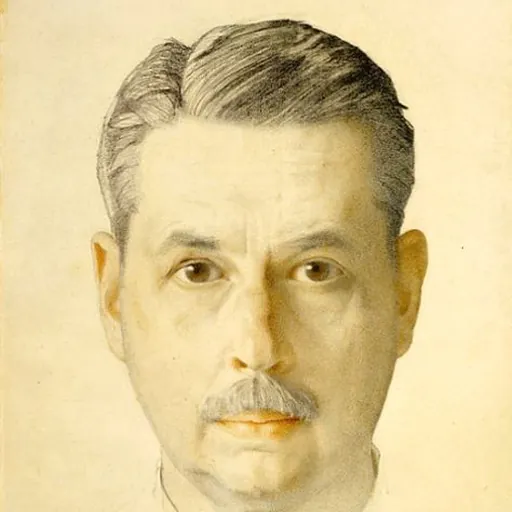
About Konstantin Somov
Lived 1869 – 1939 (aged 69). Konstantin Somov was a Russian illustrator, watercolorist, painter, graphic artist, printmaker and exlibrist.
Mir iskusstva, career success Portrait of Sergei Diaghilev by SomovIn 1898 and 1899, Somov was a founding member of Mir iskusstva (World of Art), a Russian artistic movement and magazine (edited by Sergei Diaghilev) that was a major influence on the Russians who revolutionized European art during the first decade of the 20th century. He served on the editorial board and contributed illustrations and designs.
For three years, from 1897 to 1900, he worked on his early masterpiece Lady in Blue (a portrait of Elizaveta Martynova), painted in the manner of 18th-century portraitists.
Along with landscape and portrait painting, watercolors, gouache, and graphics, Somov worked in the field of small plastic arts, creating exquisite porcelain compositions.
He had his first solo exhibition in Saint Petersburg in 1903 (162 paintings, sketches, and drawings). Also in 1903, 95 of his works were exhibited in Hamburg and Berlin. In 1906, in a group show of Russian artists organized by Diaghilev, he exhibited 32 works at the Salon d'Automne in Paris. His work was particularly appreciated in Germany, where the first monograph on him, by Oskar Bie, was published in 1907.
During the 1910s, Somov executed rococo harlequin scenes and gallant scenes, as well as illustrations for books including poems by Alexander Blok.
The colorful, festive visions created by Somov had a darker side. The Russian poet Mikhail Kuzmin noted:Some kind of demon is constantly pushing the artist, as if a piece of a magic mirror from Andersen's fairy tale had hit him in the eye [...]. Anxiety, irony, the puppet theatricality of the world, the comedy of eroticism, the variegation of masquerade freaks, the false light of candles, the sorcery-skull hidden under rags and flowers, automatic love poses, deadness and creepiness of amiable smiles—this is the pathos of a number of Somov's works. Oh, how not cheerful is this gallant Somov! What a terrible mirror he holds up to the laughing holiday!
Le Livre de la Marquise Cover for a German editionFrom 1907 to 1919, Somov drew over 120 ink drawings, some merely suggestive, some quite explicit, for multiple editions of Le Livre de la Marquise. The book is "an anthology of eighteenth century erotic French poetry and prose, and contains 56 works by some 50 authors, including excerpts from works by Voltaire, Parny, fragments from Les Liaisons dangereuses by Choderlos de Laclos and individual episodes from Casanova's Memoirs". Commenting on one edition, the Russian academician A. A. Sidorov said that Somov "seemingly permitted himself everything from which Russian art had abstained [...] the best of today's graphic artists has genuinely surpassed himself".
The most explicit edition was published after the Russian Revolution abolished censorship in 1917, which "gave Somov the opportunity of publishing a luxurious edition of the book with bolder illustrations [...]. One of the best printing houses in St Petersburg, R. Golike & A. Vilborg & Company" produced 800 copies. "In addition, part of the run was printed in a special collectors' version with additional indecent illustrations which might even be described as pornographic." He, nonetheless, became a professor at the Petrograd Free Art Educational Studios (the former Academy of Arts) in 1918, and, in 1919, he celebrated his 50th birthday jubilee with a one-person exhibition at the Tretyakov Gallery.
Living conditions deteriorated in Russia. His apartment was nationalized, and he was later evicted. He struggled to retain the rights to his art.
Somov left Russia in 1923 to accompany the seminal exhibition of Russian Art that took place in New York in 1924.
Somov's portrait of Methodiy Lukyanov, 1918, Russian Museum, Saint PetersburgIn 1910, when Somov was 40, he met 18-year-old Methodiy Lukyanov, who became Somov's closest companion and became part of the Somov family. He also helped Somov run his household and organize exhibitions, and served as Somov's trusted advisor and critic.
During World War I, the homosexual British novelist Hugh Walpole worked as a British correspondent in Russia. While in Saint Petersburg in 1915, Walpole formed a close friendship with Somov and, in February 1916, moved into Somov's home. Walpole left Russia on 7 November 1917, the day the October Revolution began.
In 1918, Somov painted a large portrait of Methodiy Lukyanov sitting on a sofa in pajamas and a dressing gown, which is now in the Russian Museum in Saint Petersburg.
In the spring of 1931, in Paris, Lukyanov fell ill with tuberculosis. In great distress, Somov wrote to his sister in Russia:Every minute of my life is now torment—although I do everything I need to—eat, talk with visitors, even work a little—the thought of Methodius and the upcoming separation does not leave me. Now I absorb into myself his face, his every word, knowing that soon I will not see him again [...]. Yesterday, lying on a mattress, on the floor by his bed, I tried to pray mentally—It's me! God, if you exist and care about people, prove, save Methodius to me, and I will believe in you! But it's all in vain.
After a year-long decline, a great deal of suffering, and an agonizing final day, Lukyanov died on 14 April 1932. In a letter to his sister, Somov wrote, "Methodius was buried yesterday [...] there are no words, how it was for me to return home alone [...]. Today I began to live a new life—without Methodius."
Somov was known for his ironic and self-deprecating humor. "I would like to become Ingres", he once said. "Or if not Ingres, then at least his little toe."
In 2016, Russian art historian Pavel Golubev founded the Somov Society to preserve, study, and popularize the heritage of Konstantin Somov.
In 2019, to mark the 150th anniversary of his birth, the Russian Museum in Saint Petersburg mounted the exhibition Konstantin Somov, which brought together over 100 works by the artist.
Also in 2019, Pavel Golubev curated the exhibition Konstantin Somov, Uncensored at the Odesa Fine Arts Museum in Ukraine.
Works Portraits
Paintings
Illustrations for Le Livre de la Marquise
Nudes
Don’t just read it —
keep it.
Full-length biographies made to live with: read them, listen on the way to work, watch them tonight.
- E-book
- Audio
- Video
Instant download · yours to keep · every purchase keeps this site free
Important facts
more
Constantin Somoff, Constantin Andreievitch Somov, Konstantin Andreevič Somov, Konstantin Andreievitch Somov, Konstantin Andreievitch Sonoff, Konstantin Andreievitch Sonov, Constantin Andrejewitsch Ssomoff, Somov, Constantine Andreievich SomoffPeople in Konstantin Somov's life
Named in this biography and alive at the same time

Related people
Same field, nearest in time




Contemporaries
People whose lives overlapped Konstantin Somov's



Frequently asked questions
Who was Konstantin Somov?
Russian artist (1869-1939)
When was Konstantin Somov born?
Konstantin Somov was born on 30 November 1869 in Saint Petersburg.
When did Konstantin Somov die?
Konstantin Somov died on 6 May 1939 in Paris.
What was Konstantin Somov's occupation?
Konstantin Somov was an illustrator, watercolorist, painter, graphic artist, printmaker and exlibrist.
What nationality was Konstantin Somov?
Konstantin Somov was Russian.
Sources & further reading
Cite this page
APA: Biography.guide. (2026). Konstantin Somov. https://biography.guide/konstantin-somov/
MLA: "Konstantin Somov." Biography.guide, https://biography.guide/konstantin-somov/.
Chicago: "Konstantin Somov." Biography.guide. https://biography.guide/konstantin-somov/.
Data last updated: 2026-09-23 · Spot an error? Report a correction.
Portrait: Wikimedia Commons · author & licence
Page generated 2026-09-27 05:08 UTC