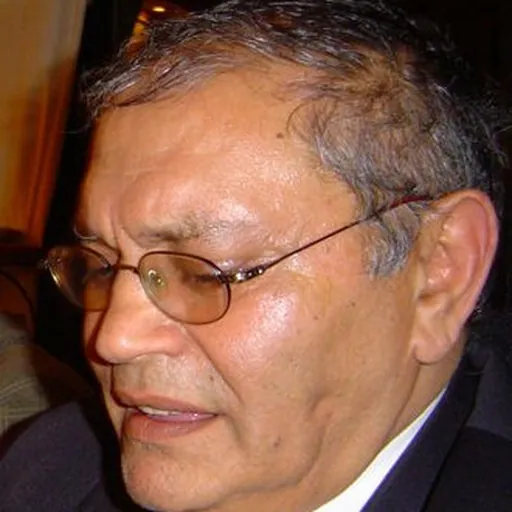
About Kochavi Shemesh
Lived 1944 – 2019 (aged 75). Kochavi Shemesh was an Israeli lawyer, activist and advocate.
Kochavi Shemesh (sometimes spelled "Kohavi", ; 10 January 1944 – 13 May 2019) was a lawyer, leftist activist, and one of the leaders of the Israeli Black Panthers and the editor of its main publication Ha'panter Ha'shachor . He also helped form the Israeli political party Hadash, which formed as a merger between the Black Panthers, the Israeli Communist Party, and other leftist organizations.
Biography
Early life Shemesh was born in Baghdad, Iraq in the Rabbi Meir Bal HaNess Jewish Hospital in January 1944. His family moved to Israel in July 1950, and he grew up in Musrara, Jerusalem, a neighborhood predominantly populated by recent Mizrahi and Sephardi immigrants. He did not receive any formal secular education as a child, dropping out before he even completed first grade. However, he did study in ultra orthodox schools until the age of 14. For most of his life, he worked as a taxi driver and restaurant worker.
In the 1960s, Shemesh founded and edited a daily community newspaper, which he operated illegally without a permit, publishing sports and Sephardi human interest stories. After its seventh issue was published, he was arrested and sentenced to either pay a fine or serve a three-week prison sentence, and chose on the basis of principle to serve the sentence in prison. from 1971 until 1977, when those duties were taken over by Charlie Biton and Saadia Marciano. Shemesh, Biton, and Marciano together comprised the leadership of the Black Panthers.
Shemesh participated in all of the Black Panthers' operations and demonstrations. In August 1971, after the police violently broke up a Black Panther demonstration in Zion Square, he was arrested alongside several of his comrades on suspicion of having violated the terms of demonstration permits that they had received. In January 1972, he participated in a demonstration against the World Zionist Congress, arguing that the Congress was partial to exclusively to the interests of Zionist Jews of European origins and that the organization "does not speak for all the Jews of the world" as it claimed. Later that year, he participated in one of the Black Panthers' most famous actions nicknamed "Operation Milk", where they stole milk bottles from the relatively wealthy neighborhood of Rehavia and distributed them to the poor living in the slums of Jerusalem, writing on the bottles "For the children of the slums who do not have the milk that they need in the morning, while elsewhere cats and dogs live in abundance".
In the run up to the 1973 Israeli legislative election, Shemesh opposed a list sponsored by the Black Panthers and headed by Shalom Cohen, instead running unsuccessfully on his own platform with Adi Malcah. In the following elections in 1977, Shemesh and Charlie Biton engaged in talks with the Israeli Communist Party, at the time known by the acronym "Rakah" , merging the Black Panthers and Rakah into Hadash (The Democratic Front for Peace and Equality).
Later life In the 1990s, following the dissolution of the Soviet Union, Shemesh advocated against accepting the mass immigration of Soviet Jews until Israel addressed the impoverished and dispossessed within its own borders. Shemesh participated in charitable aid organizations, co-founding Zoharim village, the first drug addiction recovery center in Israel. As a result of his experiences working on that project, Shemesh alongside other Black Panthers began a campaign to demand general amnesty for prison inmates.
Shemesh died on May 13, 2019, survived by his wife, Rachel Ashur Shemesh, and three children.
Views and legacy Throughout his life, Shemesh promoted the rights of Mizrahi Jews and Palestinians, as well as other marginalized groups around the world. He was quoted in 1973 as saying that "[Mizrahi's] strongest bond is with the poor and oppressed in the Middle East", and that the Black Panthers' goals were to "[seek] an alliance with the Arabs and forming an economic bloc to counter the influences of both US and the USSR." Shemesh was critical of the Israeli government, condemning its treatment of Palestinians and supporting cession of Israeli territory for the establishment of a separate Palestinian State. Shemesh met with leaders of the PLO and expressed solidarity with their cause, stating that "there will be no equality for Mizrahim for as long as there is occupation".
Although many of Shemesh's political views were unpopular in Israel, he inspired a generation of Mizrahi activists in the country.
Don’t just read it —
keep it.
Full-length biographies made to live with: read them, listen on the way to work, watch them tonight.
- E-book
- Audio
- Video
Instant download · yours to keep · every purchase keeps this site free
Important facts
People in Kochavi Shemesh's life
Named in this biography and alive at the same time



Related people
Same field, nearest in time



Contemporaries
People whose lives overlapped Kochavi Shemesh's


Frequently asked questions
Who was Kochavi Shemesh?
Israeli lawyer and social activist of the Black Panthers movement (1944-2019)
When was Kochavi Shemesh born?
Kochavi Shemesh was born on 10 January 1944 in Baghdad.
When did Kochavi Shemesh die?
Kochavi Shemesh died on 13 May 2019.
What was Kochavi Shemesh's occupation?
Kochavi Shemesh was a lawyer, activist and advocate.
What nationality was Kochavi Shemesh?
Kochavi Shemesh was Israeli.
Sources & further reading
Cite this page
APA: Biography.guide. (2026). Kochavi Shemesh. https://biography.guide/kochavi-shemesh/
MLA: "Kochavi Shemesh." Biography.guide, https://biography.guide/kochavi-shemesh/.
Chicago: "Kochavi Shemesh." Biography.guide. https://biography.guide/kochavi-shemesh/.
Data last updated: 2026-09-22 · Spot an error? Report a correction.
Portrait: Wikimedia Commons · author & licence
Page generated 2026-09-27 04:57 UTC