About Kizbech Tughuzhuqo
Lived 1777 – 1840 (aged 62–63). Kizbech Tughuzhuqo was a soldier.
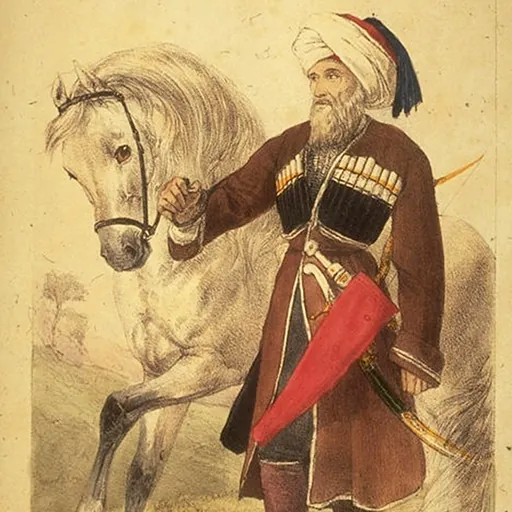
Qizbech Tughuzhuqo was a Circassian soldier, military commander and a leader of the Shapsug who took part in the Russo-Circassian War. A cavalry commander, he was known for his success in utilising guerilla tactics and raiding behind enemy lines. ransoming Circassian prisoners of war with his own money and raiding Russian supply lines, distributing the loot to Circassian commoners. In oral tradition, songs and ballads were composed in his name. Other variants include "Hajji Lion" and "Lion of the Circassian War".
Qizbech's reputation attracted the attention of European journalists and adventurers. Sources and contemporary writers on Qizbech include David Urquhart, secretary of the British Embassy in Istanbul and a supporter of the Circassians who contributed to the Portfolio magazine; Edmund Spencer and John E. Longworth, travellers who reported from Circassia for The Times; and James Stanislaus Bell, who followed Urquhart's lead in writing letters to the British people. The last three of them met Qizbech personally and recorded their memories. Among the Circassian writers of the period, Sultan Khan-Giray provides information about Qizbech. On the Russian side, both the poet Mikhail Lermontov and the Russian Lieutenant General Vasily Aleksandrovich Potto, the first detailed historian of the Caucasian War, mention him. Fyodor A. Shcherbina also provides information about Qizbech.
Qizbech's original surname was Sheretluqo, while Tughuzhuqo means "son of Tughuzh".
Early life Not much is recorded about Qizbech's early life, as Circassians did not write down their history, and all knowledge comes from Russian sources. Tughuzhuqo was born in 1777 in the village of Beannash
A theory suggests that the Sheretluqo family comes from Bekkan/Bechkan, which was a branch of Zhaney princes. He was born into a family of seven children. Qizbech was 192–193 cm tall. Historical accounts describe Qizbech as a man of enormous physical stature with a loud voice and audacious, rough mannerisms. After the revolution, Qizbech does not appear in written sources between 1796 and 1810. According to Circassian oral traditions, during this period Qizbech met with Hasan Pasha, the Ottoman governor of Anapa, and went on a pilgrimage to Mecca. After that, he stayed for a time in Egypt, where at some point he met Muhammad Ali of Egypt and served in the Egyptian army against the French invasion of Egypt and Syria. He returned to Circassia definitively in 1810 and began to appear again in written records. After this, he continued to fight for the Circassian army. In the June of the same year, Qizbech attacked the Alexandriyske Fortress with 1,000 men. In October 1822, he was wounded during the assault on the Yelizavetinskaya Fortress. The Circassians believed that Qizbech had met Khidr (Alebiy in Circassian).
On March 12, 1823, Qizbech crossed the Kuban River with an army of 1,500 and attacked a Russian stanitsa in construction near Yelizavetinsky. While he was fighting the 200-strong Cossack unit stationed there, 200 Cossacks and two cannons arrived from Alexandrovsky Fortress, and the artillery fire halted the Circassians. As Qizbech prepared for an attack, General Vlasov's army approached to the battlefield, prompting the Circassians to retreat. The Cossacks pursued and attacked the retreating forces. During the clashes, Qizbech captured a sergeant and two soldiers. Russian artillery took position and opened fire and Qizbech's eldest son was killed by the artillery, and his body was captured by the Cossacks. However, after receiving news of approaching Russian reinforcements, Qizbech headed back to Circassia. The Russians intercepted his forces twice, leading to heavy casualties on the Circassian side; however, Qizbech managed to get back to Circassia, heavily wounded and with 3 captives.
Sultan Khan-Giray had said the following about him:Qizbech was part of the team that designed the Shapsug flag. Englishman Favell Lee Mortimer said these:
On January 23, 1825, Qizbech gathered a 2,000-strong army and crossed the frozen Kuban River to avenge the Russian attacks on Circassian villages in 1824. Qizbech attacked two Cossack units there and shortly afterwards, General Vlasov and reinforcements from the surrounding positions joined the battle, and intense fighting lasting 6 hours took place. At the beginning of June 1837, he attacked the guards of the Nikolaevsky fortress (now Shapsugskaya village) alone, captured a soldier, and seized 9 rifles.
The song written for Qizbech by the Circassian bard Osman the Blind, who was a contemporary of Qizbech, goes like this:
Fame British adventurer James Bell was impressed by the courage of Qizbech. He witnessed the fear in the hearts of Russian soldiers when hearing Qizbech's name, and how they dispersed before him after they had seen him. Bell said that Qizbech had crossed the Kuban River into Russian territory "annually and almost monthly," consistently bringing back captured Russian horses and spoils.
"Shapsugs are considered the fiercest and most dangerous inhabitants of the coasts of the Black Sea... The Shapsugs were able, thanks to courage and fortitude, to defend themselves and their land, which was proven by inflicting great losses on us, in all cases our forces had to fight them. Among them were strong leaders on the For example, Sheretluqo Qizbech Tughuzhuqo". According to oral sources, Qizbech's horse was named Gu'ale (ГуIалэ). The name is derived from the Circassian word meaning "beany" "eager" or "restless". As of June 2015 the fundraising was completed and the statue was built. The Republic of Turkey created a postage stamp in memory of Qizbech.
Don’t just read it —
keep it.
Full-length biographies made to live with: read them, listen on the way to work, watch them tonight.
- E-book
- Audio
- Video
Instant download · yours to keep · every purchase keeps this site free
Important facts
People in Kizbech Tughuzhuqo's life
Named in this biography and alive at the same time




Related people
Same field, nearest in time



Contemporaries
People whose lives overlapped Kizbech Tughuzhuqo's


Frequently asked questions
Who was Kizbech Tughuzhuqo?
circassian military commander
When was Kizbech Tughuzhuqo born?
Kizbech Tughuzhuqo was born in 1777 in Circassia.
When did Kizbech Tughuzhuqo die?
Kizbech Tughuzhuqo died on 29 February 1840 in Circassia.
What was Kizbech Tughuzhuqo's occupation?
Kizbech Tughuzhuqo was a soldier.
Sources & further reading
· Wikipedia: Kizbech Tughuzhuqo
Cite this page
APA: Biography.guide. (2026). Kizbech Tughuzhuqo. https://biography.guide/kizbech-tughuzhuqo/
MLA: "Kizbech Tughuzhuqo." Biography.guide, https://biography.guide/kizbech-tughuzhuqo/.
Chicago: "Kizbech Tughuzhuqo." Biography.guide. https://biography.guide/kizbech-tughuzhuqo/.
Data last updated: 2026-09-22 · Spot an error? Report a correction.
Portrait: Wikimedia Commons · author & licence
Page generated 2026-09-27 05:02 UTC