
About Kirill Shchelkin
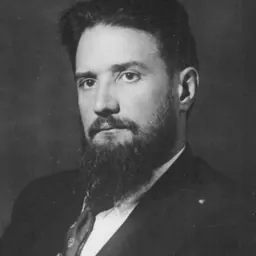
Lived 1911 – 1968 (aged 57). Kirill Shchelkin was a Russian and Georgian nuclear physicist, known for Chelyabinsk-70 and Soviet atomic bomb project.
Kirill Ivanovich Shchelkin (; born Kirakos Hovhanesi Metaksian; – 8 November 1968) was a Soviet physicist of Armenian origin in the former Soviet program of nuclear weapons who made theoretical and experimental contribution in combustion and gas dynamics.
He was notable for his work on the detonation process of the first Soviet nuclear weapon, the RDS-1, and the first thermonuclear device, and for his role as the first scientific director of the Soviet nuclear weapons development center in the Urals at Chelyabinsk-70.
Life and career He was born in Tbilisi, Russian Empire, and baptised at home by an Armenian Orthodox priest. Armenian by nationality. He lived in the Caucasus as a young child. When he was aged seven, his family moved to Krasny, where his father – a land surveyor and his mother, a teacher, both of ethnic Russian extraction – came from. In 1924, his family moved to Karasubazar (now Belogorsk) in the Crimea because his father was suffering from tuberculosis. When his father succumbed to the disease in 1926, the 15-year-old pupil Shchelkin also had to work to support his family. In 1928, he enrolled at the Crimean Pedagogical Institute in the faculty of Physics and Technology, graduating in 1932.
After graduation, he was invited to join the Institute of Chemical Physics of the USSR Academy of Sciences in Leningrad as a laboratory assistant. Here he first met Igor Kurchatov, who was to become an important supporter. He researched combustion processes, specifically the suppression of methane explosions in coal mines and suppressing the detonation of fuel-air mixtures in the cylinders of internal combustion engines. In May 1934, scientist published an article in the Journal of Experimental and Theoretical Physics in which he described calculating the frequency of rotation in the newly studied phenomenon known as spin detonation, where the flame front in combustible gaseous mixtures advances (for example) in a spiral manner along a cylinder, which drew the attention of combustion specialists. He also wrote about experiments concerning the effect of irregularities in the walls of mine workings which caused turbulence that could accelerate flame propagation should combustion occur if the chambers were filled with combustible gases. He gained his Ph.D. in December 1938 with a thesis presented to the academy: “On the theory of the onset of detonation in gas mixtures”. Yakov Zel'dovich, an expert in the field, was one of a number of scientists who argued with Shchelkin from the point of view of chemical kinetics made more complex by thermal effects – as opposed to Shchelkin's gas dynamics – but he conceded that Shchelkin's bravery produced exceptional experimental results.
He died on 8 November 1968 in Moscow, and was buried in Novodevichy cemetery.
Awards and legacy 1949, 1951, 1953: 3 times Hero of Socialist Labour. 1949, 1951, 1953: 3 times Stalin Prize. 1953: Order of the Red Banner of Labour. 1953: Corresponding member of the USSR Academy of Sciences. 1958: Lenin Prize.
The city of Shchelkino in the Crimea, constructed in 1978 for workers of the nuclear power station, was named in his honour. In Snezhinsk, an avenue is named after him and located there are two commemorative plaques. A monument to him was opened in Snezhinksk in May 2011; the same year, a Russian postage stamp (illustrated above) of 2011 bore his portrait.
The rotating flame front in cylinders of detonating gas is known as the Shchelkin spiral and research continues into its usage in propulsion.
Don’t just read it —
keep it.
Full-length biographies made to live with: read them, listen on the way to work, watch them tonight.
- E-book
- Audio
- Video
Instant download · yours to keep · every purchase keeps this site free
Important facts
People in Kirill Shchelkin's life
Named in this biography and alive at the same time

Related people
Same field, nearest in time





Contemporaries
People whose lives overlapped Kirill Shchelkin's




Frequently asked questions
Who was Kirill Shchelkin?
Soviet physicist (1911-1968)
When was Kirill Shchelkin born?
Kirill Shchelkin was born on 4 May 1911 in Tbilisi.
When did Kirill Shchelkin die?
Kirill Shchelkin died on 8 November 1968 in Moscow.
What was Kirill Shchelkin's occupation?
Kirill Shchelkin was a nuclear physicist.
What was Kirill Shchelkin known for?
Kirill Shchelkin was known for Chelyabinsk-70 and Soviet atomic bomb project.
What nationality was Kirill Shchelkin?
Kirill Shchelkin was Russian and Georgian.
Sources & further reading
Cite this page
APA: Biography.guide. (2026). Kirill Shchelkin. https://biography.guide/kirill-shchelkin/
MLA: "Kirill Shchelkin." Biography.guide, https://biography.guide/kirill-shchelkin/.
Chicago: "Kirill Shchelkin." Biography.guide. https://biography.guide/kirill-shchelkin/.
Data last updated: 2026-09-20 · Spot an error? Report a correction.
Page generated 2026-09-27 05:32 UTC