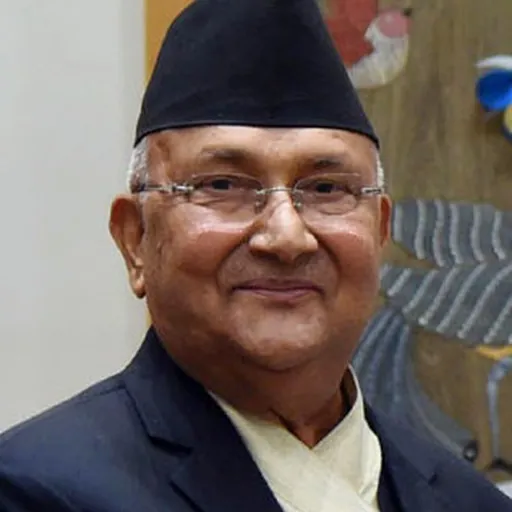
Khadga Prasad Sharma Oli
Prime Minister of Nepal (2015–2016; 2018–2021; 2024–2025)
About Khadga Prasad Sharma Oli
Born 1952. Khadga Prasad Sharma Oli is a Nepali politician.
Parliamentary politics (1991–2015) After CPN (Marxist–Leninist) merged with CPN (Marxist) to form the CPN (Unified Marxist–Leninist) in 1991, Oli became a founding central committee member of the new party. Later that year he became the founding chairman of the Democratic National Youth Federation. In 1992, he was elected as a standing committee member of the party and was appointed as the chief of the party's publicity department.
He was reelected in the 1994 election from Jhapa 6 and became Home Minister in the minority government of Man Mohan Adhikari.
Oli in 2011Following the royal coup by King Gyanendra in 2005, he was put under house arrest. Following the 2006 revolution, Oli was appointed as deputy prime minister and foreign minister in Girija Prasad Koirala's interim cabinet. He was also made chair of a cabinet committee to implement the High Level Probe Commission report which investigated abuses of state power and funds since the royal coup. Oli lost in the 2008 Constituent Assembly election in Jhapa 7. At the party's eighth general convention in 2009, his previous proposal for organizational changes was accepted. He was also reelected to the central committee by the congress but lost his bid for party chair to Jhala Nath Khanal.
Premiership (2015–2025) In the 2013 Constituent Assembly election, Oli was elected from Jhapa 7. He also became the parliamentary party leader, defeating Khanal in the contest. Oli again challenged for the party leadership at the ninth general convention in July 2015. He defeated former general secretary Madhav Kumar Nepal and was elected as party chair.
First term (October 2015–July 2016)
Following the promulgation of the new constitution, Oli was elected as Prime Minister in a parliamentary vote on 11 October 2015, receiving 338 votes out of 597 members in the Legislature Parliament. His candidacy was supported by the UCPN (Maoist), Rastriya Prajatantra Party Nepal, Madheshi Jana Adhikar Forum, Nepal (Loktantrik) and 13 other small parties. He was sworn in on 12 October.
His appointment came at the time of protests in the southern plains demanding revisions to the constitution and a blockade imposed by India. Amid deteriorating relations with India, his cabinet recalled Nepal's ambassador to India, Dip Kumar Upadhaya following differences with the cabinet. On 20 March, he went on a state visit to China where the two countries signed trade and transit treaties.
He resigned on 24 July 2016, after losing the support of his coalition partners. The main coalition partner CPN (Maoist Centre) and the opposition Nepali Congress had registered a no-confidence motion against his government on 14 July 2016.
Second and third terms (February 2018–August 2021)
In the 2017 election, the alliance between the CPN (UML) and CPN (Maoist Centre) gained a majority in the House of Representatives. Oli was elected from Jhapa 5 with a majority of over 28,000 votes. He was unanimously elected as the leader of the parliamentary party on 15 February 2018.
He was appointed prime minister for a second time on 15 February 2018 with the support of CPN (Maoist Centre). He passed the floor test on 11 March with 208 of 268 votes in the 275-member House of Representatives. Following the merger of the two coalition partners to form the Nepal Communist Party, he became co-chair of the new party along with Pushpa Kamal Dahal.
After pressure within the party from Madhav Kumar Nepal and other leaders to either give up the party leadership or the premiership, Dahal was made the executive head of the party. He reshuffled his cabinet on 22 November to manage factions within the party. His government also received criticism from leader within the party including Bhim Rawal for their agreement with the United States government for grants under the Millennium Challenge Corporation.
In February 2019, Oli claimed that the world is amazed by the supercomputer being built by Nepal. He was referring to a computer that was being built in the Banepa IT Park, which the makers had claimed to be a supercomputer in spite of its lacking computing power.
In August 2019, Oli claimed the English word rhinoceros should be replaced by the Nepali word for the animal, Gainda , and Mount Everest should be known as Sagarmatha by everyone. He said, "...Do you know what gaida [is]? You people know gaida as rhino. But rhinos are not rhinos, they are gaida. I request you to remember this word—gaida...".
His handling of the COVID-19 pandemic was criticized within the party. Party members were critical of an agreement with a private company in China to purchase medical equipment, and unbeknownst to cabinet members assigning the responsibility to purchase medical equipment to the Nepali Army. The government's late response in evacuating Nepalese citizens was also criticized. He also received criticism for suggesting that the rising number of coronavirus cases were from individuals breaking the lockdown, especially those sneaking into Nepal from India. He also claimed that the corona is similar to the flu and that one should sneeze and drink hot water to drive the virus away.
In May 2020, the Oli government unveiled new maps of the country including the disputed territories of Kalapani, Lipulekh and Limpiyadhura in response to the inauguration of a road across the Lipulekh Pass by India, which led to a "cartographic war" between the two countries. A constitutional amendment bill to amend the official map and emblem of the country passed unanimously.
Following calls within the party to resign, Oli reshuffled his cabinet again in October 2020 but was admonished for not consulting the party. Dahal presented a political document at a party secretariat meeting that accused K.P. Sharma Oli of not following the party's directions, unilaterally leading the government and turning a blind eye towards corruption. In response, Oli attacked Dahal for not letting him run the government, promoting factionalism and nepotism as well as not letting victims of the Nepalese Civil War get justice.
On 20 December 2020, K.P. Sharma Oli called on President Bidhya Devi Bhandari to dissolve the House of Representatives and call for fresh elections. In an address to the nation, Oli said he dissolved the house after the party had not let him work as prime minister and that a no-confidence motion was being prepared against him from within the party. The decision was met with criticism from within the party and seven ministers close to the Dahal–Nepal faction in his cabinet resigned in protest. On 23 February 2021, a constitutional bench led by Chief Justice Cholendra Shumsher JB Rana declared the dissolution unconstitutional, and reinstated the House to meet within 13 days. Oli respected the verdict and convened parliament on 7 March.
On 7 March 2021, the Supreme Court ruled to award the Nepal Communist Party to Rishiram Kattel after he challenged the Election Commission's ruling of providing the name of his party to the NCP formed after the 2018 merger. The verdict dissolved the ruling party jointly led by Oli and Dahal, reviving the former CPN (UML) and CPN (Maoist Centre) parties. This reduced Oli's government back to a coalition, exacerbating political tensions. The CPN (Maoist Centre) recalled its ministers on 13 March 2021 and withdrew its support from the Oli government on 5 May 2021, turning it into a minority government.
On 10 May 2021, Oli failed a vote of confidence with 93 of 232 in the House of Representatives, 43 below the 136 majority. He then became a minority Prime Minister on 13 May 2021, when no opposition party formed a majority or claimed it in time. A cabinet meeting chaired by Oli recommended the president to dissolve the House of Representatives on 22 May 2021 after members of his party led by former prime ministers Madhav Kumar Nepal and Jhala Nath Khanal supported Nepali Congress leader Sher Bahadur Deuba as the next prime minister. On 12 July 2021, the constitutional bench of the Supreme Court formed to hear the opposition's writs against the dissolution. It declared the dissolution unconstitutional and ordered the appointment of Deuba as prime minister within 28 hours. After Nepal and Khanal were suspended by the party for disobeying party orders the party split in August the former party leaders forming the Communist Party of Nepal (Unified Socialist). Oli was re-elected party chair in the 10th general convention of the CPN (UML) in November 2021 defeating Bhim Rawal in the leadership election.
Fourth term (July 2024–September 2025)
In the 2022 general election, his party became the second-largest party in the House of Representatives. Oli was reelected from Jhapa 5 with a majority of over 29,000 votes. After power-sharing talks broke down inside the ruling alliance, Oli and Dahal brokered a deal, backing Dahal's bid as prime minister. The UML withdrew from the coalition government ahead of the presidential election in March 2023, but joined hands with Dahal again in March 2024.
Following disagreements with the prime minister and other coalition partners about the annual budget and citing the need for a stable government of national consensus, Oli and Nepali Congress' Deuba agreed on 1 July 2024 to form a rotational government with the two party chairs serving equal time as prime minister. CPN (UML) withdrew its support from the Dahal government, and following a failed a motion of confidence for Dahal in the House on 12 July, Oli was appointed prime minister for a fourth stint on 14 July as part of a coalition with the Nepali Congress, and sworn in the following day.
Resignation After widespread protests that started after a government-imposed social media ban and as part of the wider movement against corruption, Oli resigned as prime minister on 9 September 2025. He along with other ministers sought shelter at an army barrack in Shivapuri.
Post-premiership In the 5 March 2026 general election, Oli was defeated in the Jhapa-5 consitutency by Balen Shah, who won 68,348 votes to Oli's 18,734. On March 28, Oli was arrested for his alleged role in the crackdown of the 2025 Gen Z protests.
2026 general election
In the 2026 Nepalese general election, K. P. Sharma Oli, leader of the Communist Party of Nepal (Unified Marxist–Leninist) and a former Prime Minister, contested the Jhapa-5 constituency, which he had represented for many years. He faced a high-profile challenge from Balen Shah, the Rastriya Swatantra Party's prime ministerial candidate, in one of the election's most closely watched contests.
The election ended in a decisive defeat for Oli. Shah won 68,348 votes, while Oli received 18,734 votes, ending Oli's long hold on the constituency. The result was widely seen as a symbol of Nepal's changing political landscape, reflecting growing public support for newer political figures and reform-oriented parties following the political unrest of 2025.
Arrest and trial
Following his defeat in the 2026 general election, K. P. Sharma Oli was arrested on 28 March 2026 in connection with the deaths of 76 people during the violent suppression of the September 2025 Gen Z anti-corruption protests. Authorities also arrested former Home Minister Ramesh Lekhak after a judicial inquiry recommended that both men face prosecution for alleged negligence in their handling of the police response.
Oli was taken into custody at his residence in Kathmandu. His supporters protested the arrest, describing it as politically motivated, while the new government stated that the investigation was intended to ensure accountability for the deadly crackdown. In April 2026, the Supreme Court ordered Oli's release pending further legal proceedings.
Political positions Oli credits his distant uncle Ramnath Dahal for his communist beliefs. As a student in Jhapa at the time, he was influenced by the Naxalite insurgency in West Bengal, India. He had not studied Marxism but had followed the line of Cultural Revolution in his earlier days. He later claimed that it was a "mistaken path". He said this during an address to the parliament where he blamed the rising number of coronavirus cases on individuals violating the nationwide lockdown, especially those sneaking into Nepal from India, claiming that "people coming from India through illegal channels are spreading the virus in the country.", which sparked a round of media attention in India.
While addressing a function celebrating the 207th birth anniversary of poet Bhanubhakta Acharya on July 2020, Oli said Lord Rama was born in Nepal and India had created a fake Ayodhya. He claimed Thori, a place near Birgunj in southern Nepal, to be the birthplace of Rama and it was impossible for Rama to reach Janakpur in eastern Nepal to marry Sita from Ayodhya in India. He later launched an investigation into this matter, asking officials in the region to research the whereabouts of Ayodhyapuri. He also claimed to have found strong evidences of the real Ayodhya, supposedly including the ruins of Someshwar Gadhi and Valmiki Ashram, both of whom are associated with Lord Rama. According to him, India as a country did not exist at the time when yogic science was founded. This caused backlash from Nepali and Indian social media.
Federalism and Republicanism After the dissolution of the parliament in 2003, there were claims from some that Oli had dealings with the palace . He had commented that turning Nepal into a republic would be like "making for America in a bullock cart". Oli also defied party whip and was not present when the interim legislature declared Nepal as a republic.
Oli has been seen as favoring centralization. During his second term as prime minister he centralized more executive power into his post. He has also been seen as unwilling to let provincial and local governments function autonomously.
Electoral history
Personal life Oli is married to Radhika Shakya. He met Shakya in 1987 at an event organized by CPN (Marxist–Leninist) for recently released political prisoners in Pulchowk Campus. She was working as a temporary worker for Nepal Rastra Bank at the time, while studying at Patan Campus. Later that year, the two married in a ceremony attended by 20 people.
He currently resides in Balkot, Bhaktapur but also has a residence in Damak, Jhapa. He was admitted to intensive care where he underwent dialysis for renal disease in November 2019.
Don’t just read it —
keep it.
Full-length biographies made to live with: read them, listen on the way to work, watch them tonight.
- E-book
- Audio
- Video
Instant download · yours to keep · every purchase keeps this site free
Important facts
People in Khadga Prasad Sharma Oli's life
Named in this biography and alive at the same time

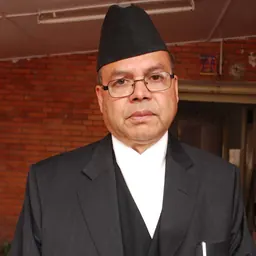

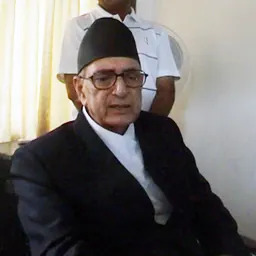
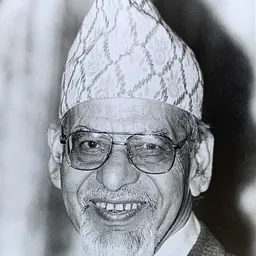



Related people
Same field, nearest in time

Contemporaries
People whose lives overlapped Khadga Prasad Sharma Oli's

Frequently asked questions
Who is Khadga Prasad Sharma Oli?
Prime Minister of Nepal (2015–2016; 2018–2021; 2024–2025)
When was Khadga Prasad Sharma Oli born?
Khadga Prasad Sharma Oli was born on 22 February 1952 in Tehrathum District.
What is Khadga Prasad Sharma Oli's occupation?
Khadga Prasad Sharma Oli is a politician.
What nationality is Khadga Prasad Sharma Oli?
Khadga Prasad Sharma Oli is Nepali.
Sources & further reading
· Wikipedia: Khadga Prasad Sharma Oli
Cite this page
APA: Biography.guide. (2026). Khadga Prasad Sharma Oli. https://biography.guide/khadga-prasad-sharma-oli/
MLA: "Khadga Prasad Sharma Oli." Biography.guide, https://biography.guide/khadga-prasad-sharma-oli/.
Chicago: "Khadga Prasad Sharma Oli." Biography.guide. https://biography.guide/khadga-prasad-sharma-oli/.
Data last updated: 2026-09-23 · Spot an error? Report a correction.
Portrait: Wikimedia Commons · author & licence
Page generated 2026-09-27 05:05 UTC