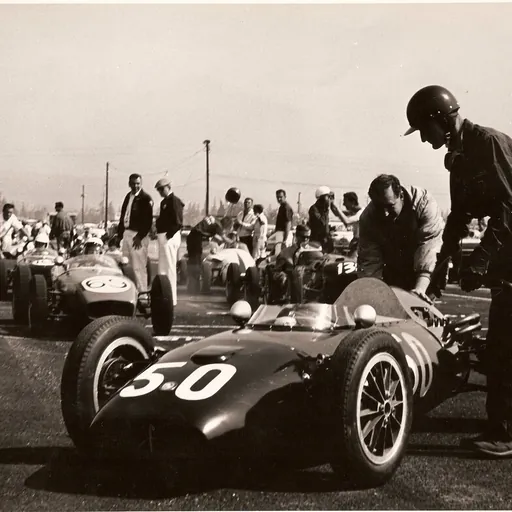
Ken Miles
British racing driver
About Ken Miles
Lived 1918 – 1966 (aged 47). Ken Miles was a British racing automobile driver, automotive engineer, motorcycle racer and formula One driver.
Kenneth Henry Jarvis Miles (1 November 1918 – 17 August 1966) was an English sports car racing engineer and driver best known for his motorsport career in the U.S. and with American teams on the international scene. He is an inductee to the Motorsports Hall of Fame of America. As an automotive engineer, he is known for developing, along with driver and designer Carroll Shelby, the Ford GT40, the car that won the 24 Hours of Le Mans in 1966, 1967, 1968, and 1969. Miles and Shelby's efforts at Le Mans were dramatized in the 2019 Oscar-winning film Ford v Ferrari.
Early life Miles was born on 1 November 1918 in Sutton Coldfield, then in Warwickshire, now in the city of Birmingham. He was the son of Eric Miles and Clarice Jarvis. Miles left school at the age of 15 to work as an apprentice at Wolseley Motors,
Miles' first role in the military was driving instructor in the Territorial Army. The following year Miles was posted to Guards Armoured Division Workshops, followed by the 29th Armoured Brigade Workshop. In 1953, he won 14 straight victories in SCCA racing in an MG-based special of his own design and construction.
For the 1955 season, Miles designed, constructed, and campaigned a second special based on MG components that was known as the "Flying Shingle". It was very successful in the SCCA F modified class on the West Coast. Miles raced the "Flying Shingle" at Palm Springs in late March, finishing first overall against veteran driver Cy Yedor, also in an MG Special, and novice driver, actor James Dean in a Porsche 356 Speedster. Miles was later disqualified on a technical infraction because his fenders were too wide, thus allowing Yedor and Dean to get 'bumped up' to first and second. During 1956, Miles raced John von Neumann 's Porsche 550 Spyder at most of the Cal Club and SCCA events.
For the 1957 season (in co-operation with Otto Zipper), Miles engineered the installation of a Porsche 550S engine and transmission in a 1956 Cooper chassis and body. It was the second successful race car to be known on the West Coast as "the Pooper", the first being an early 1950s Cooper chassis and body powered by a Porsche 356 power train that was built and campaigned by Pete Lovely of Tacoma, Washington. The resulting car dominated the F Modified class of SCCA on the West Coast in the 1957 and 1958 seasons with Miles driving.
Due to his great skill and talent, both as a driver and mechanical engineer, Miles was a significant member of the Shelby/Cobra race team in the early 1960s. Miles described himself this way: I am a mechanic. That has been the direction of my entire vocational life. Driving is a hobby, a relaxation for me, like golfing is to others. I should like to drive a Formula One machine, not for the grand prize, but just to see what it is like. I should think it would be jolly good fun!
With a very pronounced Brummie accent (from his hometown of Birmingham, renowned for car manufacturing) combined with a seemingly obscure and sardonic sense of humour, Miles was affectionately known by his American racing crew as "Teddy Teabag" (for his tea drinking) or "Sidebite" (as he talked out of the side of his mouth). He played a major role in the development and success of the racing versions of the Shelby Cobra 289 in SCCA, USRRC, and FIA sports car racing between 1962 and 1965, as well as the Daytona Coupe and 427 versions of the Cobra and the Ford GT (GT40).
Miles became the chief test driver of Shelby-American in 1963. While a member of the AC-Cobra Ford Team, Miles entered a Lotus 23 in the 1964 Player's 200 at Mosport. thumb
In 1965, Miles shared a Ford GT Mk II with Bruce McLaren at the 24 Hours of Le Mans, but retired with gearbox trouble. Earlier in the year, also with McLaren, he had finished second at the 12 Hours of Sebring, and won the Daytona 2000 km that same year, with Lloyd Ruby.
The next year, Miles won the 24 Hours of Daytona, sharing the Ford GT Mk II with Lloyd Ruby, and then won the 12 Hours of Sebring. Several months later, sharing the drive with Denny Hulme, Miles was leading the 1966 24 Hours of Le Mans in the #1 car, but Ford executives, desiring a publicity photo of three of Ford's cars crossing the finish line together, instructed Miles to slow down, which he did. Miles's #1 car and McLaren's #2 car crossed the finish line almost at the same time, with photos and official track data showing McLaren's #2 as 6 metres ahead when crossing the line. Additionally, McLaren's #2 started just over 14 metres behind Miles's car and had therefore covered more distance during the race; the official rules regarding cars finishing together indicate that starting position should be taken into account, so McLaren was declared the winner.
After the crash, the aerodynamics of the J-car were greatly modified to correct the rear-end lift generated at race speeds. Years later, Porsche and others had the same problem, as the long, low silhouette of a Kammback-tailed car behaved like an aerofoil aircraft wing and lifted at high speed. Ford executives, under pressure after the second fatal accident in the program in five months, ordered a roll cage similar to those used in NASCAR Grand National competition, be installed in future versions of the car. The significantly revised J-car, renamed the Ford Mk IV, won the only two races in which it was entered, the 1967 Sebring 12 Hours, and the 1967 24 Hours of Le Mans.
Miles is interred at the Abbey of the Psalms Mausoleum of the Hollywood Forever Cemetery in Hollywood, California.
Awards and honours Miles was posthumously inducted into the Motorsports Hall of Fame of America in 2001. He was inducted in the West Coast Stock Car Hall of Fame in 2020.
Racing record
USAC Road Racing Championship results Season Series Position Team Car 1961 USAC Road Racing Championship 1st Crandall Industries Incorporated Porsche 718 RS 61
NASCAR Grand National Series results
Formula One World Championship results (key) Year Entrant Chassis Engine 1 2 3 4 5 6 7 8 WDC Points 1961 Louise Bryden-Brown Lotus 18 Climax Straight-4 MON NED BEL FRA GBR GER ITA USADNA NC 0
24 Hours of Le Mans results Year Class No Tyres Car Team Co-Drivers Laps Pos. ClassPos. 1955 S1.5 41 MG EX182MG L4 1489cc MG Cars Ltd. John Lockett 249 12th 5th 1965 P+5.0 1 Ford GT Mk IIFord 427 V8/90° OHV 6981cc Shelby American Inc. Bruce McLaren 45DNFGearbox 1966 P+5.0 1 Ford GT Mk IIFord 427 V8/90° OHV 6982cc Shelby American Inc. Denny Hulme 360 2nd 2nd
Daytona 2000 km/24 Hours of Daytona results Year Class No Tyres Car Team Co-Drivers Laps Pos. ClassPos. 1965 P+2.0 73 Ford GT Mk IFord 427 V8/90° OHV 7000cc Shelby American Inc. Lloyd Ruby 327 1st 1st
Personal life Ken Miles was married to Mollie and had a son, Peter Miles (born 28 September 1950). He was also a very close friend of Carroll Shelby. Peter was almost 16 when he witnessed his father's death in the prototype J-car crash in 1966. A few months after Ken's death, Peter went to work for Ken's friend Dick Troutman at the Troutman and Barnes custom car shop in Culver City, California. Peter stayed at the workshop for four years. In 1986, Peter joined Precision Performance Inc. (PPI), the Cal Wells-owned Toyota off-road racing operation starting as a fabricator and then a mechanic before becoming the crew chief. Peter was the crew chief for Ivan Stewart when Stewart won the 1991 Nissan 400 in Nevada. In a 2019 interview, Peter said that the last time he went to Le Mans was in 1965 with his father Ken, and he has not returned since.
In popular culture Miles is portrayed by Christian Bale in the 2019 film Ford v Ferrari (released under the title Le Mans '66 in some parts of Europe). Miles' wife Mollie and his son Peter are portrayed by Caitriona Balfe and Noah Jupe, respectively.
Don’t just read it —
keep it.
Full-length biographies made to live with: read them, listen on the way to work, watch them tonight.
- E-book
- Audio
- Video
Instant download · yours to keep · every purchase keeps this site free
Important facts
People in Ken Miles's life
Named in this biography and alive at the same time





Related people
Same field, nearest in time


Contemporaries
People whose lives overlapped Ken Miles's

Frequently asked questions
Who was Ken Miles?
British racing driver (1918–1966)
When was Ken Miles born?
Ken Miles was born on 1 November 1918 in Sutton Coldfield.
When did Ken Miles die?
Ken Miles died on 17 August 1966 in Riverside International Raceway.
What was Ken Miles's occupation?
Ken Miles was a racing automobile driver, automotive engineer, motorcycle racer and formula One driver.
What nationality was Ken Miles?
Ken Miles was British.
Sources & further reading
Cite this page
APA: Biography.guide. (2026). Ken Miles. https://biography.guide/ken-miles/
MLA: "Ken Miles." Biography.guide, https://biography.guide/ken-miles/.
Chicago: "Ken Miles." Biography.guide. https://biography.guide/ken-miles/.
Data last updated: 2026-09-22 · Spot an error? Report a correction.
Portrait: Wikimedia Commons · author & licence
Page generated 2026-09-27 05:01 UTC