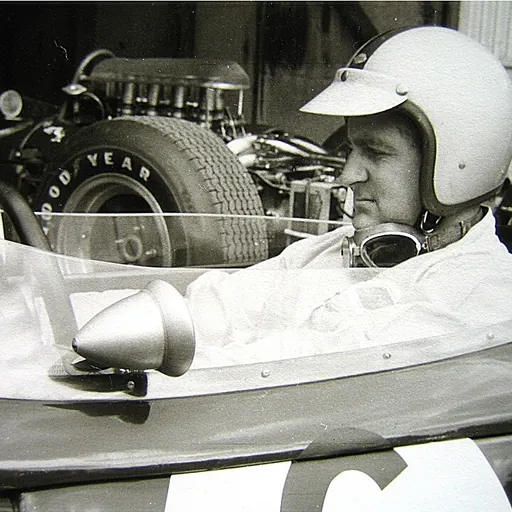
About Denny Hulme
Lived 1936 – 1992 (aged 56). Denny Hulme was a New Zealand formula One driver and racing automobile driver.
Denis Clive Hulme (18 June 1936 – 4 October 1992) was a New Zealand racing driver, who competed in Formula One from to . Nicknamed "the Bear", Hulme won the Formula One World Drivers' Championship in with Brabham, becoming the only New Zealander to do so, and won eight Grands Prix across 10 seasons. He is the World Champion with the fewest pole positions in his career, with only 1 career pole at the 1973 South African Grand Prix.
Born and raised in the South Island, Hulme was the son of Clive Hulme, who was a World War II sniper. Hulme achieved eight race wins, one pole position, nine fastest laps and 33 podiums in Formula One. He also finished third in the overall standing in 1968 and 1972.
Hulme showed versatility by dominating the Canadian-American Challenge Cup (Can-Am) for Group 7 sports cars. As a member of the McLaren team that won five straight titles between 1967 and 1971, he won the individual Drivers' Championship twice and was runner-up on four other occasions. Following his Formula One tenure with Brabham, Hulme raced for McLaren in multiple formats—Formula One, Can-Am, and at the Indianapolis 500. Hulme retired from Formula One at the end of the 1974 season but continued to race Australian Touring Cars.
Early racing career Hulme was born on a tobacco farm belonging to his parents in Motueka in the South Island of New Zealand. His father Clive Hulme was awarded a Victoria Cross, as a sniper, while fighting in the Battle of Crete in 1941.
As the New Zealand press were ignoring Hulme, he hired a 2½ litre Cooper from Reg Parnell and entered it in the 1961 New Zealand Gold Star Championship. He won the title straight away. He appeared at Le Mans for the Abarth team, taking a class win in S850 the class (partnered by fellow New Zealander Angus Hyslop), before Ken Tyrrell invited the likable (but sometimes gruff) New Zealander to race in his Formula Junior and Formula Two team, in 1962, when Tony Maggs was unavailable due to his Formula One commitments.
Once there, basing himself in London, Hulme worked as a mechanic in Jack Brabham's garage in Chessington and began to pave his way on his motor-racing path. It was Brabham who gave him drives in his Brabham sportscars and single seaters. During the 1963 season, he won seven International Formula Junior and after some impressive performances there, it was his old boss Jack Brabham who gave Hulme the call and he joined the Australian legend's F2 team. In 1964, the pair set about dominating the Championship that year, resulting in a one–two finish in the FFSA Trophées de France series. The pair also finished one–two in the 1966 series. During this spell in F2 between 1964 and 1966, Hulme won three races in the series, plus two non-championship events (the 1964 Grote Prijs van Limborg and the 1965 Spring Trophy). Hulme was rewarded with some non-championship Formula One races.
Away from single seaters, Hulme also raced the occasional saloon car. In appalling conditions, on 6 July 1963, Hulme won his first major saloon car race. The second Motor-sponsored Six-Hour, a round of the European Touring Car Championship, saw the pre-race favourite, a 7-litre Ford Galaxie driven by Dan Gurney and Jack Brabham flounder in the wet and the Jaguars dominated the race. Hulme would win, partnered by Roy Salvadori, after the winners on the road were disqualified for engine irregularities.
Formula One career
1965–1967: With Brabham
After making numerous appearances in non-championship events for Brabham during the 1964 season, as the Brabham team had signed Dan Gurney to race alongside their boss, Hulme finally got the call he had been waiting for, making his World Championship debut in 1965 at Monaco. Later that year, he scored his first points, for fourth position at the daunting Clermont-Ferrand (Charade) circuit in France.
started promisingly. At Kyalami, he led dominantly but the rising-rate suspension system forced him out, after only a few laps. The McLaren team were in disarray. The season was even worse than 1970 results wise, as Hulme did not even make the podium, although he set the fastest laps in Canada and the United States that year but results were hard to come by. Hulme ended up ninth in the standings for 1971.
Hulme won the Swedish Grand Prix luckily, though he also set the fastest lap. The race seemed to be set up for a home victory for Ronnie Peterson, with his Lotus teammate, Emerson Fittipaldi in second, when the Lotuses hit trouble. Fittipaldi being slowed with gearbox issues, and then Peterson with a slow rear wheel puncture. As Hulme decided to run with harder tyres, he passed Peterson on the penultimate lap to win. Hulme expressed sadness to "have taken that away from Ronnie".
He and Revson had built up a strong friendship off the back of their F1 camaraderie they also competed together in the Can-Am series. When Revson left McLaren at the end of 1973 to join Shadow, Hulme would have been disappointed.
In his time at McLaren, Hulme won six Grand Prix's, but he was nearing the end of his time in F1, and his competitive urges were being blunted by a growing apprehension about the dangers of racing. After the Brazilian Grand Prix in which Hulme finished twelfth, these fears were well founded. When testing at Kyalami started, in March 1974, Peter Revson suffered a front suspension failure (broken front Ball Joint), veering head-on into the barriers. Hulme tried in vain to save his friend's life, but to no avail. After the accident Hulme announced that he would see out before retiring from Grand Prix racing. However, other than winning the Argentine event (he inherited the lead when his now teammate Fittipaldi inadvertently knocked-off the electrical "kill-switch" on his steering wheel, on the penultimate lap) and coming second in Austria, he did not make much of an impact on the season, and retired at the end of the year and stepped away from the sport and returned to New Zealand.
Can-Am (1966–1972) In 1966, while driving for the Brabham team in Formula One, Hulme drove in the inaugural season of the Can-Am racing series of FIA Group 7 racing, driving the same Sid Taylor entered Lola T70 he had driven with success in UK Group 7 races that year, but achieving no success in the Can-Am races. In 1967, he joined the McLaren team of New Zealand countryman Bruce McLaren for the series, replacing Chris Amon who had gone to Ferrari. This partnership became so successful, the Americans called them the 'Bruce and Denny Show', such was their domination.
Tasman Series Hulme finished third in the 1964 Tasman Series with one win and three podiums. He would later compete in 1967 and 1968, collecting a podium in each year.
British Sportscar Championship (1965–1969) On weekends away from the Formula One, Hulme would sometimes race for Sid Taylor Racing in the British Sportscar Championship. During this time, he won a total of 12 races, mostly in a Lola T70, including three RAC Tourist Trophies, one of which was a round of the 1965 World Sportscar Championship.
After F1 After leaving the sport, Hulme led the GPDA (Grand Prix Drivers' Association) for a brief period, but the cut and thrust nature of the post was ill-suited to his gentlemanly nature and he did not fill the post for very long. He then retired to New Zealand, returning to touring cars to race occasionally in the Benson & Hedges 500 race at Pukekohe Park Raceway in the late 1970s first in Chrysler Chargers then later a Volkswagen Golf, partnering Stirling Moss on occasion for the 500 kilometre endurance format.
Hulme began racing regularly again in 1982 with amateur racer Ray Smith, building up a team with the Holden Commodore V8 capable of winning the New Zealand Production Car Series for Group A touring cars in 1983–84. Hulme also started racing in Australia, racing in the team of former European compatriot Frank Gardner's JPS Team BMW, which included second in class at the 1984 Bathurst 1000.
Hulme returned to Europe in 1986 racing in the European Touring Car Championship in a Tom Walkinshaw Racing prepared Rover Vitesse. That campaign culminated in a victory in the RAC Tourist Trophy, Hulme's fourth win in the event, 18 years after his third win. After that Hulme raced briefly for Bob Jane's Mercedes-Benz team before linking up with Larry Perkins in 1987, moving with Perkins in 1988 to the newly formed Holden Racing Team. It was with Holden, that Hulme would record his last visit to a podium, when he finished second, in the 1988 South Australia Cup. Hulme would later join Benson & Hedges Racing, another team run by Frank Gardner in 1990. In the meantime, Hulme was a keen enthusiast of truck racing, which became popular in New Zealand in the early 1990s running Scania trucks, returning to Europe to race in European Truck Championship.
Death A favourite event of Hulme's was the Bathurst 1000, held at the Mount Panorama track in Australia. In the 1992 event he was driving a semi-works supported BMW M3 for Benson & Hedges Racing when, after complaining over the car-to-pits radio of blurred vision, originally thought to be because of the heavy rain, Hulme suffered a massive heart attack at the wheel whilst driving along the high-speed Conrod Straight. After veering into the wall on the left side of the track at about , he managed to bring the car to a relatively controlled stop sliding against the safety railing and concrete wall on the right side of the track. When marshals reached the scene, they found Hulme still strapped in. He was taken from the car straight to Bathurst Hospital where he was officially pronounced dead.
According to his sister Anita, Hulme's health began deteriorating after the death of his 21-year-old son, Martin Clive, on Christmas Day, 1988, at Lake Rotoiti in the Bay of Plenty. "He was so upset after Martin’s death", says Anita. "He used to go and sit in the cemetery. I know that he died of a broken heart".
Legacy Several awards were named in Hulme's memory:
The Denny Hulme Memorial Trophy awarded at the Targa Tasmania The NZ Motor Cup: Denny Hulme Memorial Trophy awarded during the Toyota Racing Series
Hulme was portrayed by Ben Collins in the 2019 film Ford v Ferrari.
Honours and awards 1967 – New Zealand Sportsman of the Year. 1993 – Inducted into the New Zealand Sports Hall of Fame. 1994 – Inducted into the New Zealand Motorsports Wall of Fame. 1998 – Inducted into the Motorsports Hall of Fame of America. 2002 – Inducted into the International Motorsports Hall of Fame.
Racing record
Career summary Season Series Position Car Team 1960 Campionato A.N.P.E.C./Auto Italiana d'Europe 3rd Envoy-FordCooper-BMC T52 Envoy Racing TeamNew Zealand International Grand Prix Team Formula 2 Drivers' & Constructors' Championship NC Cooper-Ford T45 New Zealand International Grand Prix Team B.R.S.C.C. John Davy Championship 2nd Cooper-Ford T56Brabham-Ford BT2 New Zealand Grand Prix Racing TeamBrabham Racing B.A.R.C. Championship 2nd Brabham-Ford BT6 Brabham Racing Organisation Championnat de France NC Brabham-Ford BT6 Brabham Racing Organisation European Touring Car Challenge NC Jaguar 3.8 Mk II Tommy Atkins British Saloon Car Championship NC Ford Galaxie Alan Brown Racing Ltd1964 Grote Prijs van Limborg 1st Brabham-Cosworth BT10 Brabham Racing Developments FFSA Trophées de France 2nd Brabham-Cosworth BT10 Brabham Racing Organisation Tasman Cup Series 3rd Brabham-Climax BT4 Brabham Racing OrganisationEcurie Vitesse Autocar British Formula Two Championship 4th Brabham-Cosworth BT10 Brabham Racing Developments Australian Formula One Championship NC Brabham-Climax BT4 Ecurie Vitesse European Touring Car Challenge NC Ford Galaxie Alan Brown Racing Ltd British Saloon Car Championship NC Ford GalaxieAustin Mini Cooper S Alan Brown Racing LtdDon Moore Deutsche Rundstrecken-Meisterschaft für Grand-Tourisme-Wagen 13th (overall)
Complete Formula One World Championship results (key) (Races in bold indicate pole position)
Non-championship Formula One results (key) (Races in bold indicate pole position) (Races in italics indicate fastest lap)
Complete British Saloon Car Championship results (key) (Races in bold indicate pole position; races in italics indicate fastest lap.) Year Team Car Class 1 2 3 4 5 6 7 8 9 10 11 Pts Class 1962 Cooper Car Co. Austin Mini Cooper S SNE GOO AIN SIL CRY AIN BRH OULovr:?cls:3 26th 4 7th 1963 Alan Brown Racing Ltd Ford Galaxie SNE OUL GOO AIN SIL CRY SILDNS BRH BRH OUL SIL NC 0 NC 1964 Alan Brown Racing Ltd Ford Galaxie SNE GOO OUL AIN SIL CRY BRHRet NC 0 NC Don Moore Austin Mini Cooper S OULRet NC
Tasman Series Year Car 1 2 3 4 5 6 7 8 Rank Points 1964 Brabham BT4 LEV PUK WIG TER SAN WAR LAK LON 3rd 23 1967 Brabham BT22 PUK WIG LAK WAR SAN LON 8th 7 1968 Brabham BT23 PUK LEV WIG TER SUR WAR SAN LON 7th 8
Complete Canadian-American Challenge Cup results (key) (Races in bold indicate pole position) (Races in italics indicate fastest lap) Joint fastest lap.
Indianapolis 500
Complete 24 Hours of Le Mans results Year Team Co-drivers Car Class Laps Abarth & Cie Angus Hyslop Fiat-Abarth 850 S S 850 263 14th 1st Shelby-American Inc. Ken Miles Ford GT40 Mk.II P+5.0 360 2nd 2nd Holman & Moody Lloyd Ruby Ford GT40 Mk.IV P+5.0 86 DNF DNF
24 Hours of Daytona Year Team Co-drivers Car Class Laps 1966 Team Chamaco Collect Victor Wilson Ferrari 250LM P+2.0 53 DNF DNF 1967 Ford Motor Company (Holman & Moody) Lloyd Ruby Ford Mk IV P+2.0 299 DNF DNF
Complete Bathurst 1000 results Year Team Co-drivers Car Class Laps 1982 JPS Team BMW Stephen Brook BMW 635 CSi A 41 DNF DNF 1984 JPS Team BMW Leopold von Bayern BMW 635 CSi Group A 148 15th 2nd 1985 Auckland Coin & Bullion Exchange Ray Smith Holden VK Commodore C 146 DNF DNF 1986 Bob Jane T-Marts Franz Klammer Mercedes-Benz 190E B 157 9th 2nd 1987 Enzed Team Perkins Larry Perkins Holden VK Commodore SS Group A 1 2 DNF DNF 1988 Holden Special Vehicles Larry Perkins Tom Walkinshaw Holden VL Commodore SS Group A SV A 137 DNF DNF 1989 Benson & Hedges Racing Alan Jones Tony Longhurst Ford Sierra RS500 A 158 5th 5th 1990 Benson & Hedges Racing Alan Jones Ford Sierra RS500 A 65 DNF DNF 1991 Benson & Hedges Racing Peter Fitzgerald BMW M3 Evolution 2 157 4th 1st 1992 Benson & Hedges Racing Paul Morris BMW M3 Evolution 2 32 DNF DNF
Don’t just read it —
keep it.
Full-length biographies made to live with: read them, listen on the way to work, watch them tonight.
- E-book
- Audio
- Video
Instant download · yours to keep · every purchase keeps this site free
Important facts
People in Denny Hulme's life
Named in this biography and alive at the same time





Related people
Same field, nearest in time


Contemporaries
People whose lives overlapped Denny Hulme's




Frequently asked questions
Who was Denny Hulme?
New Zealand racing driver (1936–1992)
When was Denny Hulme born?
Denny Hulme was born on 18 June 1936 in Motueka.
When did Denny Hulme die?
Denny Hulme died on 4 October 1992 in Mount Panorama Circuit.
What was Denny Hulme's occupation?
Denny Hulme was a formula One driver and racing automobile driver.
What nationality was Denny Hulme?
Denny Hulme was New Zealand.
Sources & further reading
Cite this page
APA: Biography.guide. (2026). Denny Hulme. https://biography.guide/denny-hulme/
MLA: "Denny Hulme." Biography.guide, https://biography.guide/denny-hulme/.
Chicago: "Denny Hulme." Biography.guide. https://biography.guide/denny-hulme/.
Data last updated: 2026-09-23 · Spot an error? Report a correction.
Portrait: Wikimedia Commons · author & licence
Page generated 2026-09-27 05:06 UTC