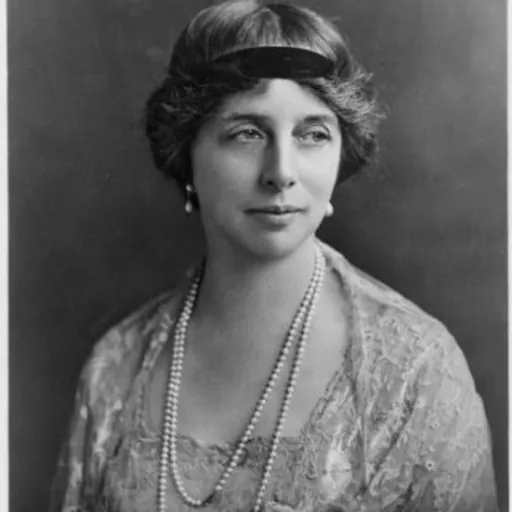
Katharine Stewart-Murray, Duchess of Atholl
British politician
About Katharine Stewart-Murray, Duchess of Atholl
Lived 1874 – 1960 (aged 85). Katharine Stewart-Murray, Duchess of Atholl was a British politician, aristocrat and civil servant.
Katharine Marjory Stewart-Murray, Duchess of Atholl, DBE (née Ramsay; 6 November 1874 – 21 October 1960), known as the Marchioness of Tullibardine from 1899 to 1917, was a Scottish noblewoman and Scottish Unionist Party politician. She was the first woman to be elected as a Member of Parliament (MP) in Scotland, despite having campaigned against women's suffrage before it was granted in 1918. She was the first woman to serve in a British Conservative government. She later found herself at odds with her party and resigned the Whip in 1935 over the India Bill. She became strongly anti-fascist in the 1930s and criticised authoritarian regimes in Soviet Russia, Italy and Spain as well as Nazi Germany. She was given the nickname 'Red Duchess' for these views.
Political career Stewart-Murray was active in Scottish social service and local government and in 1912 served on the hugely influential "Highlands and Islands Medical Service Committee" (authors of the Dewar Report) that has been widely credited with creating the forerunner of the National Health Service. She was the chairman of the Consultative Council on Highlands and Islands.
Anti-suffrage As the Marchioness of Tullibardine she was an opponent of female suffrage, with Leah Leneman describing her as 'a key speaker at the most important Scottish anti-suffrage demonstration', which took place in 1912. In 1913 she became vice-president of the branch of the Anti-Suffrage League based in Dundee.
Political career Despite this opposition to women gaining the right to vote in parliamentary elections, Stewart-Murray went on to be the Scottish Unionist Member of Parliament (MP) for Kinross and West Perthshire from 1923 to 1938, and served as Parliamentary Secretary to the Board of Education from 1924 to 1929, the first woman other than a mistress of the robes to serve in a British Conservative government. She was the first woman elected to represent a Scottish seat at Westminster.
It has been argued that, like other early female MPs in the UK, Stewart-Murray "inherited" her seat from her husband. However, her husband had stood down from the former West Perthshire seat in 1917, when he succeeded to the dukedom, and it had then been won by a Liberal candidate in both 1918 and 1922. Her victory in 1923 was not seen as "a foregone conclusion". Stewart-Murray often placed her political allegiance ahead of gender unity, and campaigned for the male Unionist candidate in Edinburgh South at the 1922 general election against the Liberal Catherine Buchanan Alderton, though Labour and Liberal women had refused to campaign against Lady Astor in Plymouth.
Anti-fascism Stewart-Murray argued that she actively opposed totalitarian regimes and practices. In 1931, she published The Conscription of a People—a protest against the abuse of human rights in the Soviet Union. After reading the German edition of Mein Kampf she also condemned Nazi Germany. In 1936, she was involved in a long-running battle in the pages of various newspapers with Lady Houston after the latter had become notorious for her outspoken support of Benito Mussolini. Stewart-Murray had taken issue with Houston calling in the pages of the Saturday Review for Edward VIII to become a dictator in imitation of European interwar dictatorships.
In February 1937 three leading British women made a tour of Romania, Czechoslavakia and Yugoslavia. They were Dorothy Layton, Eleanor Rathbone and the Duchess of Atholl. They observed the conditions and they were received by Deputy Františka Zeminová in Prague. Zeminová used the occasion to laud the support of Britain. Atholl recalls that it was at the prompting of Ellen Wilkinson that in April 1937 she, Rathbone, and Wilkinson went to Spain to observe the effects of the Spanish Civil War. In Valencia, Barcelona and Madrid she saw the impact of Luftwaffe bombing on behalf of the Nationalists, visited prisoners of war held by the Republicans and considered the impact of the conflict on women and children, in particular.
Her book Searchlight on Spain resulted from the involvement, and sold more than 100,000 copies in its first week of publication. Her support for the Republican side in the conflict led to her being nicknamed by some the Red Duchess. She became active in the National Joint Committee for Spanish Relief, a cross-party group coordinating aid to Spain. She later served as the group's chairwoman. She was instrumental in persuading the British government to accept child refugees fleeing the combat, 4,000 of which arrived on the SS Habana which sailed from Bilbao to Southampton in May 1937.
Her role in the Spanish Civil War, however, was years later criticized by George Orwell, who saw the Duchess as the "pet of the Daily Worker", and someone who "lent the considerable weight of her authority to every lie the Communists happened to be uttering at the moment. Now she is fighting against the monster that she helped create. I am sure that neither she nor her Communist ex-friends see any moral in this."
Shortly before or even during 1938, she travelled to Romania where she visited Satu Mare Romanian Women Association in the city of Satu Mare, aiming to support the Romanian cause to preserve the state borders established in 1918, and to keep Hungary from regaining the territory that it lost in the Treaty of Trianon. She campaigned against the Soviet control of Poland, Czechoslovakia and Hungary as the chairman of the League for European Freedom in Britain from 1945.
Other work Stewart-Murray was a keen composer, setting music to accompany the poetry of Robert Louis Stevenson.
Honours She was appointed Dame Commander of the Order of the British Empire (DBE) in the 1918 Birthday Honours for her wartime service. until she relinquished it in 1952.
Death Katharine, Duchess of Atholl, died in a nursing home in Edinburgh, aged 85, on 21 October 1960. She is buried in the grounds of Blair Castle.
Publications (2 Volumes)
1st, 2nd & 3rd editions
Don’t just read it —
keep it.
Full-length biographies made to live with: read them, listen on the way to work, watch them tonight.
- E-book
- Audio
- Video
Instant download · yours to keep · every purchase keeps this site free
Important facts
Family & relationships
People in Katharine Stewart-Murray, Duchess of Atholl's life
Named in this biography and alive at the same time


Related people
Same field, nearest in time


Contemporaries
People whose lives overlapped Katharine Stewart-Murray, Duchess of Atholl's
Frequently asked questions
Who was Katharine Stewart-Murray, Duchess of Atholl?
British politician (1874-1960)
When was Katharine Stewart-Murray, Duchess of Atholl born?
Katharine Stewart-Murray, Duchess of Atholl was born on 6 November 1874 in Edinburgh.
When did Katharine Stewart-Murray, Duchess of Atholl die?
Katharine Stewart-Murray, Duchess of Atholl died on 21 October 1960 in Edinburgh.
What was Katharine Stewart-Murray, Duchess of Atholl's occupation?
Katharine Stewart-Murray, Duchess of Atholl was a politician, aristocrat and civil servant.
What nationality was Katharine Stewart-Murray, Duchess of Atholl?
Katharine Stewart-Murray, Duchess of Atholl was British.
Sources & further reading
· Wikipedia: Katharine Stewart-Murray, Duchess of Atholl
· DBpedia: Katharine Stewart-Murray, Duchess of Atholl
Cite this page
APA: Biography.guide. (2026). Katharine Stewart-Murray, Duchess of Atholl. https://biography.guide/katharine-stewart-murray-duchess-of-atholl/
MLA: "Katharine Stewart-Murray, Duchess of Atholl." Biography.guide, https://biography.guide/katharine-stewart-murray-duchess-of-atholl/.
Chicago: "Katharine Stewart-Murray, Duchess of Atholl." Biography.guide. https://biography.guide/katharine-stewart-murray-duchess-of-atholl/.
Data last updated: 2026-10-01 · Spot an error? Report a correction.
Portrait: Wikimedia Commons · author & licence
Page generated 2026-10-05 03:01 UTC