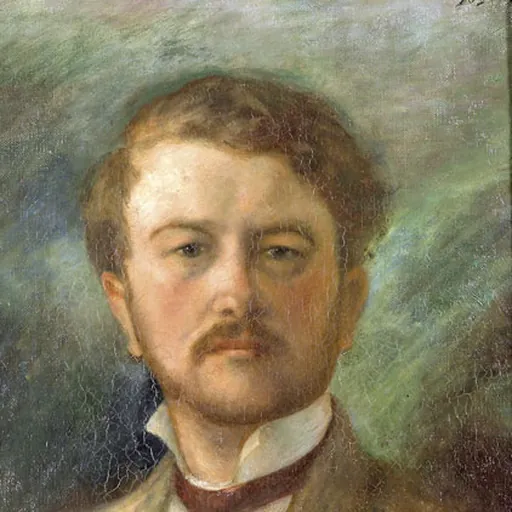
About Károly Kernstok
Lived 1873 – 1940 (aged 66). Károly Kernstok was a Hungarian painter and draftsperson.
Károly Kernstok (23 December 1873, in Budapest – 9 June 1940, in Budapest) was a Hungarian painter. In the early twentieth century, he was known for being among the leading groups of Hungarian painters known as the "Neos" and The Eight (1909–1918), before the First World War. He was particularly influenced by the work of Henri Matisse, as may be seen in his monumental painting Riders at the Waterside.
Kernstok studied in Munich and Paris, and practiced as an artist mostly in Budapest. After the fall of the Hungarian Soviet Republic in 1919, he emigrated to Berlin. He lived and worked there until 1926. His work is collected in the Hungarian National Gallery, among other institutions. With the centenary of The Eight's first exhibit under that name, commemorative exhibits have been mounted in Hungary and Austria in 2011 and 2012.
Early life and education Károly Kernstok was born in 1873 in Budapest, where he lived most of his life. Attracted to art, at age 19 he went to Munich, Germany in 1892, where he studied with Simon Hollósy. From 1893 to 1896, he studied at the Académie Julian in Paris. At the time, Budapest did not have an academy of fine art.
Career After returning to Hungary in 1897, Kernstok painted the Agitátor, a picture with socialist implications. Later he painted scenes of peasant life, often in bold and glowing colours related to the Fauvist movement in France.
In 1905 he settled in Nyergesújfalu, where he had inherited an estate. He was considered a leader of the "Neos", a group of artists with radical artistic views, working against the naturalism of the Nagybánya artists' colony. Fellow "Neo" artists included Béla Czóbel, Béla Iványi-Grünwald, Vilmos Perlrott-Csaba, Lajos Tihanyi and Sándor Ziffer. Some had studied briefly at Nagybánya, but they were influenced by the French painters, particularly Paul Cézanne and Henri Matisse.
The Eight embraced the radical intellectual movements in the early 20th century, which was reflected in Budapest in both literature and music. They worked with such writers and composers included Endre Ady and Béla Bartók. The Eight's style was quite complex. They worked with the rationalism of cubists, the decorative use of strong color as seen in the Fauves, and the emotional depth of German Expressionism. Kernstok's "monumental painting," Riders at the Waterside (1910) shows the influence of Matisse. Bertalan Pór's Family (1909) represented another aspect of the group's work. After the fall of the Soviet Republic in early August 1919, Kernstok was briefly arrested by the new Horthy regime and subsequently forced to leave the country.
In the last period of his life, Kernstok became interested in Etruscan painting, and completed The Rape of St. Helen (1933) and Burial (1934). He may also have seen works by the painter Pablo Picasso, who was also exploring Etruscan and classical monumentalism. Kernstok's graphic works, together with his copper engravings, are also considered significant. 2012, The Eight. Hungary's Highway in the Modern (Die Acht. Ungarns Highway in die Moderne), 12 September 2012 - 2 December 2012, Bank Austria Kunstforum, Vienna, collaboration with Museum of Fine Arts and Magyar Nemzeti Galéria, Budapest.
Don’t just read it —
keep it.
Full-length biographies made to live with: read them, listen on the way to work, watch them tonight.
- E-book
- Audio
- Video
Instant download · yours to keep · every purchase keeps this site free
Important facts
People in Károly Kernstok's life
Named in this biography and alive at the same time



Related people
Same field, nearest in time

Contemporaries
People whose lives overlapped Károly Kernstok's


Frequently asked questions
Who was Károly Kernstok?
Hungarian artist (1873–1940)
When was Károly Kernstok born?
Károly Kernstok was born on 23 December 1873 in Budapest.
When did Károly Kernstok die?
Károly Kernstok died on 9 June 1940 in Budapest.
What was Károly Kernstok's occupation?
Károly Kernstok was a painter and draftsperson.
What nationality was Károly Kernstok?
Károly Kernstok was Hungarian.
Sources & further reading
Cite this page
APA: Biography.guide. (2026). Károly Kernstok. https://biography.guide/karoly-kernstok/
MLA: "Károly Kernstok." Biography.guide, https://biography.guide/karoly-kernstok/.
Chicago: "Károly Kernstok." Biography.guide. https://biography.guide/karoly-kernstok/.
Data last updated: 2026-09-22 · Spot an error? Report a correction.
Portrait: Wikimedia Commons · author & licence
Page generated 2026-09-27 05:04 UTC