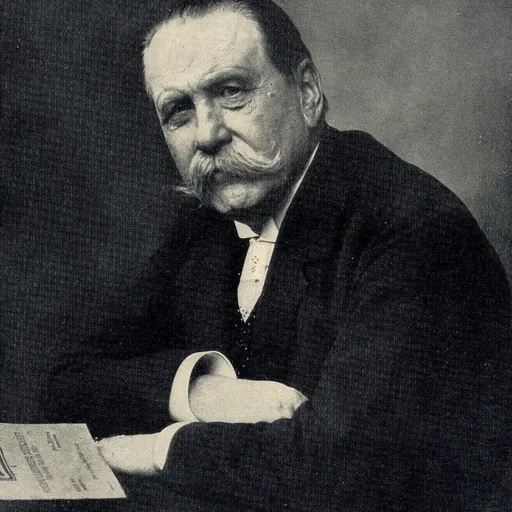
About Karl von Wedel
Lived 1842 – 1919 (aged 77). Karl von Wedel was a German politician.
Karl, Prince of Wedel (; 5 February 1842 – 30 December 1919), born Karl Leo Julius Graf von Wedel, was a Prussian general and diplomat who served as the fourth Imperial Lieutenant of the Reichsland of Alsace–Lorraine from 27 October 1907 until his resignation on 18 April 1914.
Formerly a soldier in the Hanoverian Army, Wedel entered the service of the Prussian Army after Hanover's defeat in the Austro-Prussian War, subsequently rising through the ranks. In addition to his military roles, he also served in various governmental posts before eventually succeeding Prince Hermann zu Hohenlohe-Langenburg as Reichsstatthalter. Wedel inherited from his predecessor a province troubled by conflict between French and German nationalists and the question of its place in the empire, though his open-minded disposition did much to ingratiate himself towards the Alsatians. It was under his auspices that the Constitution of 1911—which granted semi-statehood to Alsace–Lorraine—was enacted.
Wedel was forced to resign following the Zabern Affair, the incident severely damaging relations between Alsace–Lorraine and the rest of the German states, as well as tarnishing the reputation of the Kaiser and, by extension, Prussian militarism. He continued to carry out his diplomatic duties until Germany's defeat in the First World War and the November Revolution, after which he retired with his wife to Stora Sundby Castle in Sweden, where he died the following year. He is remembered as a liberal ruler and conciliator in the same vein as Edwin von Manteuffel and Prince Chlodwig zu Hohenlohe-Schillingsfürst.
Family Born into the ancient Holsteinian noble House of Wedel, he was the youngest child and son of (1798–1872), a lieutenant general in the Oldenburg army who was head of the Department of Military Affairs and chief of staff to Grand Duke Peter II, and his wife Baroness Wilhelmine Bertha Sophie von Glaubitz (1802–1887). His father's family had branches in Denmark and Norway; among his relatives were Wilhelm von Wedell-Piesdorf, Baroness Charlotte Wedell-Wedellsborg, and Baron Fritz Wedel-Jarlsberg.
In 1894, Wedel married in Stockholm the prominent Countess Stephanie Augusta von Platen, née Hamilton af Hageby (1852–1937), a member of the Swedish branch of the Scottish Clan Hamilton; the marriage was childless. Stephanie was widely-known for her accommodating and empathic nature, as well as her contributions to charity and animal welfare; for this she was included among Europe's "grand dames". During the Austro-Prussian War, Hanover fought on the side of Austria; Wedel took part in the Battle of Langensalza, for which he was awarded the Langensalza Medal by King George V. After Prussia's victory and its annexation of Hanover, which resulted in the absorption of the Hanoverian Army into its armed forces, Wedel was commissioned as an officer for a second time by patent in the service of Prussia in November 1866. He joined the 8th (1st Westphalian) Hussars Regiment, (Some sources erroneously list it as the 2nd Guards Uhlans Regiment.) This was met with mixed reactions, with Holstein opposing the decision on the grounds of Wedel being a supporter of home rule, which he felt would undermine Berlin's influence. Holstein was also doubtful of Wedel's reliability, citing his past as a Hanoverian soldier. Others, namely Imperial Chancellor Prince Bernhard von Bülow, supported the move, as he favored Wedel's more restrained foreign policy in contrast to that of pro-French diplomats such as Prince Hatzfeldt and Radowitz. In a letter to Holstein, Bülow stated that:
Despite his loyalty to Berlin and his concerns over pro-French sentiment in the province, Wedel was sympathetic towards the Alsatians. "The people of this Land have, as do other German tribes", he declared, "the right to maintain their own special character." This, along with his moderate governance, won him the respect of even the French-speaking populace. His wife, Countess Stephanie, was just as popular, with the Alsatians even coming to regard her as a national mother-figure. Wedel himself stepped down on 18 April of that year; initially, the Kaiser suggested one of his sons as his successor, though nothing came of it. He eventually appointed Johann von Dallwitz, whose authoritarian policies and rejection of the constitution would only serve to further alienate the Alsatians. On the day of his resignation, Wedel was elevated by the Kaiser to the status of Prince (Fürst). For a time, the German government considered sending Wedel on a diplomatic mission to Stockholm, due to his good relations with Sweden from his time as envoy and through his wife. Though that plan never came to pass, Prince Wedel would move there upon his full retirement.
Titles, honours and awards Granted the title of Prince, 18 April 1914
German orders and decorations
Foreign orders and decorations
Military appointments À la suite of the 2nd Guards Uhlan Regiment, 25 January 1899
Don’t just read it —
keep it.
Full-length biographies made to live with: read them, listen on the way to work, watch them tonight.
- E-book
- Audio
- Video
Instant download · yours to keep · every purchase keeps this site free
Important facts
People in Karl von Wedel's life
Named in this biography and alive at the same time

Related people
Same field, nearest in time





Contemporaries
People whose lives overlapped Karl von Wedel's

Frequently asked questions
Who was Karl von Wedel?
German politician (1842-1919)
When was Karl von Wedel born?
Karl von Wedel was born on 5 February 1842 in Oldenburg.
When did Karl von Wedel die?
Karl von Wedel died on 30 December 1919 in Stockholm.
What was Karl von Wedel's occupation?
Karl von Wedel was a politician.
What nationality was Karl von Wedel?
Karl von Wedel was German.
Sources & further reading
Cite this page
APA: Biography.guide. (2026). Karl von Wedel. https://biography.guide/karl-von-wedel/
MLA: "Karl von Wedel." Biography.guide, https://biography.guide/karl-von-wedel/.
Chicago: "Karl von Wedel." Biography.guide. https://biography.guide/karl-von-wedel/.
Data last updated: 2026-09-22 · Spot an error? Report a correction.
Portrait: Wikimedia Commons · author & licence
Page generated 2026-09-27 05:02 UTC