
Karl Rammelt
German fighter ace and Knight's Cross recipient
About Karl Rammelt
Lived 1914 – 2009 (aged 94). Karl Rammelt was a German.
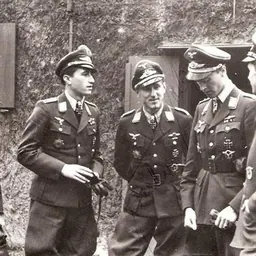
Karl Rammelt (10 June 1914 – 13 May 2009) was a German Luftwaffe ace and recipient of the Knight's Cross of the Iron Cross during World War II. The Knight's Cross of the Iron Cross, and its variants were the highest awards in the military and paramilitary forces of Nazi Germany during World War II. Rammelt was credited with 46 aerial victories in 450 combat missions.
Early life and career Rammelt was born on 10 June 1914 in Nebra, then in the Province of Saxony within the German Empire. He joined the military service of the Luftwaffe in 1934, serving on the technical ground staff until 1940. Following flight fighter pilot training, Rammelt was posted to II. Gruppe of Jagdgeschwader 51 (JG 51—51st Fighter Wing) in May 1942.
World War II World War II in Europe had begun on Friday 1 September 1939 when German forces invaded Poland. In May 1942, II. Gruppe was commanded by Hauptmann Hartmann Grasser and based at Bryansk but periodically also operated from airfields at Oryol and Dugino on the Eastern Front. On 2 July, the 9th Army launched Operation Seydlitz as part of the Battles of Rzhev. Defending against this operation, the Soviet Air Forces (VVS—Voyenno-Vozdushnye Sily) attacked the Luftwaffe airfield at Bryansk on 5 July. II. Gruppe of JG 51 was scrambled and claimed 46 Soviet aircraft shot down for the loss of two Bf 109s damaged. That day, Rammelt claimed five aerial victories, two Petlyakov Pe-2 bombers and three Ilyushin Il-2 ground-attack aircraft, making him an "ace-in-a-day". On 3 September 1942, Rammelt's Messerschmitt Bf 109 F-2 (Werknummer 12808–factory number) ran out of fuel, resulting in an emergency landing at Dugino.
North Africa II. Gruppe had been withdrawn from the Eastern Front in early October 1942 and sent to Jesau in East Prussia, present day Yushny, Bagrationovsky District, for conversion to the Focke-Wulf Fw 190. Conversion training began on 7 October and on 4 November, the unit received the order to convert back to the Bf 109 and to transfer to the Mediterranean theatre. Via various stopovers, II. Gruppe moved to Sidi Ahmed airfield, arriving on 14 November. There, the unit was subordinated to Fliegerführer Tunis (Flying Leader Tunis). On 27 November, Rammelt claimed his first aerial victory in North Africa. The Gruppe had encountered squadrons of the Royal Air Force (RAF) No. 324 Wing from Souk-el-Arba Airfield. In the encounter, Rammelt claimed a Supermarine Spitfire fighter shot down southwest of Béja.
On 4 February 1943, the United States Army Air Forces (USAAF) 97th Bombardment Group sent 18 Boeing B-17 Flying Fortress bombers against an airfield west of Gabès. Defending against this attack, Rammelt claimed one of the B-17 bombers shot down, which was not confirmed. On 17 March, Rammelt was appointed Staffelkapitän (squadron leader) of 4. Staffel of JG 51, succeeding Oberleutnant Georg Seelmann. On 18 April, II. Gruppe received orders to exchange their newer Bf 109 G-4 and G-6 aircraft with older Bf 109 G-2 trop aircraft of Jagdgeschwader 77 (JG 77—77th Fighter Wing) and retreat from Africa to Bari, Italy. On 20 March, II. Gruppe engaged in combat with fighters of the USAAF 31st Fighter Group. In this engagement, Rammelt claimed a Curtiss P-40 Warhawk fighter shot down northwest of Maknassy. On 29 March, he claimed another P-40 fighter shot down in an area northeast of Skhira.
On 7 June, Rammelt was appointed Gruppenkommandeur (group commander) of II. Gruppe of JG 51. Rammelt had unofficially led the Gruppe since his predecessor, Hauptmann Hartmann Grasser, had left in April. In consequence, command of 4. Staffel was given to Oberleutnant Horst Walther.
Defense of the Reich On 18 August, II. Gruppe relocated to Neubiberg Airfield near Munich for combat in defense of the Reich mission where they received factory new Bf 109 G-6 aircraft. On 28 December, Rammelt claimed a Consolidated B-24 Liberator bomber of the USAAF Fifteenth Air Force shot down south of Padua. Hit by the defensive fire, he was then wounded when he bailed out of his Bf 109 G-6 (Werknummer 160717) south of Rovigo. During his convalescence until March 1944, Rammelt was replaced by Hauptmann Günther Rübell. On 24 October 1944, Rammelt was awarded the Knight's Cross of the Iron Cross for 40 aerial victories claimed. On 23 December, Rammelt was again wounded when he bailed out of his Bf 109 G-14 (Werknummer 780887) in a location north of Esztergom. Due to his injuries sustained, command of II. Gruppe was passed to Oberleutnant Otto Schultz.
Later life Following World War II, Rammelt applied for service in the West German Air Force, at the time referred to as the Bundesluftwaffe of the Bundeswehr. On 1 June 1956, he was appointed the first commander of a training squadron of Flugzeugführerschule "S" (FFS "S"—Pilot Training School) based at Memmingen Air Base. On 1 June 1958, Rammelt was succeeded by Oberstleutnant Wilhelm Batz In July 1965, Rammelt served in the Hubschrauber -Lehr, Versuchs- und Transportstaffel (HLVsuTrspStff—Helicopter Demonstration, Trial and Transport Squadron) at Fürstenfeldbruck Air Base. There he formulated his ideas for the creation of heavy helicopter transportation squadrons. Although preparations for the creation of Helicopter Transport Wing 64 were already in progress, Rammelt believed in decentralizing helicopter units, resulting in a less effective leadership of such units. Rammelt retired on 30 September 1969 holding the rank of Oberstleutnant. He died on 13 May 2009 at the age of in Fürstenfeldbruck, Germany.
Summary of career Aerial victory claims According to Obermaier, Rammelt was credited with 46 aerial victories victories claimed in 450 combat missions, among them many ground support missions. This figure includes 20 claims on the Eastern Front and 26 over the Western Allies, including 11 four-engine heavy bombers. Further 12 claims on the Eastern Front and two B-17 bombers on the Western Front were not confirmed. Aders and Held also list him with 46 aerial victories of which 27 were claimed over the Western Allies. Matthews and Foreman, authors of Luftwaffe Aces — Biographies and Victory Claims, researched the German Federal Archives and found records for 41 aerial victory claims, plus 16 further unconfirmed claims. Of his 41 confirmed aerial victories, 19 were claimed on the Eastern Front and 22 on the Western Front, including eight heavy bombers.
Victory claims were logged to a map-reference (PQ = Planquadrat), for example "PQ 04 Ost 90761". The Luftwaffe grid map covered all of Europe, western Russia and North Africa and was composed of rectangles measuring 15 minutes of latitude by 30 minutes of longitude, an area of about . These sectors were then subdivided into 36 smaller units to give a location area in size.
Chronicle of aerial victories Claim Date Time Type Location Claim Date Time Type Location – 4. Staffel of Jagdgeschwader 51 "Mölders" –Eastern Front — 1 May – 4 October 1942 1 12 June 1942 17:45 Yak-1 southwest of Bolkhov 8 August 1942 16:15 MiG-1 west of Chask 26 June 1942 10:40 Yak-1 east of Oryol 8 10 August 1942 17:05 Pe-2 north of Rzhev 2♠ 5 July 1942 05:00 Pe-2 southwest of Belyov 9 13 August 1942 18:05 Yak-1 southwest of Belyov 3♠ 5 July 1942 05:05 Pe-2 northwest of Belyov 21 August 1942 11:20 LaGG-3 north of Belyov 4♠ 5 July 1942 05:20 Il-2 northeast of Bolkhov 10 23 August 1942 06:43 Il-2 northeast of Uljanowo 5 July 1942 05:22? Il-2 northeast of Bolkhov 23 August 1942 06:55 Il-2 northeast of Uljanowo 5♠ 5 July 1942 09:30 Il-2 northwest of Bolkhov 25 August 1942 06:35 Pe-2 west of Zhizdra 6♠ 5 July 1942 14:06 Yak-1 southeast of Bolkhov 11 27 August 1942 17:54? Il-2 northeast of Oryol 7 6 July 1942 06:30 Il-2 southeast of Zhizdra 12 28 August 1942 13:57? Il-2 northwest of Belyov southeast of Rzhev 10 July 1942 17:05 Pe-2 4 September 1942 11:40 P-39 northwest of Zhizdra 4 August 1942 11:00 LaGG-3 northeast of Rzhev 13 8 September 1942 09:00 Pe-2 northeast of Belyov 4 August 1942 12:05 LaGG-3 north of Rzhev 14 14 September 1942 17:05? Pe-2 southeast of Rzhev 5 August 1942 16:55 Il-2 northeast of Rzhev 27 September 1942 07:45 MiG-3 northwest of Rzhev 5 August 1942 17:15 Il-2 east of Dugino – 4. Staffel of Jagdgeschwader 51 "Mölders" –Mediterranean Theater, North Africa — 5 November – 31 December 1942 15 27 November 1942 09:18 Spitfire southwest of Béja 17 28 November 1942 15:42 Spitfire southwest of Bizerte 16 28 November 1942 15:35 Spitfire southwest of Bizerte southeast of Gabès – 4. Staffel of Jagdgeschwader 51 "Mölders" –Mediterranean Theater, North Africa — 1 January – 11 April 1943 4 February 1942 14:30 B-17 southwest of Gabès 20 29 March 1943 18:45 P-40 northeast of Skhira 18 20 March 1943 18:05 P-40 northwest of Maknassy 21? 31 March 1943 19:00 P-40 south of El Ayacha 19 21 March 1943 13:06 Spitfire southeast of Gabès 22 5 April 1943 14:48 P-40 southwest of Hajeb El Ayoun 21 March 1943 16:30 B-17 southwest of Gabès 6 April 1943 B-17 La Sebala Airfield – 4. Staffel of Jagdgeschwader 51 "Mölders" –Mediterranean Theater, Sardinia and Sicily — May – July 1943 13 May 1943 14:05 B-17 south of the southern edge of Sardinia 25 5 June 1943 15:16 P-38 PQ 04 Ost 90761 23 19 May 1943 13:33 Spitfire PQ 04 Ost 8037PQ 8637 26 18 June 1943 11:22 B-26 PQ 04 Ost 7087 24 31 May 1943 12:57 P-38 PQ 04 Ost 8044 – Stab II. Gruppe of Jagdgeschwader 51 "Mölders" –Defense of the Reich — 15 August – 3 December 1943 27 14 October 1943 14:22 B-17 north-northeast of Frankfurt 28 2 November 1943 13:35 B-17 south-southwest of Wiener Neustadtnortheast of Graz – Stab II. Gruppe of Jagdgeschwader 51 "Mölders" –Mediterranean Theater, Northern Italy — December 1943 29 25 December 1943 11:20 P-38 Villa Estense 30 28 December 1943 11:52 B-24 southwest of Padua – Stab II. Gruppe of Jagdgeschwader 51 "Mölders" –Mediterranean Theater and in the Southeast — April – 31 August 1944 31 5 April 1944 14:18? B-24 northeast of Craiova 34? 24 June 1944 08:42 B-24 PQ 24 Ost GJ-5, northwest of Sofia 32 15 April 1944 12:30 P-38 PQ 24 Ost AN-AO 24 June 1944 11:08 B-24 Radomir 33 5 May 1944 15:30 P-38 PQ 24 Ost CB-3Raška 35 15 July 1944 13:10 B-24 PQ 24 Ost CB-3, west of NišStalati – Stab II. Gruppe of Jagdgeschwader 51 "Mölders" –Southeast of the Eastern Front — 1 September – 23 December 1944 36 13 October 1944 16:01 Il-2 PQ 24 Ost GD-4, south of Debrecen 40 21 December 1944 11:35 Yak-9 PQ 14 Ost ES-3/3, northeast of Esztergom 37 6 December 1944 11:35 B-24 PQ 14 Ost EQ-4, north of Győr 41 21 December 1944 14:40 Il-2 PQ 14 Ost DW-6/1, northeast of Esztergom 38 8 December 1944 13:55 Boston PQ 14 Ost ET-9/9, northeast of Budapest 21 December 1944 B-24 39 8 December 1944 14:10 La-5 PQ 14 Ost FT-3/4, northeast of Budapest
Awards Iron Cross (1939) 2nd and 1st Class Honor Goblet of the Luftwaffe on 25 June 1943 as Oberleutnant and pilot German Cross in Gold on 16 January 1944 as Hauptmann in the II./Jagdgeschwader 51 Knight's Cross of the Iron Cross on 20 October 1944 as Major and Gruppenkommandeur of the II./Jagdgeschwader 51 "Mölders"
Don’t just read it —
keep it.
Full-length biographies made to live with: read them, listen on the way to work, watch them tonight.
- E-book
- Audio
- Video
Instant download · yours to keep · every purchase keeps this site free
Important facts
People in Karl Rammelt's life
Named in this biography and alive at the same time



Contemporaries
People whose lives overlapped Karl Rammelt's




Frequently asked questions
Who was Karl Rammelt?
German fighter ace and Knight's Cross recipient (1914-2009)
When was Karl Rammelt born?
Karl Rammelt was born on 10 June 1914 in Nebra.
When did Karl Rammelt die?
Karl Rammelt died on 13 May 2009 in Germany.
What nationality was Karl Rammelt?
Karl Rammelt was German.
Sources & further reading
Cite this page
APA: Biography.guide. (2026). Karl Rammelt. https://biography.guide/karl-rammelt/
MLA: "Karl Rammelt." Biography.guide, https://biography.guide/karl-rammelt/.
Chicago: "Karl Rammelt." Biography.guide. https://biography.guide/karl-rammelt/.
Data last updated: 2026-09-20 · Spot an error? Report a correction.
Page generated 2026-09-27 05:28 UTC