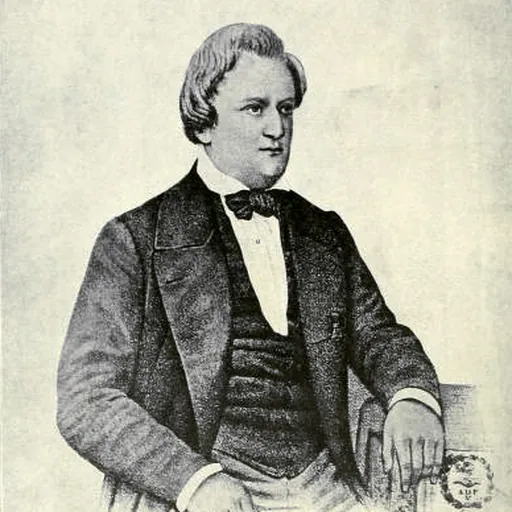
About Karl Marlo
Lived 1810 – 1865 (aged 54). Karl Marlo was a German economist and university teacher.
Karl Marlo, pseudonym of Karl Georg Winkelblech (11 April 1810 – 10 January 1865), was a German professor, scientist, chemist, and state socialist.
Life Marlo was born in Ensheim near Mainz. After finishing his studies in natural sciences and chemistry in Giessen, he became a private tutor in Marburg and, from 1839, a Professor of Chemistry at the Higher Trade School at Kassel, Hesse. He became deeply involved in the fate of the working class and became an exponent of socialist ideas. From 1843 on, he spent all his time and all his (considerable) talents to produce just a single book, a comprehensive book in four volumes about social reform, which was left unfinished upon his death in Kassel.
The four volumes, published between 1849 and 1859, were issued under the general title Enquiries concerning the Organisation of Labour, or, System of World Economy (Untersuchungen über die Organisation der Arbeit oder System der Weltökonomie). This work of this quixotic champion of the artisan cause was not widely read. It was not intended to bear immediate consequences. It was published in a period of public apathy, following the failed struggle for constitutional liberty of 1848. This work seemed to have been almost entirely forgotten when the German statesman and economist with socialist tendencies, Albert Schäffle, made favorable mention of this monumental work in his book Kapitalismus und Socialismus (Capitalism and Socialism), published in 1870.
Thought A conversation between Marlo and a German worker in Norway about the privations and insecurities of working-class life stimulated his interests in socialism and led him to study working-class conditions himself. He proposed a comprehensive reform scheme for compulsory social insurance against old age, sickness and financial misfortunes, paid by individual contributions.
Marlo was in line with the criticism of socialists on industrial capitalism, and therefore he rejected liberalism. He also rejected communism because it fails to motivate the individual worker. He tried to find a common ground between the two systems that he called panpolism (the opposition of monopolism). In industrial states, the means of production should be common property, managed and organized by the state, while the produce of the labour of the individual worker should remain private property. He gave every man the right to dispose of his earnings according to his own wishes.
Don’t just read it —
keep it.
Full-length biographies made to live with: read them, listen on the way to work, watch them tonight.
- E-book
- Audio
- Video
Instant download · yours to keep · every purchase keeps this site free
Important facts
People in Karl Marlo's life
Named in this biography and alive at the same time

Related people
Same field, nearest in time



Contemporaries
People whose lives overlapped Karl Marlo's





Frequently asked questions
Who was Karl Marlo?
German economist (1810–1865)
When was Karl Marlo born?
Karl Marlo was born on 11 April 1810 in Ensheim.
When did Karl Marlo die?
Karl Marlo died on 10 January 1865 in Kassel.
What was Karl Marlo's occupation?
Karl Marlo was an economist and university teacher.
What nationality was Karl Marlo?
Karl Marlo was German.
Sources & further reading
Cite this page
APA: Biography.guide. (2026). Karl Marlo. https://biography.guide/karl-marlo/
MLA: "Karl Marlo." Biography.guide, https://biography.guide/karl-marlo/.
Chicago: "Karl Marlo." Biography.guide. https://biography.guide/karl-marlo/.
Data last updated: 2026-09-24 · Spot an error? Report a correction.
Portrait: Wikimedia Commons · author & licence
Page generated 2026-09-27 05:09 UTC