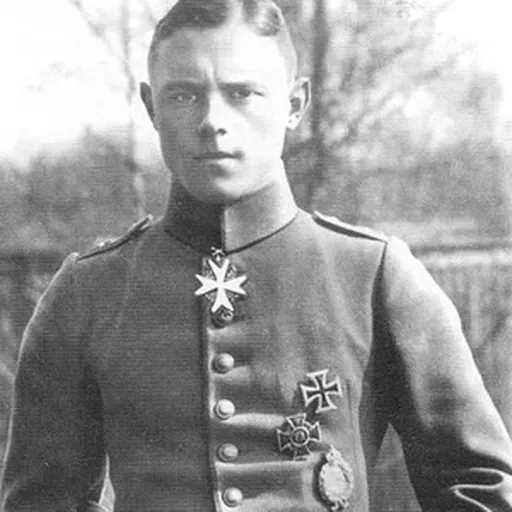
About Karl Allmenröder
Lived 1896 – 1917 (aged 21). Karl Allmenröder was a German fighter pilot and military personnel.
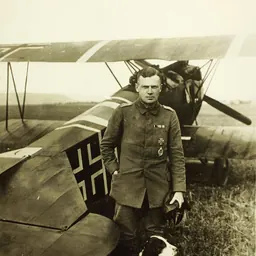
Leutnant Karl Allmenröder (3 May 1896 – 27 June 1917) was a German World War I flying ace credited with 30 aerial victories. The medical student son of a preacher father was seasoned in the trenches as an 18-year-old artilleryman in the early days of the First World War, earning promotion via battlefield commission to Leutnant on 30 March 1915. After transferring to aviation and serving some time as an artillery spotter in two-seater reconnaissance airplanes, he transferred to flying fighter aircraft with Jagdstaffel 11 in November 1916. As Manfred von Richthofen's protege, Karl Allmenröder scored the first of his 30 confirmed victories on 16 February 1917. Flying a scarlet Albatros D.III trimmed out with white nose and elevators, Allmenröder would score a constant string of aerial victories until 26 June 1917, the day before his death. On 27 June 1917, Karl Allmenröder was shot down near Zillebeke, Belgium. His posthumous legacy of patriotic courage would later be abused as propaganda by the Nazis.
Early life and ground service
Karl Allmenröder was born in Wald, Rhine Province, on 3 May 1896, the son of a Lutheran minister. He was interested in the practice of medicine and was a medical student in Marburg. His reputation became one of a quiet, amiable, and dutiful young man.
Allmenröder was only 18 when the war began. He became an artilleryman, joining Field Artillery Regiment 62 for training, and being transferred to Field Artillery Regiment 20 for duty. In January 1915, he returned to Field Artillery Regiment 62. While serving in Poland fighting against the Imperial Russian Army, he was awarded the Iron Cross Second Class in March, 1915. He also was commissioned to leutnant on 30 March 1915. He was awarded the Friedrich-August Cross First Class in August 1915. Karl Allmenröder was sent for training at Halberstadt. He flew two-seaters as an artillery spotter in Flieger-Abteilung (Artillerie) [Flier Detachment (Artillery)] 227 before joining Jagdstaffel 11 in November 1916. The Red Baron often chose Allmenröder as a wingman.
Karl Allmenröder's Albatros D.III fighter was painted red and white.
Allmenröder claimed his first victim, a BE.2c from No. 16 Squadron RFC at noon on 17 February 1917. He scored four more victories the following month, becoming an ace on 30 March. On 24 March 1917, he was awarded the Iron Cross First Class for his valor. Also, at some point on that day, he was slightly wounded in combat. The wound did not prevent him shooting down New Zealand ace Captain Alan Scott on 28 May 1917.
On 6 June 1917, Allmenröder was awarded the Knight's Cross of the Royal Hohenzollern House Order and, on 14 June, he received the German Empire's most prestigious award, the Prussian Pour le Mérite.
His 29th, and penultimate victory, was scored on 25 June against Canadian ace Flight Lieutenant Gerald Ewart Nash, who became a prisoner of war. Allmenröder had succeeded to permanent command of Jagdstaffel 11 on that day, when von Richthofen had been promoted to command of Germany's first fighter wing, Jagdgeschwader 1, commonly called "The Flying Circus".
Karl Allmenröder was interred at the Evangelical Lutheran Cemetery in Wald.
Legacy
Karl Allmenröder's legacy of valor was later used by the Nazis for propaganda purposes. For this reason, streets named after him have been renamed since the fall of the Third Reich, and Karl Allmenröder goes unhonored in his hometown.
Decorations and awards
Pour le Merite (14 June 1917) Knights Cross of the Royal House Order of Hohenzollern (6 June 1917) Iron Cross, 1st and 2nd class Friedrich August Cross, 1st and 2nd class (Grand Duchy of Oldenburg, 20 July 1917) Military Merit Order (Bavaria) Pilot's Badge German Empire
Footnote
Don’t just read it —
keep it.
Full-length biographies made to live with: read them, listen on the way to work, watch them tonight.
- E-book
- Audio
- Video
Instant download · yours to keep · every purchase keeps this site free
Important facts
People in Karl Allmenröder's life
Named in this biography and alive at the same time



Related people
Same field, nearest in time


Contemporaries
People whose lives overlapped Karl Allmenröder's


Frequently asked questions
Who was Karl Allmenröder?
German World War I flying ace (1896–1917)
When was Karl Allmenröder born?
Karl Allmenröder was born on 3 May 1896 in Solingen.
When did Karl Allmenröder die?
Karl Allmenröder died on 27 June 1917 in Zillebeke.
What was Karl Allmenröder's occupation?
Karl Allmenröder was a fighter pilot and military personnel.
What nationality was Karl Allmenröder?
Karl Allmenröder was German.
Sources & further reading
Cite this page
APA: Biography.guide. (2026). Karl Allmenröder. https://biography.guide/karl-allmenroder/
MLA: "Karl Allmenröder." Biography.guide, https://biography.guide/karl-allmenroder/.
Chicago: "Karl Allmenröder." Biography.guide. https://biography.guide/karl-allmenroder/.
Data last updated: 2026-09-20 · Spot an error? Report a correction.
Page generated 2026-09-27 05:10 UTC