
About Karin Magnussen
Lived 1908 – 1997 (aged 89). Karin Magnussen was a German biologist.
Karin Magnussen (9 February 1908 – 19 February 1997) was a German biologist, teacher and researcher at the Kaiser Wilhelm Institute of Anthropology, Human Heredity, and Eugenics during the Third Reich. She is known for her 1936 publication Race and Population Policy Tools and her studies of heterochromia iridis (different-coloured eyes) using iris specimens, supplied by Josef Mengele, removed from the heads of Auschwitz concentration camp victims.
After receiving her doctorate, she studied at the Zoological Institute of the University of Göttingen in Alfred Kühn. She was first and later second in her state examinations for a high school teaching position; inter alia in biology in 1936. In Hanover, Magnussen was employed as a secondary school teacher. She possibly modeled herself after "...the biologist Agnes Bluhm, who worked at the Kaiser-Wilhelm-Institut fur Biologie and wrote "Die rassenhygienischen Aufgaben des weiblichen Arztes", Berlin, 1934, and who unhesitatingly supported Hitler's regime." In 1935, Magnussen went to work in the Nazi Racial Policy Office in the District of Hanover. A year later, she wrote Race and Population Policy Tools. In Bremen, she lectured on racism and demographics. She was BDM leader in the Gau. In 1935, she was employed in the Gau Hannover in the Racial Politics Office. Her publication of Race and Population Policy Tools appeared in 1936.
In the third published edition of 1943, Magnussen expressed the following:
This war is not just about the preservation of the German people, but is about the question, which races and peoples should live in the future on European soil.... Basically England had no interest in the prosecution of this war, but it is a very different people, working parasitically behind the scenes and which is afraid to lose everything. In all of the enemy States, Judaism has significant influence. And just as Judaism had probably the clearest recognition that in the decisive struggle, the question of them was to be decided. The current war must therefore be also about the repression of the black danger in the West and the elimination of the Bolshevik threat in the East, which still resolves a racial problem in Europe, which all States are more or less interested in: the Jewish question. Also the Jew who enjoys life as a host in our country, is our enemy, even if he does not actively engage with weapons in this fight. …From the European point of view, the Jewish question is resolved in that the emigrant Jews do the thinking for the leaders in the other States. We have seen that these emigrants are only troublesome and set up the peoples against each other.
Kaiser Wilhelm Institute Having received a scholarship, Magnussen was suspended in fall 1941 from her teaching profession and moved to the Kaiser Wilhelm Institute of Anthropology, Human Heredity, and Eugenics (KWI-A), in Berlin-Dahlem. From this time on, she worked in the Department of Experimental Pathology of Heritage under the department head, Hans Nachtsheim. Her research focused on the inheritance of eye color in rabbits and humans. Her particular interest was the Heterochromic iris that she had examined since 1938. Magnussen used the scientific method to lead her to the conclusion that the eye is not only genetically, but also hormonally, determined. While there, she initially undertook studies on rabbit eyes. In July 1943, she was the research assistant of Otmar Freiherr von Verschuer, at the KWI-A.
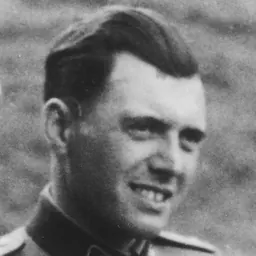
Auschwitz-Birkenau From a colleague, she received the information that more twins and family members with Heterochromic irises would be found in the Sinti people in Mechau from northern Germany. Members of this community were taken in spring 1943 to the KWI-A, where they were photographed. In March 1943, the Sinti were deported to Auschwitz concentration camp, where Mengele would be camp physician from late May 1943. This circumstance allowed Mengele to carry out the experiments (that Magnussen had done on rabbits) on people. Josef Mengele in 1956. Photo taken by a police photographer in Buenos Aires for Mengele's Argentine identification document. According to a statement by Magnussen, Mengele dealt, among other things, with the eyes of the Sinti using hormonal substances. Often, these painful interventions resulted in suppuration of the eyes and blindness of the victims. These experiments aimed at the investigation and eradication of the abnormality in people with Heterochromic Irises. In the event of death of the prisoners, Mengele pledged to Magnussen to give her the eyes of the victims for further research and evaluation. In the second half of 1944, Magnussen received the eyes of the experiment victims from Auschwitz-Birkenau in several deliveries. No fewer than 40 pairs of eyes should have been received by Magnussen from Auschwitz-Birkenau. The Hungarian prisoner pathologist Miklós Nyiszli noted after the autopsy of Sinti twins that they had been killed, not due to illness, but because of a chloroform injection to the heart. Nyiszli had to prepare their eyes and send them to the KWI-A. After the end of the Second World War, she moved to Bremen again and continued her research. Her completed research was published in 1949, being entitled On the relationship between histological distribution of pigment, Iris color and pigmentation of the eyeball of the human eye. She was later denazified in Bremen.
In 1950, Magnussen taught at a girls' high school in Bremen. She worked as study counselor and official, including the teaching of biology. She was considered a popular teacher who led an interesting biology lesson. Her pupils could examine, for example, living and dead rabbits from their breeding. Until 1964, essays in scientific journals were published by her. She retired in August 1970. Even in old age, she justified the Nazi racial ideology. She noted in 1980, in a conversation with the geneticist Benno Müller-Hill, that the Nuremberg Laws were not fair enough. She also denied until her last breath that Mengele would have killed children for their scientific studies. She was entangled by her cooperation with Mengele and the supply of "human material", and mired deep in concentration camp crimes, but she claimed to know nothing about them.
She began a lifelong relationship with her partner Dorothea Michaelsen in 1945. In 1990, Magnussen moved into a nursing home. She died in February 1997 in Bremen.
Don’t just read it —
keep it.
Full-length biographies made to live with: read them, listen on the way to work, watch them tonight.
- E-book
- Audio
- Video
Instant download · yours to keep · every purchase keeps this site free
Important facts
People in Karin Magnussen's life
Named in this biography and alive at the same time





Related people
Same field, nearest in time


Contemporaries
People whose lives overlapped Karin Magnussen's

Frequently asked questions
Who was Karin Magnussen?
Genman Nazi biologist, eugenicist (1908-1997)
When was Karin Magnussen born?
Karin Magnussen was born on 9 February 1908 in Bremen.
When did Karin Magnussen die?
Karin Magnussen died on 19 February 1997 in Bremen.
What was Karin Magnussen's occupation?
Karin Magnussen was a biologist.
What nationality was Karin Magnussen?
Karin Magnussen was German.
Sources & further reading
Cite this page
APA: Biography.guide. (2026). Karin Magnussen. https://biography.guide/karin-magnussen/
MLA: "Karin Magnussen." Biography.guide, https://biography.guide/karin-magnussen/.
Chicago: "Karin Magnussen." Biography.guide. https://biography.guide/karin-magnussen/.
Data last updated: 2026-09-20 · Spot an error? Report a correction.
Page generated 2026-09-27 05:32 UTC