
About Kamo no Mabuchi
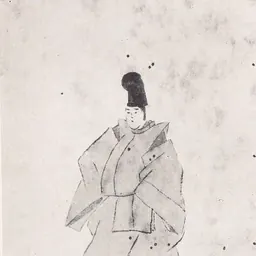
Lived 1697 – 1769 (aged 72). Kamo no Mabuchi was a Japanese linguist, poet, philosopher and writer.
was a kokugaku scholar, poet and philologist during mid-Edo period Japan. Along with Kada no Azumamaro, Motoori Norinaga, and Hirata Atsutane, he was regarded as one of the Four Great Men of Kokugaku, and through his research into the spirit of ancient Japan (through his studies of the Man'yōshū and other works of ancient literature) he expounded on the theory of magokoro, which he held to be fundamental to the history of Japan. Independently of and alongside his contemporary Motoori Norinaga, Mabuchi is accredited with the initial discovery of Lyman's Law, governing rendaku in the Japanese language, though which would later be named after Benjamin Smith Lyman.
Biography Mabuchi was born in 1697 in the village of Iba in Tōtōmi Province (currently part of the city of Hamamatsu, Shizuoka), as the third son of Okabe Masanobu. The Okabe were hereditary kannushi of Kamo Shrine in Kyoto, but his father was from a cadet branch of the clan and was a farmer. In 1707, he began training under Sugiura Kuniakira, a kokugaku scholar with a private academy in Hamamatsu and a disciple of Kada no Azumamaro. Mabuchi married in 1723, but his wife died the following year. At the age of 37, Mabuchi moved to Kyoto to study directly under Kada no Azumamaro. Following the master's death in 1736, Mabuchi moved to Edo in 1738 where he taught kokugaku. In 1746, he was hired by Tokugawa Munetake, the head of the Tayasu branch of the Tokugawa clan. He served in that role until 1760; four years later, in 1764, he settled in Hamachō in the Nihonbashi district of Edo, where he founded the Agatai academy and devoted his final years to writing and to teaching his disciples.
Mabuchi's works include commentaries on the Man'yōshū, norito (Shinto prayers), kagura (Shinto dances), the Tale of Genji, the meaning of poems, and other ancient works and their themes. Chief among these is the Kokuikō ("A Study of the Idea of the Nation"), which most fully expresses his reverence for the unadorned poetic style of the Man'yōshū and his advocacy of a school of thought venerating ancient Japan; his other named works include the Engi shiki noritokai (a commentary on the liturgical prayers of the Engishiki), the Goikō (a treatise on five classical subjects: literature, poetry, nativism, language, and writing), the Man'yōkai, the Kanjikō, the Nihimanabi, and the Noritokō. An explanatory marker stands at the site of Mabuchi's residence in Edo (Hisamatsu-cho, Nihonbashi, Chūō, Tokyo), and a memorial museum was built beside the house where he was born in Hamamatsu.
Don’t just read it —
keep it.
Full-length biographies made to live with: read them, listen on the way to work, watch them tonight.
- E-book
- Audio
- Video
Instant download · yours to keep · every purchase keeps this site free
Important facts
People in Kamo no Mabuchi's life
Named in this biography and alive at the same time


Related people
Same field, nearest in time




Contemporaries
People whose lives overlapped Kamo no Mabuchi's



Frequently asked questions
Who was Kamo no Mabuchi?
Japanese philosopher
When was Kamo no Mabuchi born?
Kamo no Mabuchi was born on 24 April 1697 in Iba.
When did Kamo no Mabuchi die?
Kamo no Mabuchi died on 27 November 1769 in Edo.
What was Kamo no Mabuchi's occupation?
Kamo no Mabuchi was a linguist, poet, philosopher and writer.
What nationality was Kamo no Mabuchi?
Kamo no Mabuchi was Japanese.
Sources & further reading
Cite this page
APA: Biography.guide. (2026). Kamo no Mabuchi. https://biography.guide/kamo-no-mabuchi/
MLA: "Kamo no Mabuchi." Biography.guide, https://biography.guide/kamo-no-mabuchi/.
Chicago: "Kamo no Mabuchi." Biography.guide. https://biography.guide/kamo-no-mabuchi/.
Data last updated: 2026-09-20 · Spot an error? Report a correction.
Page generated 2026-09-27 05:18 UTC