
About K.W. Gullers
Lived 1916 – 1998 (aged 81). K.W. Gullers was a Swedish photographer.
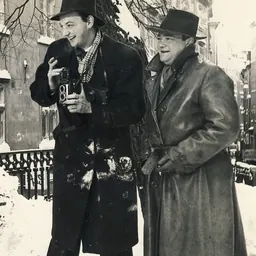
The author Stig Trenter (right) with his fictional character Harry Friberg (the photographer Karl W. Gullers) Karl Werner Edmund Gullers (September 5, 1916 – February 21, 1998), was a Swedish press and commercial photographer, and also the model for Stieg Trenter's crime novel Harry Friberg. Gullers established his photography business in 1938 under the name Studio Gullers and it was active until 1978.
Early years Gullers was one of five children of Emil, a lawyer and farmer's son from Rising, Östergötland (one of the founders of what is now the Swedish Liberal Party) and Anna Charlotta Gullers, a teacher. He grew up in Klara, the most central parish in Stockholm. He was brother of Arvid Gullers, and half-brother of Waldemar Gullers, Maj Amalia Gullers, Sigrid Augusta Järemo and Emil Ragnar Gullers. He frequently borrowed his brother's camera and at the age of twelve his father bought him his own, a Kodak Brownie box camera.
Three years later, in 1932, he began working for Anders Forsner, a leading photographer in Stockholm, who gave him his photographic education. He also photographed after hours, learning to use available light, which he continued to favour even for industrial photography. He was one of the founders of the blixthatarnas förening (‘flash-haters association') for hard-core press photographers. At eighteen years old, he received a scholarship for a trip to England. The trip piqued his interest in photojournalism.
Photography Returning to Sweden, Gullers started working with photographer Jan de Meyere, known for his distinctive high-key portraits, at Kungsgatan 19, the street where Gullers had his studio for twenty years. He also worked as aerial photographer at Aeromateriel AB for three summers producing photographs for the first book depicting Sweden from the air.
In 1938 Gullers started its own company, Studio Gullers at St Eriksgatan in Stockholm which he operated for forty years. He later employed other photographers to assist with its burgeoning business; notably his son Peter Gullers who later became an architectural photographer and also published many books, Bo Trenter (son of his friend Steig), and Georg Sessler and Björn Enström who both worked there for twenty five years. Assisting were Gullers' then wife Ingvor and Magda Persson, a skilled copyist, both recruited from Jan de Meyere's studio. After few years at St. Eriksgatan, Studio Gullers moved into one of the 1906 Kungstorn tower blocks at Kungsgatan 30. Studio Gullers AB Gullers Production Ltd was also a book publisher.
On September 1, 1939, Gullers was enlisted at Västerås in 1940 and later was deployed as a war photographer. There he befriended Stieg Trenter who based his novel Harry Friberg on the photographer. They remained close until Trenters' death in 1967, and the writer's novels were used as the screenplays for a 1987 TV drama series in which the part of Harry Friberg was played by Örjan Ramberg; Träff i helfigur, Lysande landning, and Idag röd. In an accompanying TV Movie documentary Stieg Trenter - Ett porträtt, Gullers appeared as himself.
Immediately after the war Gullers went to the US where he produced work for magazines and some industrial photography. Fascinated with the photo-books that started appearing in the US about that time, and meeting many of the photographers who had produced them, he returned to Stockholm inspired. He found a publisher for a picture-book on Stockholm which came out in 1946. In 1947 Ziff-Davis in Chicago also published one of his earliest books. He started to spend about 200 days of the year travelling the world.
In 1953, Gullers became chairman of Svenska Fotografers Förbund (SFF). Over four years as chairman he worked with, inter alia, Kerstin Bernhard and Karl Sandel on training standards and legal and pricing issues. He was succeeded by Curt Götlin. Gullers was also active in the Nordiska fotografförbundet (‘Nordic Photographic Association’) for fifteen years and was a founding member of Europhot (European Association for the Photographer).
He was included in Postwar European Photography, May 26 to 23 August 23, 1953, at the Museum of Modern Art. Gullers' representation of Swedish poverty, a Karelian grandmother embracing her granddaughter on a low bed, her bare feet resting on worn floorboards as she rocks a baby in a makeshift cradle, was seen by Edward Steichen. He selected it for the 1955 world-touring Museum of Modern Art exhibition The Family of Man seen by 9 million visitors.
From 1957 Gullers became one of the first Stockholm studios with its own Type C colour laboratory, for twelve years producing thousands of photographs a week, and for commissions from major Swedish companies ASEA, Astra, Fiskeby, Volvo, Svenska Metallverken, Stora, Kopparberg, Möln-lycke Väfveriakriebolag, amongst others,
Gullers was the first Swedish photojournalist to have a solo exhibition in Sweden, at the gallery De Unga in Stockholm, following international exhibitions of his work held in London, New York and Chicago, and elsewhere. In 1963, Studio Gullers celebrated its twenty-fifth birthday with a major exhibition at the Ealing Technical College March 19–31, and the book Made in Sweden.
Legacy In 1990, the Nordic Museum purchased Guller's collection of pictures from 1938 to 1978. The collection consists of approximately 470,000 negatives, monochrome and colour, most in 6x6 format. There are also approximately 5,000 archival copies of size 24x30 cm and over 100,000 contact sheets. The collection also includes a negative ledger, a copy of the first editions of sixty-two book titles, press releases and two cameras; his Kodak Brownie and a Rolleiflex. Among subjects of his portraits are Charlie Chaplin (1945), Ingrid Bergman (1945), Ingrid Bergman and Alfred Hitchcock (1946), Gregory Peck (1945), Orson Welles (1952), John Steinbeck (1947), Bruno Mathsson (1951), Duke Ellington (1945), Prince Bertil (1940s), Astrid Lindgren (1952), and Carl XVI Gustaf (1952)
Personal life In 1937 Gullers married Ingvor Margareta Alberts (April 4, 1914 – August 21, 2009). They had a son Peter (b.1938), three daughters Lena Gullers Branderud, Ingela Rudebeck Gullers (1949–1973), and Kristina Gullers (Levander). Gullers later married author Barbara Donnely.
Exhibitions 1946: Jan 20–Feb 3, Sweden: A Workshop of Democracy, American Swedish Historical Museum, solo show of fifty photographs. 1948 solo show, De Unga Gallery, Stockholm 1960 Swedish Industry in Colour during 'Sweden Comes to Britain 1961–62' exposition at the Federation of British Industries headquarters, Tothill Street, London 1963 solo show at Ealing Technical College, London, March 19–31. 1993 KW Gullers: Photo Memories, Mölndal museum 2013: Jan 16–Aug 18 Folkhemmets kändisar ('Celebrity Photographs'), group exhibition from the collection, Nordiska Museet. 2013-2015: images included in travelling group exhibition Folkhemmets room , Nordiska Museet.
Don’t just read it —
keep it.
Full-length biographies made to live with: read them, listen on the way to work, watch them tonight.
- E-book
- Audio
- Video
Instant download · yours to keep · every purchase keeps this site free
Important facts
People in K.W. Gullers's life
Named in this biography and alive at the same time





Related people
Same field, nearest in time





Contemporaries
People whose lives overlapped K.W. Gullers's



Frequently asked questions
Who was K.W. Gullers?
Swedish photographer (1916-1998)
When was K.W. Gullers born?
K.W. Gullers was born on 5 September 1916 in Klara Church Parish.
When did K.W. Gullers die?
K.W. Gullers died on 21 February 1998 in Högalid Parish.
What was K.W. Gullers's occupation?
K.W. Gullers was a photographer.
What nationality was K.W. Gullers?
K.W. Gullers was Swedish.
Sources & further reading
Cite this page
APA: Biography.guide. (2026). K.W. Gullers. https://biography.guide/k-w-gullers/
MLA: "K.W. Gullers." Biography.guide, https://biography.guide/k-w-gullers/.
Chicago: "K.W. Gullers." Biography.guide. https://biography.guide/k-w-gullers/.
Data last updated: 2026-09-25 · Spot an error? Report a correction.
Page generated 2026-09-27 05:13 UTC