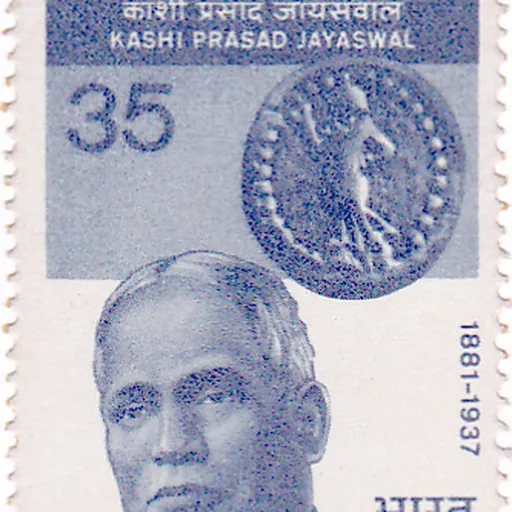
About K.P. Jayaswal
Lived 1881 – 1937 (aged 55). K.P. Jayaswal was an Indian historian.
Kashi Prasad Jayaswal (27 November 1881 – 4 August 1937) was an Indian historian and lawyer. Jayaswal's works Hindu Polity and History of India, 150 A.D. to 350 A.D. (1933) are classics of ancient Indian historical literature. Among other things, he is credited with showing that Indian republics, based on principles of representation and collective decision-making, were among the most democratic polities of the ancient world.
Biography
K. P. Jayaswal was born in Mirzapur, North-Western Provinces (now in Uttar Pradesh), and graduated from Allahabad University. He left India for Britain in 1906 aged 25. "He was permitted to go to England on condition he would not take food touched by anyone there, except hi Brahmin cook who accompanied him and that he remained a vegetarian" (Hindu Polity - Appreciations)> He went on to Jesus College, Oxford University, where he was awarded the Davis Scholarship in Chinese and graduated with a M.A. in Ancient Indian History in 1909. He was called to the Bar of Lincoln's Inn in London in 1910. After returning to India, Jayaswal set up practice at the Calcutta High Court, where he came into contact with Sir Ashutosh Mukherjee, who inspired Jayaswal to undertake further research in ancient Indian history. Jayaswal moved to Patna in 1916, and remained there.
A prolific scholar, Jayaswal wrote more than 120 research papers in addition to 11 books and numerous commentaries and translations. He also played a pioneering role in excavating and restoring ancient sites, including the university of Nalanda in modern Bihar. He was also an expert in numismatics, and his discovery of several coins of the Maurya and Gupta periods led to his being the first Indian to be invited to speak at the Royal Asiatic Society of London in 1931.
He was twice elected president of the Numismatic Society of India, and was awarded the degree of Doctor of Philosophy (Honoris Causa) by Benares Hindu University and Patna University.
Jayaswal was the grandfather of Oxford economist Sanjaya Lall.
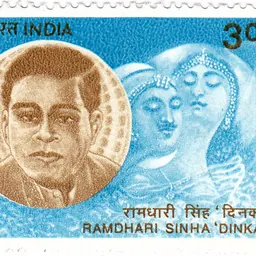
Influence on Ramdhari Singh 'Dinkar' Jayaswal loved Ramdhari Singh 'Dinkar' like a son and assisted him during the early days of his poetic career. Jayaswal's death in 1937 was a blow to the young poet.
Don’t just read it —
keep it.
Full-length biographies made to live with: read them, listen on the way to work, watch them tonight.
- E-book
- Audio
- Video
Instant download · yours to keep · every purchase keeps this site free
Important facts
People in K.P. Jayaswal's life
Named in this biography and alive at the same time
Related people
Same field, nearest in time

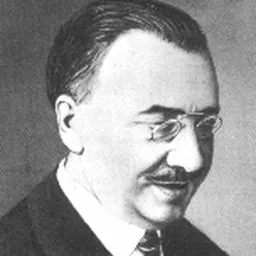
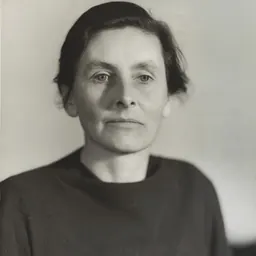
Contemporaries
People whose lives overlapped K.P. Jayaswal's


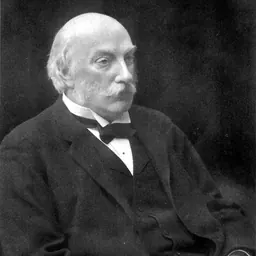


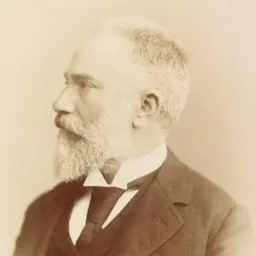
Frequently asked questions
Who was K.P. Jayaswal?
Indian historian and lawyer (1881–1937)
When was K.P. Jayaswal born?
K.P. Jayaswal was born on 27 November 1881 in Mirzapur-cum-Vindhyachal.
When did K.P. Jayaswal die?
K.P. Jayaswal died on 4 August 1937 in Patna.
What was K.P. Jayaswal's occupation?
K.P. Jayaswal was a historian.
What nationality was K.P. Jayaswal?
K.P. Jayaswal was Indian.
Sources & further reading
Cite this page
APA: Biography.guide. (2026). K.P. Jayaswal. https://biography.guide/k-p-jayaswal/
MLA: "K.P. Jayaswal." Biography.guide, https://biography.guide/k-p-jayaswal/.
Chicago: "K.P. Jayaswal." Biography.guide. https://biography.guide/k-p-jayaswal/.
Data last updated: 2026-09-20 · Spot an error? Report a correction.
Portrait: Wikimedia Commons · author & licence
Page generated 2026-09-27 04:57 UTC