
About K. M. Cariappa
Lived 1899 – 1993 (aged 94). K. M. Cariappa was an Indian military officer.
World War II In 1939, the Skeen Committee was set up to examine the options for the Indianisation of the Indian Army's officer ranks. As Cariappa was one of the most senior Indian officers with about 19 years of service, the committee held several discussions with him. He expressed his displeasure at the treatment of Indian officers in the Army. He stressed the discrimination shown toward Indian officers in terms of appointments, promotions, benefits and allowances to which European officers were entitled but Indian officers were not.
After World War II began, Cariappa was posted as brigade major to the 20th Indian Brigade stationed in Derajat. Later he was appointed the DAQMG of 10th Indian Division which was stationed in Iraq. He earned a Mention in Despatches as DAA and quartermaster general of General (later Field Marshal) William Slim's 10th Division. He served in Iraq, Iran and Syria in 1941–1942 and then in Burma in 1943–1944. Back in India in March 1942, he was posted as second-in-command of the newly raised 7th Rajput Machine Gun Battalion at Fatehgarh. On 15 April 1942, he was promoted to acting lieutenant colonel and was appointed commanding officer of the same battalion, receiving an advancement to temporary lieutenant-colonel on 15 July. With this appointment he became the first Indian to command a battalion in the Indian Army. Cariappa was successful in stabilising the newly raised battalion in terms of administration, training, and the handling of arms. Later the unit was rechristened as the 52nd Rajput and put under 43rd Indian Armoured Division. Within a span of a few months, the unit observed two transformations and two moves. First, the battalion's machine guns were replaced with tanks in order to convert it into an armoured regiment. But soon the battalion was reverted to infantry and re-designated as 17/7 Rajputs. Subsequently, it was moved to Secunderabad. This move led to unrest among the unit's troops which was successfully handled by Cariappa.
On 1 April 1943, he was appointed the assistant quarter master general (AQMG) in the headquarters of Eastern Command. Though Cariappa wished to serve in combat, chance did not favour him. In August 1943, when the South East Asia Command was formed, and the Fourteenth Army was placed under it, Cariappa volunteered for active service in the war. But he was again posted as AQMG of the 26th Indian Division stationed at Buthidaung in Burma. The division played an important role in pushing the Japanese back from Arakan. For his services in the operation, Cariappa was awarded the Order of the British Empire (OBE) in June 1945.
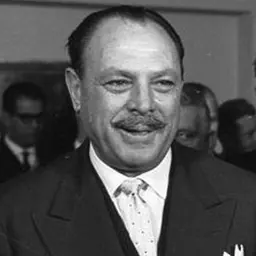
On 1 November 1944, Cariappa was promoted to the acting rank of brigadier, Finally, in November, Cariappa was made the commander of the Bannu Frontier Brigade in Waziristan. It was during this time that Colonel Ayub Khan – later field marshal and President of Pakistan (1962–1969) – served under him. Unlike previous commanders who tried to keep the local tribes under control by force, Cariappa adopted an alternate approach by extending friendly relations to them- which proved a far more effective tactic. When Head of the Interim Government, Jawaharlal Nehru, visited Bannu he found it extremely peaceful and settled, compared to Razmak where another brigade was stationed. Nehru was impressed by Cariappa's way of dealing with the tribes. He was also widely acclaimed for his treatment of the Indian National Army's (INA) prisoners. When Cariappa visited one of the camps that held INA prisoners, he was moved by the conditions in which they lived. He immediately wrote to the Adjutant General recommending that their living conditions be improved and to pardon some of those who were not guilty. These included Colonel Prem Kumar Sahgal, Gurbaksh Singh Dhillon and Shah Nawaz Khan. Cariappa pointed out that these prisoners had considerable support from the Indian leaders, who would later rule the country. This led the British authorities to release most of the prisoners who were detained.
In 1947, Cariappa was the first of two Indians selected to undergo training at the Imperial Defence College at Camberley in the United Kingdom, in order to attend the higher command courses. With the experience he had gained at the Imperial Defence College, Cariappa felt that dividing the Indian Army during the partition would have a devastating effect on both the Indians and Pakistanis. He explained to the hierarchy that without the assistance of British officers, there was a risk of inexperienced Indian officers taking over higher commands. Despite this, his concerns went unaddressed by the hierarchy. During partition, Cariappa handled the division of the Army and sharing of its assets between the two new nations as the officer in charge. On 30 July 1947, Cariappa was promoted to the rank of major-general, becoming one of the first Indians to be promoted to this rank in a combat arm of the Indian Army, along with brigadiers Muhammad Akbar Khan and Maharaj Shri Rajendrasinhji Jadeja.
Post-Independence Post-Independence, Cariappa was appointed deputy chief of the general staff.
Post-retirement and death Cariappa's alliance with the Indian Army was spread over a period of around three decades, during which he had broad experience of staff and command work. After his retirement in 1953, he served as the Indian high commissioner to Australia and New Zealand until 1956. While in Canberra, Cariappa was instrumental in the founding of the Commonwealth Club. With a view toward ex-servicemen's welfare, Cariappa founded the Indian Ex-Servicemen's League (IESL) in 1964. He was also instrumental in setting up the Directorate of Resettlement (later Directorate General Resettlement), an inter-service organisation under the Department of Ex-servicemen Welfare, Ministry of Defence, that looked after the various issues surrounding the resettlement of retired soldiers, especially those who retired young.
Cariappa took part in the re-organisation of the armed forces in many foreign countries. He was awarded the Legion of Merit in the degree of Chief Commander by the American President Harry S. Truman.
Cariappa also tried his luck in politics after a lot of persuasion from his friends and admirers. He contested 1971 Lok Sabha poll from Mumbai North East (Lok Sabha constituency) but came third. Erroneous claims about him contesting against Krishna Menon appear in some books but they are not supported by any evidence on any Indian govt site.
As a mark of recognition for his commendable service to the nation, the Government of India conferred the rank of field marshal on Cariappa on 15 January 1986, 17 July 1920 (substantive)
Don’t just read it —
keep it.
Full-length biographies made to live with: read them, listen on the way to work, watch them tonight.
- E-book
- Audio
- Video
Instant download · yours to keep · every purchase keeps this site free
Important facts
People in K. M. Cariappa's life
Named in this biography and alive at the same time



Related people
Same field, nearest in time



Contemporaries
People whose lives overlapped K. M. Cariappa's




Frequently asked questions
Who was K. M. Cariappa?
Second Field marshal of the Indian Army (1899-1993)
When was K. M. Cariappa born?
K. M. Cariappa was born on 28 January 1899 in Madikeri.
When did K. M. Cariappa die?
K. M. Cariappa died on 15 May 1993 in Bengaluru.
What was K. M. Cariappa's occupation?
K. M. Cariappa was a military officer.
What nationality was K. M. Cariappa?
K. M. Cariappa was Indian.
Sources & further reading
Cite this page
APA: Biography.guide. (2026). K. M. Cariappa. https://biography.guide/k-m-cariappa/
MLA: "K. M. Cariappa." Biography.guide, https://biography.guide/k-m-cariappa/.
Chicago: "K. M. Cariappa." Biography.guide. https://biography.guide/k-m-cariappa/.
Data last updated: 2026-09-20 · Spot an error? Report a correction.
Page generated 2026-09-27 05:19 UTC