
Junius Griffin
African American civil rights activist
About Junius Griffin
Lived 1929 – 2005 (aged 75–76).
Junius Griffin (January 13, 1929 – June 1, 2005) was an African American Civil Rights activist working as the President of the Beverly-Hills Hollywood chapter of the NAACP, who is best known for his work alongside Martin Luther King Jr. as well as for coining the term “Blaxploitation” in regard to the African American film industry of the 1970s.
Early life Junius Griffin was born in Stonega, Virginia, on January 13, 1929. Not much is known about Griffin's childhood, however by age 16 it is recorded that he decided to leave Stonega and go to Bluefield College in Virginia. After a short time there he found it not to be a good fit and decided to enlist in the United States Marine Corps.
Career When Griffin enlisted in the United States Marines, he worked as a journalist and became well known for his writing, working as the Taiwan Bureau Chief for the Stars and Stripes. Griffin's writing quickly became in high demand as he was one of the first black reporters for not only the Stars and Stripes, but also The Associated Press and The New York Times. Griffin alongside Caldwell and colleagues like Gerald Fraser, Austin Scott, Lester Carson, Ted Jones, Wallace Terry, Ted Poston, and Claude Lewis were all reporters who reported on situations from the front lines and often worked together comparing and sharing information to get the stories.
In 1966 Griffin, who had already been working closely with Martin Luther King Jr. as part of the Southern Christian Leadership Conference, gained the attention of Motown. He was hired initially for Motown Records of Detroit as an administrative assistant to President Berry Gordy and Vice president Esther Edwards,
After his time working at Motown, Griffin, alongside Ewart Abner, and George Schiffer, created and became the heads of a new label, known as “Black Forum Records” and shaped its political orientation, declaring it “A Medium for the presentation of ideas and voices of the worldwide struggle of Black people to create a new era." The label fell through in 1973 after its final album "Elaine Brown" as it was a spoken word catalogue and therefore did not move copies as fast as its music focused counterpart Motown. However the label was revived in 2021, and is now headed by Jamila Thomas of Blackout Tuesday. and were "gnawing away at the moral fiber of our [the Black] community."
Black Power Movies were a genre of film made by African Americans, for African Americans, about African Americans, focusing on urban life and struggles, with popular entries including Sweet Sweetback's Baadasssss Song (1971), Super Fly (1972), Blacula (1972), Blackenstein (1973), and Detroit 9000 (1973) with which this movie specifically Griffin himself was the executive producer. The hypocrisy of this is noted by JET journalist William E. Berry, in JET s September 20, 1973 issue. Griffin went on record to say that the popularity and approval of Black power media was instead of entertainment was escapism. By allowing people to become copacetic to their situations they would stop trying to fight the broken systems, "This is counter-revolutionary because our leaders have always emphasized the importance of dealing with reality." He went on record declaring Black Producers as "Front men to white society," and the insistence on morality pushed by the NAACP and CORE, believing movies like SuperFly and Sweet Sweetback's Baadasssss Song perpetuate harmful stereotypes that destroy the communities it was meant to represent.
Awards and recognition Griffin received several awards throughout his career, including being nominated for a Pulitzer Prize for coverage of the civil rights struggle of 1963, Griffin accepted the award for “Best Spoken Word” at the 13th annual Grammy Awards ceremony; this would be Motown's second Grammy awarded and "Why I oppose the Vietnam War," was Black Forum's initial debut album in 1971.
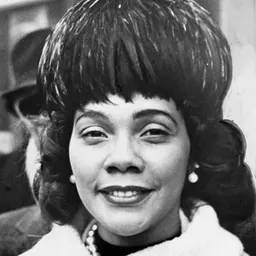
Griffin received a special citation from Coretta Scott King for his assistance in bringing the Jackson Five to Atlanta for the inaugurate annual memorial concert to honor her then late husband Martin Luther King Jr. His parents were in attendance as part of a celebration on Scott King's part for Griffin's birthday.
Personal life Not much is currently known about Griffin's early home life before the age of 16 when he enrolled in college, and Griffin was the producer in charge of the recording of King's speech. Griffin was represented by Attorney Melvin Belli and argued that their daughters had been raised black and would suffer from culture shock if forced to move to Sweden. After the divorce Lantz returned to Sweden to become the director of the Swedish Baptist Women's Union.
Griffin's parents were confirmed to be alive and involved in his life when attending his birthday in 1972.
Death Junius Griffin died June 1, 2005, in Beaufort County, South Carolina. He was buried in the Beaufort National Cemetery.
Don’t just read it —
keep it.
Full-length biographies made to live with: read them, listen on the way to work, watch them tonight.
- E-book
- Audio
- Video
Instant download · yours to keep · every purchase keeps this site free
Important facts
People in Junius Griffin's life
Named in this biography and alive at the same time







Contemporaries
People whose lives overlapped Junius Griffin's


Frequently asked questions
Who was Junius Griffin?
African American civil rights activist
When was Junius Griffin born?
Junius Griffin was born in 1929.
When did Junius Griffin die?
Junius Griffin died in 2005.
Sources & further reading
Cite this page
APA: Biography.guide. (2026). Junius Griffin. https://biography.guide/junius-griffin/
MLA: "Junius Griffin." Biography.guide, https://biography.guide/junius-griffin/.
Chicago: "Junius Griffin." Biography.guide. https://biography.guide/junius-griffin/.
Data last updated: 2026-09-20 · Spot an error? Report a correction.
Page generated 2026-09-27 05:30 UTC