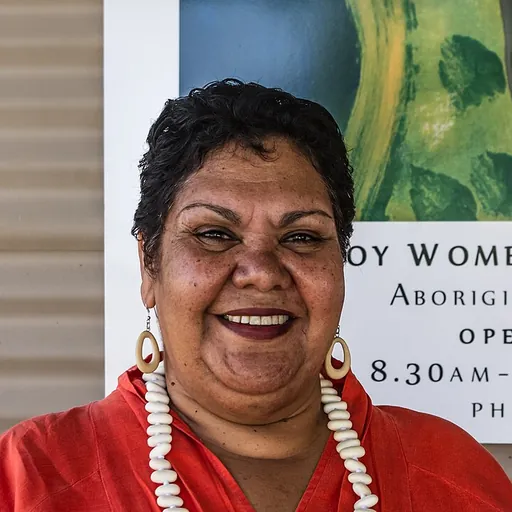
About June Oscar
Born 1962. June Oscar is an Australian civil servant and human rights defender.
June Oscar is an Australian Aboriginal woman of Bunuba descent, Indigenous rights activist, community health and welfare worker, film and theatre, and since 2017 and Aboriginal and Torres Strait Islander Social Justice Commissioner.
She is best known for her fight against Fetal Alcohol Spectrum Disorder (FASD) and work in improving the lives of Aboriginal people in remote communities, in particular the Kimberley (Western Australia) town of Fitzroy Crossing. In 2013 Oscar was awarded the Order of Australia for "distinguished service to the Indigenous community of Western Australia, particularly through health and social welfare programs".
In October 2019 she was appointed to the Senior Advisory Group to help co-design the Indigenous voice to government.
Early life and education
Born in Fitzroy Crossing, Western Australia, Oscar was the second of her mother Mona's three girls and three boys. Her biological father was a local white Australian cattle farmer whom she only met once as an adult.
At the age of seven, authorities removed Oscar from the care of her mother and placed her into the United Aborigines Mission in Fitzroy Crossing. Recognised by the missionaries as being a clever child, she was later sent for secondary education at John Forrest Senior High School in Perth, before leaving at the age of 16 to return to Fitzroy Crossing. Oscar didn't think she was capable of studying at tertiary level, but completed a Bachelor of Business degree in 2004
Career
After returning to Fitzroy Crossing, Oscar worked in state government community welfare and health departments, before becoming the Junjuwa Community Women's Resource Officer in 1989. When she was 29 years old, Oscar received a phone call from Aboriginal Affairs Minister Robert Tickner asking her to join the Aboriginal and Torres Strait Islander Commission. She hung up the phone because she thought the call was a hoax but then decided to call him back. In 2010, she became Chairperson of the Kimberley Language Resource Centre, and was considered a strong advocate for the recognition, rights, preservation and promotion of Australian Aboriginal languages. In the same year, Oscar also became a member of the Western Australian Pastoral Lands Board. In 2013, Oscar was elected Councillor to the Derby / West Kimberley Shire, and in 2015, appointed Board Member of the Kimberley Development Commission.
Current positions In February 2017, Attorney-General for Australia George Brandis announced that Oscar was the new Australian Human Rights Commission's Aboriginal and Torres Strait Islander Social Justice Commissioner. Indigenous Affairs Minister Nigel Scullion said, "Ms Oscar's appointment demonstrates the central role Indigenous women play in bringing about social change and I look forward to working closely with her in the future". she is still in this position.
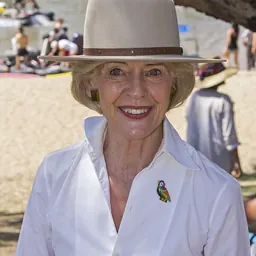
She joined Quentin Bryce as joint patron of the Indigenous Literacy Foundation in September 2019.
In November 2019, it was announced that Oscar would be one of 20 members of the Senior Advisory Group to help co-design the Indigenous voice to government set up by Ken Wyatt, the Minister for Indigenous Australians. The Group is co-chaired by Wyatt, Marcia Langton and Tom Calma.
Oscar is co-chair of the Close the Gap campaign, along with Rod Little.
Building on her term as Aboriginal and Torres Strait Islander Social Justice Commissioner, Oscar launched the Wiyi Yani U Thangani Institute For First Nations Gender Justice in 2024 at the Australian National University where she acts as chair. The Institute continues the Wiyi Yani U Thangani project beginning at the Australian Human Rights Commission in 2017 to elevate the voices and rights of First Nations women, girls and gender-diverse peoples.
Community reconstruction
In March 2007 Oscar became CEO of the MWRC in Fitzroy Crossing, that incorporated initiatives such as the Baya Gawiy Children and Family Centre, The Shelter women's refuge, a legal aid unit, a community garden, and a social enterprise. The MWRC was committed to protecting the safety and wellbeing of children, and wanted to stop the violence occurring in their communities as a result of alcohol abuse.
In 2007, the Fitzroy Crossing Hospital was treating around 30 to 40 people per night for alcohol related injuries and the community was in a state of crisis. In the same 12-month period, 55 funerals and 13 suicides were recorded in Fitzroy Valley, a town of approximately 4000 people. In a city the size of Perth, this would have been equal to 500 suicides per month. In response to calls from the community, the State Coroner for Western Australia, Alistair Hope, commissioned a coronial inquest into 22 recent deaths by self-harm in the Kimberley region. The number of deaths by self-harm in Fitzroy Valley were found by the Coroner to be extraordinarily high and there was a "very high correlation between death by self-harm and alcohol and cannabis use".
Oscar then organised the 2007 Annual Women's Bush Meeting, a traditional gathering of Bunuba, Gooniyandi, Walmajarri, Wangkatjunka and Nyikina women. They represented a significant segment of the community and gave their consent to the MWRC beginning a campaign to limit the sale of take-away alcohol in Fitzroy Valley. A community-led intervention to the crisis was formed that proved to be fundamental to its success.
After the Women's Bush Meeting, Oscar wrote to the Director of Liquor Licensing (Western Australia) asking for an initial 12-month suspension of take-away liquor sales in the Valley. The MWRC maintained that alcohol restrictions were required because high numbers of alcohol and drug related suicides were happening in the Valley, people were in a perpetual state of grief and despair and their women's refuge was not able to cope with the number of people seeking protection from domestic violence. Unacceptably high numbers of medical outpatients were suffering from alcohol abuse, and at the local hospital 85% of trauma patients were affected by alcohol and 56% of all patients were under the influence of alcohol when they were admitted. It was even becoming normal for children to drink alcohol. Crime rates included a disproportionately high number of alcohol related incidents, local employers had difficulty retaining staff, school attendance was reduced, and a substantial number of children under the age of five had FASD-related symptoms.
During this period, the MWRC networked with community cultural leaders through the Kimberley Aboriginal Law and Cultural Centre (KALACC), an Aboriginal organisation that supports the traditional practices of the 30 language groups in the Kimberley. Oscar revealed the significance of their support in the alcohol restriction campaign:
Oscar's move to get the backing of elders and cultural leaders was a major factor in persuading the Director of Liquor Licensing to impose the alcohol restrictions. Certain sectors of the community were against the restrictions and the support from elders gave the MWRC campaign the legitimacy it needed. In the face of fierce opposition from some members of her community who had a vested interest in the sale of alcohol, Oscar stood firm. She knew the restrictions would give her people much needed relief from the trauma and chaos caused by alcohol abuse.
Western Australia Police supported the fight against take-away liquor and a strategic partnership was formed. The campaign was strengthened by this partnership, though it did not affect how it was managed.
In July 2009, the University of Notre Dame released the findings of its review on the first 12 months of restrictions. Their report, Fitzroy Valley Alcohol Restriction Report: An evaluation of the effects of a restriction on take-away alcohol relating to measurable health and social outcomes, community perceptions and behaviours after a 12-month period, suggested that nearly all people surveyed on the impact of restrictions believed some type of limit on alcohol consumption was required, and none of them wanted their community to go back to what it was like before restrictions were introduced.
The Notre Dame review also noted that benefits from the restrictions were not enough to address the deep-rooted issues associated with alcohol abuse, and communities in the Valley needed continuing support. In her speech at the Western Australian Equal Opportunity Commission Forum, Perth, 10 August 2009, Oscar stated that Aboriginal leaders in the Valley had taken their first steps on the path of reconstructing their communities but now needed the government to support them: Aboriginal cultural knowledge is taught to new generations through song, dance and storytelling, and Oscar was concerned. "These kids may have speech delays and difficulty remembering. But memory is critical to our whole heritage because Aboriginal culture and language is passed down orally. Language is the essence of who we are; it identifies us and the world we come from". The Marulu Project focused on: FASD and ELT prevention, including creating awareness in communities that the project existed and educating pregnant women to prevent alcohol abuse; FASD diagnosis, including the development of diagnostic systems; FASD support, including the establishment of a map of support services available in the valley and a network of carers; conversation at a high level on FASD, including strategic communication through media channels, discussion with the scientific community, and increasing awareness through strategic partnerships; strengthening the project's capacity to fight FASD through participating in workshops and attending conferences; identifying existing resources and securing new resources, including approaching the government and organisations for funding; and engaging resources in the local community in FASD prevention, diagnosis and support. and had a guiding a set of principles and preconditions:
Principles First, to do no harm. Commitment existed to a process of two-way learning. All activity had to provide short- and long-term benefits for communities. Informed involvement and consent needed to be ensured in the sharing of information and knowledge. All activity needed to preserve the dignity of participating individuals and communities. Preconditions Clear and broad informed consent from communities and local service providers existed. Local control – the project leadership team needed to be, and needed to be perceived by communities as being, in control of the study. An appropriate and adequate workforce existed to conduct the study. The Lililwan Project had two distinct stages. Stage 1 commenced in April 2010, and involved collecting demographic, prenatal and early childhood data and reviewing children's medical records. Parents and carers were interviewed, and questions were included on the alcohol consumption habits of mothers during pregnancy and the development of children. Stage 2 commenced in May 2011, and involved conducting child health and development tests, and making opportunistic medical treatments and referrals. This stage included examinations by doctors and other health professionals of all children in the study born in 2003 and 2003 to determine the prevalence of FASD. A health plan was developed for every child diagnosed with the disorder to ensure they received suitable ongoing care. Oscar said Jandamarra was fighting for his people's freedom. "He was not an outlaw, he was fighting for his land, I think he was a freedom fighter."
Yajilarra (2008) by Australian director Melanie Hogan, was a powerful documentary film based on Oscar's and the MWRC's campaign to restrict alcohol consumption in Fitzroy Valley. In 2007, Oscar and Emily Carter from the MWRC invited the Sex Discrimination Commissioner (Australian Human Rights Commission), Elizabeth Broderick, to visit Fitzroy Crossing and help them to make a film that would create social change. To get ongoing help for their community they knew they had to tell the world about the crisis it was in. Commissioner Broderick introduced Oscar and Carter to The George, who helped secure funding to produce the film. Yajilarra was shown at an event hosted by Commissioner Broderick and the Hon. Tanya Plibersek MP, Australian Minister for the Status of Women, at the 53rd Session of the UN Commission on the Status of Women (CSW) in New York, from 2 to 13 March 2009. That was the first time Australian Aboriginal women were presented at CSW.
Awards and honours
National NAIDOC Person of the Year 2018 WA Australian of the Year Award, Local Hero (2017) Honorary doctorate from Edith Cowan University (2017) Desmond Tutu Reconciliation Fellowship, Global Reconciliation (2016) Menzies School of Health Research Medallion (2014) Winner of the Westpac and Australian Financial Review 100 Women of Influence, Social Enterprise and Not for Profit category (2013) Officer for the Order of Australia (2013) Ambassador for Children and Young People in Western Australia (2012) One of the fifty most influential women in the world in The Age Good Weekend magazine and Sydney Morning Herald Weekend magazine (2011) Australian of the Year Award State Finalist, Local Hero (2010)
Publications
The Lililwan Collaboration: Inquiry into Fetal Alcohol Spectrum Disorders (FASD) 'Making FASD History' Fetal Alcohol Spectrum Disorder Prevention Strategy Report 2014-2015 Making FASD History: 2015 Annual Report to Western Australian Government Department of Aboriginal Affairs: Marulu Fetal Alcohol Spectrum Disorders Prevention Strategy
Don’t just read it —
keep it.
Full-length biographies made to live with: read them, listen on the way to work, watch them tonight.
- E-book
- Audio
- Video
Instant download · yours to keep · every purchase keeps this site free
Important facts
People in June Oscar's life
Named in this biography and alive at the same time







Related people
Same field, nearest in time


Contemporaries
People whose lives overlapped June Oscar's




Frequently asked questions
Who is June Oscar?
Bunuba leader
When was June Oscar born?
June Oscar was born in 1962.
What is June Oscar's occupation?
June Oscar is a civil servant and human rights defender.
What nationality is June Oscar?
June Oscar is Australian.
Sources & further reading
Cite this page
APA: Biography.guide. (2026). June Oscar. https://biography.guide/june-oscar/
MLA: "June Oscar." Biography.guide, https://biography.guide/june-oscar/.
Chicago: "June Oscar." Biography.guide. https://biography.guide/june-oscar/.
Data last updated: 2026-09-23 · Spot an error? Report a correction.
Portrait: Wikimedia Commons · author & licence
Page generated 2026-09-27 05:05 UTC