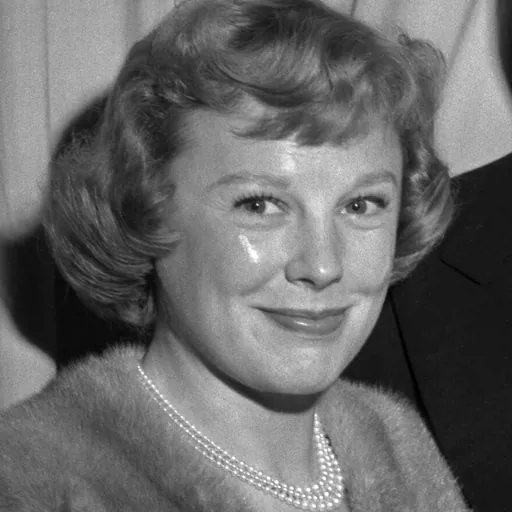
About June Allyson
Lived 1917 – 2006 (aged 88). June Allyson was an American film actor, dancer, stage actor, television actor, singer and actor.
June Allyson (born Eleanor Geisman; October 7, 1917 – July 8, 2006) was an American stage, film, and television actress.
Allyson began her career in 1937 as a dancer in short subject films and on Broadway in 1938. She signed with MGM in 1943 and rose to fame the following year in Two Girls and a Sailor. Allyson's "girl next door" image was solidified during the mid-1940s when she was paired with actor Van Johnson in six films. In 1951 she won the Golden Globe Award for Best Actress for her performance in Too Young to Kiss. From 1959 to 1961 she hosted and occasionally starred in her own anthology series, The DuPont Show with June Allyson, which aired on CBS. in a successful marketing campaign that has been credited in reducing the social stigma of incontinence. She made her final onscreen appearance in 2001.
Allyson was married four times (to three husbands) and had two children with her first husband, Dick Powell. She died of respiratory failure and bronchitis in July 2006 at the age of 88.
Early life Allyson was born Eleanor Geisman, nicknamed Ella, in The Bronx, New York City. Studio biographies listed her as Jan Allyson born to Franco-English parents. Upon June's death, her daughter said Allyson was born "Eleanor Geisman to a French mother and Dutch father." In an interview with Larry King Allyson denied being of German Jewish descent.
In April 1918 (when Allyson was six months old), her alcoholic father, who had worked as a janitor, abandoned the family. Allyson was brought up in near poverty, living with her maternal grandparents. To make ends meet, her mother worked as a telephone operator and restaurant cashier. When she had enough funds, she occasionally reunited with her daughter, but more often Allyson was "farmed" to her grandparents or other relatives. Allyson sustained a fractured skull and broken back, and her dog was killed. Her doctors said she never would walk again and confined her to a heavy steel brace from neck to hips for four years. She ultimately regained her health, but when Allyson had become famous, she was terrified that people would discover her background from the "tenement side of New York City", and she readily agreed to studio tales of a "rosy life", including a concocted story that she underwent months of swimming exercises in rehabilitation to emerge as a star swimmer.
After gradually progressing from a wheelchair to crutches to braces, Allyson's true escape from her impoverished life was to go to the cinema, where she was enraptured by Ginger Rogers and Fred Astaire movies. She also tried to emulate the singing styles of movie stars, but she never mastered reading music.
When her mother remarried and the family was reunited with a more stable financial standing, Allyson was enrolled in the Ned Wayburn Dancing Academy and began to enter dance competitions with the stage name of Elaine Peters.
Career Early work With the death of her stepfather and a bleak future ahead, she left high school midway through her junior year to seek jobs as a dancer. Her first $60-a-week job was as a tap dancer at the Lido Club in Montreal. Returning to New York City, she found work as an actress in movie short subjects filmed by Educational Pictures at the General Service Studio in Astoria, New York.
Fiercely ambitious, Allyson tried her hand at modeling but to her consternation became the "sad-looking before part" in a before-and-after bathing suit magazine ad.
Musical shorts Her first career break came when Educational cast her as an ingenue opposite singer Lee Sullivan, comic dancers Herman Timberg, Jr. and Pat Rooney, Jr., and future comedy star Danny Kaye in a series of shorts. These included Swing for Sale (1937), Pixilated (1937), Ups and Downs (1937), Dime a Dance (1937), Dates and Nuts (1937), and Sing for Sweetie (1938).
When Educational ceased operations, Allyson moved to Vitaphone in Brooklyn and starred or co-starred (with dancer Hal Le Roy) in musical shorts. These included The Prisoner of Swing (1938), The Knight Is Young (1938), and Rollin' in Rhythm (1939). She starred in All Girl Revue (1940).
Broadway Interspersing jobs in the chorus line at the Copacabana Club with acting roles at Vitaphone, the diminutive 5'1", below 100-lb Allyson landed a chorus job in the Broadway show Sing Out the News in 1938. When she arrived in Hollywood, the production had not started, so MGM "placed her on the payroll" of Girl Crazy (1943). Despite playing a bit part, Allyson received good reviews as a sidekick to Best Foot Forwards star, Lucille Ball, but was still relegated to the "drop list."
MGM's musical supervisor Arthur Freed saw her screen test sent up by an agent and insisted that Allyson be put on contract immediately. Another musical, Thousands Cheer (1943), was a showcase for her singing, albeit still in a minor role.
As a new starlet, although Allyson had already been a performer on stage and screen for over five years, she was presented as an "overnight sensation", with Hollywood press agents attempting to portray her as an ingenue, selectively slicing years off her true age. Studio bios listed her variously as being born in 1922 and 1923. was fostered by her being cast alongside long-time acting chum Van Johnson, the quintessential "boy next door." As the "sweetheart team", Johnson and Allyson were to appear together in four later films.
Allyson supported Lucille Ball again in Meet the People (1944), which was a flop.
She supported Margaret O'Brien in Music for Millions (1944) and was billed after Robert Walker and Hedy Lamarr in the romantic comedy Her Highness and the Bellboy (1945).
Stardom
Allyson was top-billed along with Walker in The Sailor Takes a Wife (1945). She had a role in Two Sisters from Boston (1946) with Kathryn Grayson and Peter Lawford, and she was one of several MGM stars in Till the Clouds Roll By (1946). She also appeared in her first drama, The Secret Heart, in 1946 with Claudette Colbert and Walter Pidgeon. which was a huge hit. She was adept at crying on cue, and many of her films incorporated a crying scene. Fellow MGM player Margaret O'Brien recalled that she and Allyson were known as "the town criers". "I cried once in a picture and they said 'Let's do it again', and I cried for the rest of my career", she later said.
She made two films with Dick Powell: The Reformer and the Redhead (1950) and Right Cross (1950), after which she was reunited with Johnson in Too Young to Kiss (1951).
In 1950 Allyson had been signed to appear opposite her childhood idol Fred Astaire in Royal Wedding but had to leave the production due to pregnancy. She was replaced initially by Judy Garland, who in turn was replaced by Jane Powell.
Allyson played a doctor in The Girl in White (1952), which lost revenue, and a nurse in Battle Circus (1953), a hit.
Post MGM In 1954 Allyson was in a huge Universal Pictures hit, The Glenn Miller Story,which starred James Stewart as well as another successful MGM film, Executive Suite. She also starred in the Fox Film Woman's World, which was less successful.
Allyson was teamed with Stewart again in Strategic Air Command (1955) at Paramount, another success.
She had a change of pace in The Shrike (1955) with José Ferrer at Universal; it flopped. More popular was The McConnell Story (1955) with Alan Ladd at Warner Bros.
In 1956 Allyson starred in some musical remakes of classic films: The Opposite Sex, a remake of The Women at MGM, and You Can't Run Away from It, a remake of It Happened One Night at Columbia, which was directed by Powell. Her efforts were dismissed by an entertainment critic in the LA Examiner as "reaching down to the level of mag fiction." However, TV Guide and other fan magazines such as TV Magazine considered Allyson's foray into television as revitalizing her fame and career for a younger audience and remarked that her typecasting by the movie industry as the "girl next door" was a "waste and neglect of talent on its own doorstep."
She also appeared on shows like Zane Grey Theater, The Dick Powell Theatre, The Judy Garland Show, and Burke's Law before retiring for several years after the death of Powell in 1963. The American Urogynecologic Society established the June Allyson Foundation in 1998, made possible by a grant from Kimberly-Clark. The foundation raises money for incontinence education and research. Although dating David Rose, Peter Lawford, and John F. Kennedy, Allyson was actually being courted by Dick Powell.
On August 19, 1945, Allyson caused MGM studio chief Louis B. Mayer some consternation by marrying Dick Powell. After defying him twice by refusing to stop seeing Powell, in a "tactical master stroke", she asked Mayer to give her away at the wedding. He was so disarmed that he agreed but put Allyson on suspension anyway.
The Powells had two children, Pamela Allyson Powell (adopted in 1948 through the Tennessee Children's Home Society in an adoption arranged by Georgia Tann) and Richard Powell, Jr., born December 24, 1950.
In the mid 1950s, Allyson reportedly had an affair with actor Alan Ladd.
In 1961, Allyson underwent a kidney operation and later, throat surgery, temporarily affecting her trademark raspy voice. She filed for divorce that year, the reason being Powell's devotion to work. In February 1961, Allyson was awarded $2.5 million in settlement, along with custody of their children, in an interlocutory divorce decree. However, before the divorce was final, they reconciled and remained married until his death on January 2, 1963. Later, Allyson reflected on how Powell's death affected her:I felt I had no props. I'm not really that wise to be able to live life alone and know where I'm going. I felt fear. I felt loneliness. I felt guilt and anger. I was afraid that I would not be able to stand on my own two feet. The loneliness made me feel empty. Then I had an awful guilt. I had always complained that Richard worked too hard, that he had no time for me. I gave him a bad time about this. When he left, I realized that he was working for our future and he wasn't there for me to say, "I'm sorry." I was angry because God had taken Richard away. God should have taken me. He should have left Richard, who had so much more to give. She and Maxwell would later get married and divorced, then married and divorced again between 1963 and 1970.
During this time, Allyson struggled with alcoholism, which she overcame in the mid-1970s.
In 1976, Allyson married David Ashrow, a dentist turned actor. The couple occasionally performed together in regional theater, and in the late 1970s and early 1980s, toured the US in the play My Daughter, Your Son. They also appeared on celebrity cruiseship tours on the Royal Viking Sky ocean liner in a program that highlighted Allyson's movie career.
Philanthropy and advertising After Dick Powell's death, Allyson committed herself to charitable work on his behalf, championing the importance of research in urological and gynecological diseases in seniors.
Allyson represented the Kimberly-Clark Corporation in commercials for adult incontinence products. She was initially reticent to participate, but her mother, who had incontinence, convinced her that it was her duty in light of her successful career. The product proved a success. In 1993, actor-turned-agent Marty Ingels publicly charged Allyson with not paying his large commission on the earlier deal on incontinence product advertising. Allyson denied owing any money, and Ashrow and she filed a lawsuit for slander and emotional distress, charging that Ingels was harassing and threatening them, stating Ingels made 138 phone calls during a single eight-hour period. Earlier that year, Ingels had pleaded no contest to making annoying phone calls.
Following a lifelong interest in health and medical research (Allyson had initially wanted to use her acting career to fund her own training as a doctor), Her daughter served as Chairman of the Inaugural Concerts for Nixon's second inauguration in 1973. Allyson also supported Barry Goldwater in the 1964 United States presidential election.
Later years Powell's wealth made it possible for Allyson effectively to retire from show business after his death, making only occasional appearances on talk and variety shows. Allyson returned to the Broadway stage in 1970 in the play Forty Carats and later toured in a production of No, No, Nanette.
Her autobiography, June Allyson by June Allyson (1982), received generally complimentary reviews due to its insider look at Hollywood in one of its golden ages. A more critical appraisal came from Janet Maslin at the New York Times in her review, "Hollywood Leaves Its Imprint on Its Chroniclers", who noted: "Miss Allyson presents herself as the same sunny, tomboyish figure she played on screen in Hollywood... like someone who has come to inhabit the very myths she helped to create on the screen."
As a personal friend of Ronald and Nancy Reagan, she was invited to many White House dinners, and in 1988, Reagan appointed her to the Federal Council on Aging. Allyson and her later husband, David Ashrow, actively supported fund-raising efforts for both the James Stewart and Judy Garland museums; both Stewart and Garland had been close friends.
Death Following hip-replacement surgery in 2003, Allyson's health began to deteriorate. With her husband at her side, she died July 8, 2006, aged 88 at her home in Ojai, California. Her death was a result of pulmonary respiratory failure and acute bronchitis. On her death, Kimberly-Clark Corporation contributed $25,000 to the June Allyson Foundation to support research advances in the care and treatment of women with urinary incontinence.
Awards and honors 1955: named the ninth most popular movie star in the annual Quigley Exhibitors Poll and the second most popular female star, after Grace Kelly 2007: received a special tribute during the Academy Awards as part of the annual memorial tribute
Broadway credits I couldn't dance, and, Lord knows, I couldn't sing, but I got by somehow. Richard Rodgers was always keeping them from firing me.
Don’t just read it —
keep it.
Full-length biographies made to live with: read them, listen on the way to work, watch them tonight.
- E-book
- Audio
- Video
Instant download · yours to keep · every purchase keeps this site free
Important facts
Family & relationships
People in June Allyson's life
Named in this biography and alive at the same time



Related people
Same field, nearest in time



Contemporaries
People whose lives overlapped June Allyson's



Frequently asked questions
Who was June Allyson?
American actress (1917–2006)
When was June Allyson born?
June Allyson was born on 7 October 1917 in The Bronx.
When did June Allyson die?
June Allyson died on 8 July 2006 in Ojai.
What was June Allyson's occupation?
June Allyson was a film actor, dancer, stage actor, television actor, singer and actor.
What nationality was June Allyson?
June Allyson was American.
Sources & further reading
Cite this page
APA: Biography.guide. (2026). June Allyson. https://biography.guide/june-allyson/
MLA: "June Allyson." Biography.guide, https://biography.guide/june-allyson/.
Chicago: "June Allyson." Biography.guide. https://biography.guide/june-allyson/.
Data last updated: 2026-09-21 · Spot an error? Report a correction.
Portrait: Wikimedia Commons · author & licence
Page generated 2026-09-27 05:00 UTC