
About Juliusz Hibner
Lived 1912 – 1994 (aged 82). Juliusz Hibner was a Polish physicist, soldier and politician.
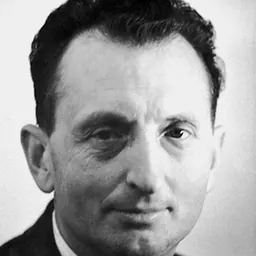
Juliusz Hibner (real name Dawid Szwarc; 11 October 1912 – 13 November 1994) was a brigadier general in the Polish People's Army and recipient of the title of Hero of Soviet Union. He also served as the commander of the Internal Security Corps and later became a nuclear physicist.
Early life Hibner was born in a poor Jewish family. His father joined the Zarudzia Region Council organized by the Bolsheviks during the Polish-Soviet War. In 1931, Hibner graduated from a gymnasium in Ternopil and in the summer of the same year, he joined the Young Communist League of Western Ukraine (KZMZU), an autonomous section of the Union of Polish Youth, where he was active in the propaganda division.
He also continued his activity with KZMZU during his studies at the Polytechnic University in Lwów, where he started studying in 1932, but he did not graduate. In 1933 he returned to Ternopil, where he continued his activity in KZMZU, acting for the benefit of Communist Party of Western Ukraine. In September 1934, he was arrested but soon released due to lack of evidence. He was arrested again in January 1935, but managed to escape. After a short stay on false documents in Lwów, he left for Warsaw in 1936. While working at a factory in Warsaw, he made contact with the Communist Party of Poland.
Military career In February 1937, he volunteered to go to Spain to fight in the ranks of the Spanish Republican Army, during the Spanish Civil War. Serving under the name Julek Hübner, he was assigned to the 20th International Battalion of the International Brigades, and in May 1937 he was admitted to the Communist Party of Spain. He was promoted quickly in his unit and in September 1937 he became the battalion's political commissar. In March 1938, it was transferred to line units, and he was soon promoted to the rank of captain, assuming the position of battalion commander.
On 11 March 1944, he was wounded again and sent to the hospital. After he recovered on 1 May 1944, he became a student at the Frunze Military Academy in Moscow. He was then appointed as the deputy commander of the 37th Infantry Regiment, and later as the commander of the 32nd Infantry Regiment of the 8th Infantry Division of 2nd Polish Army. During this time, he participated in the Battle of Bautzen. During the battle at the village of Malkowitz, he was wounded for the third and final time.
On 27 April 1949, he appointed commander of the Internal Security Corps, after being promoted to brigadier general. On 29 April 1951, he became the commander of the Internal Forces of the Border Protection Troops and Internal Security Corps. On 23 August 1956, he became undersecretary of state in the Ministry of Internal Affairs and supervisor of the Internal Forces. The Internal Security Corps troops led by Hibner have been associated with numerous crimes and repressions against the Polish opposition activists and the civilian population. Hibner's rapid promotion in the Internal Security Corps and the Ministry of Public Security proves the trust in his command skills expressed by the leadership of the Polish Workers' Party and the Soviet authorities.
Later life Hibner retired from military service in 1959. Between 1960 and 1969, he obtained a PhD in physical sciences and worked at the Institute for Nuclear Research in Świerk. He defended his doctoral dissertation and taught physics at universities in Warsaw and Paris, after his retirement in 1969. In 1988, he left the Polish United Workers' Party.
Hibner died on 13 November 1994, at the age of 82. He is buried at the Powązki Military Cemetery in Warsaw. Hibner's wife Irena Bozena Puchalska-Hibner, who was a French and Polish physicist, wrote memoirs of her husband which was published in 2001. It was later translated and published in French, in 2004.
Awards and decorations
Don’t just read it —
keep it.
Full-length biographies made to live with: read them, listen on the way to work, watch them tonight.
- E-book
- Audio
- Video
Instant download · yours to keep · every purchase keeps this site free
Important facts
Related people
Same field, nearest in time




Contemporaries
People whose lives overlapped Juliusz Hibner's





Frequently asked questions
Who was Juliusz Hibner?
Polish physicist (1912–1994)
When was Juliusz Hibner born?
Juliusz Hibner was born on 11 October 1912 in Hrymailiv.
When did Juliusz Hibner die?
Juliusz Hibner died on 13 November 1994 in Warsaw.
What was Juliusz Hibner's occupation?
Juliusz Hibner was a physicist, soldier and politician.
What nationality was Juliusz Hibner?
Juliusz Hibner was Polish.
Sources & further reading
Cite this page
APA: Biography.guide. (2026). Juliusz Hibner. https://biography.guide/juliusz-hibner/
MLA: "Juliusz Hibner." Biography.guide, https://biography.guide/juliusz-hibner/.
Chicago: "Juliusz Hibner." Biography.guide. https://biography.guide/juliusz-hibner/.
Data last updated: 2026-09-20 · Spot an error? Report a correction.
Page generated 2026-09-27 05:32 UTC