About Julio Le Parc
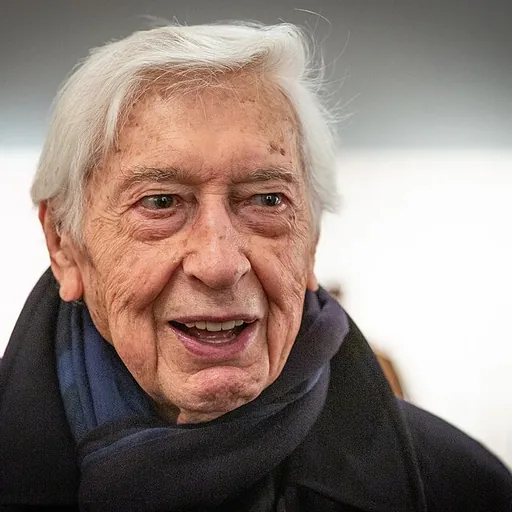
Lived 1928 – 2026 (aged 97). Julio Le Parc was an Argentine and French sculptor, painter and visual artist.
"Sphere Rouge" installed at Palais du TokyoJulio Le Parc (23 September 1928 – 30 May 2026) was an Argentine-born artist who focused on both modern op art and kinetic art. Le Parc attended the School of Fine Arts in Argentina. A founding member of the Groupe de Recherche d’Art Visuel (GRAV) and creator of award-winning artworks, he remains a significant figure in the history of Argentine modern art. He was bestowed the Konex Award from Argentina in 1982 and 2022.
Background Julio Le Parc was born on 23 September 1928 in Mendoza, Argentina, into a family of limited economic means. At age thirteen he moved with his mother and brothers to Buenos Aires. While there he attended the School of Fine Arts and showed growing interest in artistic avant-garde movement in Argentina. and recipient of the Grand Prize for Painting at the 33rd Venice Biennale in 1966, Julio Le Parc is a major figure in modern art history. The socially conscious artist was expelled from France in May 1968, after participating in the Atelier Populaire and its protests against major institutions.
Le Parc later lived and worked in Cachan, France. He died in Paris on 30 May 2026, at the age of 97. After returning, in 1958 Le Parc received a grant from the French Cultural Service to go to Paris. Much of his early career was committed to painting, engraving, and creating monotypes. However, in 1959 Le Parc begins his experimentation with image produced by light multiplied by layers of planes of Plexiglas. Le Parc participated in his first exhibition, Bienal de São Paulo in São Paulo, Brazil, in 1957.
Middle Upon arriving in Paris in 1958 he connected with Jesús Rafael Soto and Carlos Cruz-Diez who were already in Paris.
Late Le Parc continued his use of light and kinetics. However, "in the 1970s, Le Parc's artistic activities became less frequent, to the degree that his work almost went unnoticed in the international arena for several decades". This work was the most highlighted work in his exhibition in Miami, United States, in 2011. This work was placed at the center of the main room, allowing the viewer to walk around it to see all the different angles reflected on a mirror directly below it on the floor. The work is approximately 42 ft. x 16 ft. x 16 ft. This artwork is found inside a dark semi-circular hallway where light is experienced as both a reflection and refraction. A projector displays light on a wall and changes pattern in a rhythmical way that appears to be a vibration.
Exhibitions
Solo Julio Le Parc, Tate Modern, London, United Kingdom, 11 June 2026–3 May 2027 Julio Le Parc 1959, Metropolitan Museum of Art, New York, United States, 2018 Perez Art Museum Miami (PAMM), Miami, Florida, United States, 2016 Serpentine Sackler Gallery, London, United Kingdom, 25 November 2014–15 February 2015 Palais de Tokyo, Paris, France, 2013 Otra Mirada, Buenos Aires, Argentina, 2010 Le Parc. Lumière. La Habana, Cuba, 2009 Julio Le Parc et Vertige Vertical. Cachan, France, 2005 Julio Le Parc - Verso la Luce - TORSIONS, scultura monumentale permanente nel giardino del Castello di Boldeniga-Brescia (Italia), 2004 Alquimias. Quito, Ecuador, 1998 Salle de jeux et travaux de surface. Arcueil, France, 1996 Obra reciente. Valencia, Spain, 1991 Modulazioni di Julio Le Parc. Brescia, Italy, 1988 Galleria La Polena, Genova, Italy, 1979 Galerie Denise René, New York, United States, 1973 Kinetische Objekte. Ulm, Germany, 1970
Group Flash! Light and Movement. Tampere, Finland, 2009 50 años de pintura geométrica latino-americana. La Plata, Argentina, 2002 Portes ouvertes. Cachan, France, 1994 I Bienal de Cuenca. Cuenca, Ecuador, 1987 Arte Programmata e Cinetica 1953–1963. Milan, Italy, 1983 Brigade International de Peintres Antifascistes. Athens, Greece, 1975 Kinetics. London, UK, 1970 Light in Orbit. New York, New York, USA, 1967 Groupe de Recherche d'Art Visuel. Paris, France, 1960 IV Bienal de São Paulo. São Paulo, Brazil, 1957
Don’t just read it —
keep it.
Full-length biographies made to live with: read them, listen on the way to work, watch them tonight.
- E-book
- Audio
- Video
Instant download · yours to keep · every purchase keeps this site free
Important facts
People in Julio Le Parc's life
Named in this biography and alive at the same time



Related people
Same field, nearest in time


Contemporaries
People whose lives overlapped Julio Le Parc's



Frequently asked questions
Who was Julio Le Parc?
Argentine painter and sculptor (1928–2026)
When was Julio Le Parc born?
Julio Le Parc was born on 23 September 1928 in Mendoza, Palmira.
When did Julio Le Parc die?
Julio Le Parc died on 30 May 2026 in Paris, Cachan.
What was Julio Le Parc's occupation?
Julio Le Parc was a sculptor, painter and visual artist.
What nationality was Julio Le Parc?
Julio Le Parc was Argentine and French.
Sources & further reading
Cite this page
APA: Biography.guide. (2026). Julio Le Parc. https://biography.guide/julio-le-parc/
MLA: "Julio Le Parc." Biography.guide, https://biography.guide/julio-le-parc/.
Chicago: "Julio Le Parc." Biography.guide. https://biography.guide/julio-le-parc/.
Data last updated: 2026-09-21 · Spot an error? Report a correction.
Portrait: Wikimedia Commons · author & licence
Page generated 2026-09-27 04:58 UTC