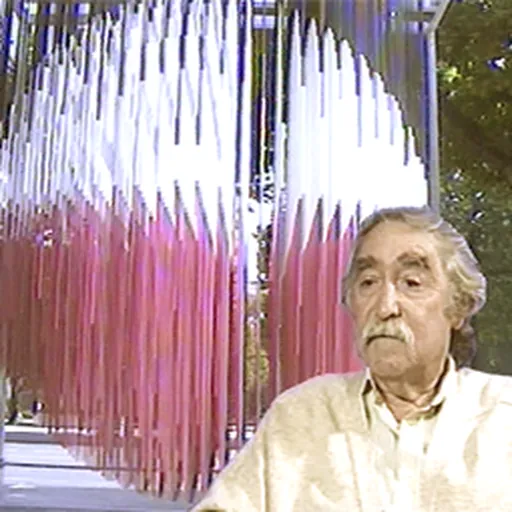
About Jesús Rafael Soto
Lived 1923 – 2005 (aged 81). Jesús Rafael Soto was a Venezuelan and French painter, sculptor and jewelry designer.
Jesús Rafael Soto (June 5, 1923 – January 14, 2005) was a Venezuelan kinetic and op artist, sculptor, and painter.
His works can be found in the collections of the main museums of the world, including Tate (London), Museum Ludwig (Germany), Centre Georges Pompidou (Paris), (Roma), and MoMA (New York). In his hometown, one of the main art museums in Venezuela, the Jesús Soto Museum of Modern Art, is named in his honor.
Early life Jesús Rafael Soto was born in Ciudad Bolívar, Venezuela. He was the eldest of four children born to Emma Soto and Luis Garcia Parra, a violin player. From a very young age, Soto wanted to help support his family in any way he could, and art was the most interesting to him. He picked up the guitar and also began recreating famous pieces of art that he found in various books, magazines, and almanacs.
At 16, Soto started his serious artistic career when he began to create and paint posters for the cinemas in Ciudad Bolívar. "At that age," says Soto, "the only artists that I knew were the lettering painters. My family was very happy. I could earn some money, make lettering till the end of my days. Nobody looked further than that..."
In 1938, Soto participated in a student group affiliated with surrealism ideas and published poems in the local journal that scandalized society. In the group, Soto learned about automatic writing and charcoal drawing, "I drew heads, portraits, I had a great technique. Finally, there were people who made a petition, the bishop asked to see it, and he signed it. I got a scholarship…"
Education In 1942, he received a scholarship to study artistic training at the Escuela de Artes Plásticas y Artes Aplicadas (Plastic and Applied Arts School) in Caracas, finishing his studies in 1947. Once there, he took classes in "pure art" and the "training course for instructors in art education history."
In France, Soto discovered Paul Klee and Piet Mondrian's work, and the latter suggested the idea of 'dynamizing the neoplasticism'. This, joined with Soto's will to create a new sort of movement that would add to three-dimensional art, concluded in associations with Yaacov Agam, Jean Tinguely, Victor Vasarely, and other artists connected with the Salon des Réalités Nouvelles and the Galerie Denise René.
In 1955, Soto participated in the exhibition Le Mouvement at Galerie Denise René in Paris. Other artists being shown were Yaacov Agam, Marcel Duchamp, and Victor Vasarely. The exhibition prompted the publication of the 'Yellow Manifest' about kinetic art and the visual research involving spectators and stimulus. The kinetic art movement gained force in Europe and Latin America after this exhibition.
Dematerialization of form As a result of the optical vibratory states that Soto achieves from the superposition of plans, a new situation appears: the outbreak of the solid body, its dematerialization in our retina, phenomena that are produced for the first time in Permutación (1956). In Estructuras cinéticas de elementos geométricos (1955-57) and Armonía transformable (1956), a new element is added that was relegated in his research: color. It is about the superposition of different plexiglass planes, where color frames are inscribed, introducing new vibratory elements. The real division of the plane that had previously undergone an unfolding is produced here. Its structure already suggests a true spatial dimension, as a consequence of the equivalence of its obverse and its reverse. The situation becomes more complex, due to the multiplication of different lines, colors, and directions. Plexiglass, a medium that had provided the possibility of conforming aleatory states, begins to be an impediment, and the search for a new way of materializing vibration starts.thumb Brussels Mural, Jesús Soto (1958). Museo de Bellas Artes de Caracas.
The conformation of a new visual order To the preoccupation of searching for a new way of materializing the vibratory states is added the concern to approach the human scale, integrating Soto's works into architecture. This is how, in Estructura Cinética (1957), the frames that had been drawn on plexiglass become real elements: metal rods welded between them. Soto's works become real special objects that visitors are able to penetrate.
In the 1950s and the beginning of the 1960s, starting from his basic concept of matter and space as different manifestations of energy, Soto had already structured the conceptual platform of his plastic language. Works like Escritura and Muro de Bruselas, both from 1958, already contain all the elements that will be developed later.
"My work of art," as Soto says, "is totally abstract. It was born from a reflection about painting and the propositions of our biggest (artists). I don't copy nature, I isolate fundamental properties of the reality. For me, works are, before all, signs, no matter. It would be wrong to see in the work that is in front of you the object of my art, it isn't there if not as a witness, sign of another thing..."
Space plenitude All of Soto's work, from start to end, answers to the same necessity of materializing his concept of the world as an impossible reality to measure on a human scale; a vision where energy and space are vital as essential situations inside nature. To reveal these situations in all of their complex dimensions was the impulse that has fed his plastic research.
"When you enter a penetrable, you have the sensation of being in a light swirl, a total plenitude of vibrations. The Penetrable is a kind of concretization of this plenitude in which I make people move and make them feel the body of space. Is a way of materializing what exist, is an immaterial state, one state that for me isn't irreal, but a reality. Reality exists all over the place and fill all the universe. Emptiness doesn't exist, anywhere. This is my basic line of thought."
Contributions
'Soto would set the bases for an art that transcended the conventional parameters of painting and sculpture.' Another artist who participated in this style was Alejandro Otero. His series Colortions (Rhythmicolors) combines the same concepts of the perception of colour in the eye and participants' movement with the work, but gives greater attention to how the colours are controlled with vertical lines.
Impact left|frameless Like many other Venezuelan artists from this time, Jesus Rafael Soto and Carlos Cruz-Diez considered their works a response to what they felt the problems were in the art of their time. They wanted to express a more universal process of art. Because of this, their works are contributions that continue to enrich the art world. ArgentinaMuseo Nacional de Bellas Artes, Buenos AiresAustraliaNational Gallery of Australia, CanberraNational Gallery of Victoria, MelbourneBelgiumRoyal Museums of Fine Arts of Belgium, BrusselsMusée de Sculpture en Plein Air, MiddelheimBrazilMuseu de Arte Contemporânea da Universidade de São PauloCanadaMusée d'Art Contemporain de MontréalChileMuseo de la Solidaridad Salvador Allende, SantiagoColombiaMuseo de Arte Moderno La Tertulia, CaliCubaCasa de las Américas, La HavanaDenmarkLouisiana, HumlebaekEgyptUniversal Graphic Museum, GizaFinlandThe Museum of Contemporary Art, HelsinkiFranceLe Musée Martiniquais des Arts des Amériques- M2A2, Le Lamentin (Martinique)Musée d'Art Contemporain, LyonMusée des Beaux-Arts de NantesMusée d'Art Moderne de la Ville de ParisMusée National d'Art Moderne, Centre Georges Pompidou, ParisFonds Départemental d'Art Contemporain, Val-de-MarneMusée des Beaux-Arts, PauGermanyJosef Albers Museum, Quadrat, BottropMuseum Ludwig, CologneSprengel Museum Hannover, HanoverKaiser Wilhelm Museum, KrefeldMuseum Wurth, KunzelsauMuseum Morsbroich, LeverkusenSammlung Lenz Schönberg, MunichStaatsgalerie, StuttgartUlmer Museum, UlmIsraelThe Israel Museum, JerusalemTel Aviv Museum of Art, Tel AvivItalyFondazione Lucio Fontana, MilanGalleria Nazionale d'Arte Moderna e Contemporanea di RomaFondazione Il Giardino di Daniel Spoerri, Seggiano (Grosseto)Galleria Civica d'Arte Moderna e Contemporanea, TurinFondazione Calderara, Vacciago di AmenoJapanFukuoka Art MuseumMuseum of Modern Art, HokkaidoItami City Art Museum, ItamiThe Iwaki City Museum, IwakiMuseum of Modern Art, SaitamaHara Museum of Contemporary Art, TokyoMuseum of Modern Art, WakayamaMexicoMuseo Rufino Tamayo, Mexico.NicaraguaMuseo de Arte Latino Americano Contemporáneo de ManaguaNetherlandsMondriaanhuis, AmersfoortPeter Stuyvesant Foundation, AmsterdamStedelijk Museum, AmsterdamRijksmuseum Kröller-Müller, OtterloMuseum Boymans-van Beuningen, RotterdamNew ZealandAuckland City Art Gallery, AucklandRoumaniaMuezul de Arta Universala Burcuresti, BucarestSouth KoreaHo-Am Art Museum, SeoulNational Museum of Contemporary Art, SeoulTongyoung Nammang Open Air Sculpture Park,Tongyoung CitySpainMuseo Luis González Robles, Universidad de Alcalá, Alcalá de HenaresMuseo de La Asegurada, AlicanteMuseo Nacional Centro de Arte Reina Sofía, MadridFundación ARCO, MadridCentro Atlántico de Arte Moderno, Las Palmas, Grande CanarieFundación César Manrique, Teguise, Lanzarote (Canary Islands)SwedenMalmö Konstmuseum, MalmöModerna Museet, StockholmSwitzerlandMuseum für Gegenwartskunst, BaselKunstmuseum, BerneUnited KingdomTate Gallery, LondonU.S.A.Norton Museum of Art, West Palm Beach, FloridaAlbright-Knox Art Gallery, Buffalo (New York)Neuberger Museum of Art, Purchase (New York)The Museum of Modern Art, New YorkSolomon R. Guggenheim Museum, New YorkOklahoma City Art Museum, Oklahoma City, (Oklahoma)Archer M. Huntington Art Gallery, Austin, (Texas)Hirshhorn Museum and Sculpture Garden, Washington D.C.VenezuelaFundación Galería de Arte Nacional, CaracasMuseo de Arte Contemporáneo de Caracas Sofía Imber, CaracasMuseo de Bellas Artes, CaracasMuseo de Arte Moderno - Fundación Jesús Soto, Ciudad BolívarMuseo de Arte Moderno de Mérida Juan Astorga Anta, Mérida
Environmental integrations
1958: "Wall of Brussels", I.V.I.C., Caracas, Venezuela (made for Universal Exhibition of Brussels, 1958). "Tour de Bruxelles", I.V.I.C., Caracas, Venezuela (made for Universal Exhibition of Brussels, 1958). 1967: "Volume suspendu", Expo 67, Pavililon of Venezuela, Montreal, Canada (ephemeral environment in the pavilion made by architect Carlos Raúl Villanueva for intégration of Soto's monumental artwork, Universal Exhibition in Montréal, 1967). 1968-69: made for the end year festivities, Place Furstenberg, Paris, France. 1969: "Mur cinétique" (2), UNESCO, Paris, France. "Progresión a centro móvil", Torre Capriles, Caracas, Venezuela. "Paralelas vibrantes", Torre Capriles, Caracas, Venezuela. "Volumen cinético", Torre Capriles, Caracas, Venezuela. 1970: Hall, Deutsche Bundesbank, Francfort, Germany. "Extension et progression dans l'eau", Rethel college, The Ardennes, France. Hall, Faculté de Médecine et de Pharmacie, Rennes, France. 1971: "Vibración amarilla", I.V.I.C., Caracas, Venezuela. 1972: Hall, pharmaceutical Laboratory Sandoz, Basle, Switzerland. 1972-82: Complejo Cultural Teresa Carreño, Caracas, Venezuela. 1973: "El gran mural de las escrituras", Banco Central de Venezuela, Caracas, Venezuela. "Extension et progression dans l'eau", Paseo Ciencias, Maracaibo, Venezuela. 1973-95: "Penetrable", Parque García Sanabría, Santa Cruz de Tenerife, Spain. 1974: "Mur cinétique", International duOffice for Work, Geneva, Switzerland. 1975: Hall and restaurant of the personnel, Régie Renault, Boulogne- Billancourt, France. "Progression", CES (college), Moreuil, France. 1977: " Suspended Virtual Volume", Royal Bank of Canada, Toronto, Canada. "Mural Cavendes", Edificio Cavendes, Caracas, Venezuela. 1979: "Environnement", Reception, Cars-Motors, Caracas, Venezuela. "Gran escritura negra", Banco de Venezuela, Caracas, Venezuela. "Volumen virtual suspendido", Centro Banaven, Caracas, Venezuela. "Interférences vibrantes", West Deutsche Landesbank, Dortmund, Germany. 1982: "Progresión suspendida amarilla y blanca", Entidad de Ahorro y Préstamo, Puerto La Cruz, Venezuela. 1983: "Progresión amarilla", Metro Chacaíto, Caracas, Venezuela. "Cubo virtual azul y negro", Metro Chacaíto, Caracas, Venezuela. 1984: "Extensión azul y blanca", Seguros La Seguridad, Caracas, Venezuela. "Volumen virtual polícromo", Deutsche Eisenbahn Versicherung, Cologne, Germany. 1985: "Esfera Japón", Edificio Banco Lara, Caracas, Venezuela. 1987: " Cubo Meneven", Edificio Corpoven, Puerto La Cruz, Venezuela. 1988: "Ovoide Polar", Fundación Polar, Caracas, Venezuela. "Cubo Provincial", Banco Provincial, Caracas, Venezuela. " Mur Polychrome", CFDT, Paris, France. " Ecriture", CFDT, Paris, France. " Large Sphere of Seoul", Olympic Park, Seoul, South Korea (made for Olympiade of Arts during Olympic Games in Seoul, 1988). "Media esfera roja", Seguros La Seguridad, Caracas, Venezuela. "Cubo virtual", Torre Banco Provincial, Caracas, Venezuela. 1992: "'Media esfera azul y Verde", Seville, Spain (made for Universal Exhibition in Seville, 1992). 1993: "Dos cubos virtuales", Darier Hentsch & Cie., Geneva, Switzerland. 1993-94: "Cubo de Francia", Ambassade de France, Caracas, Venezuela. 1995: "Welcoming Flag", Dowa Fire & Marine Insurance Company Phoenix Tower, Osaka, Japan. 1989-1995: " Volume virtual Air France", Air France Head Office, Roissy, France. 1997: Integration of four artworks, Hall, KPMG, La Défense (Paris), France. "Cube noir Penetrable", Fondazione Il Giardino di Daniel Spoerri, Seggiano (Grosseto), Italy. "Sphère bleue", Samsung Plaza, Gare de Suhyun (Megaport of Bundang), South Korea. " Penetrable of Tongyoung", Tongyoung Nammang Open Air Sculpture Park, Korea (1997). " Virtual Ellipsoids", Dresdner Bank Head Office, Berlin, Germany. "Esfera de Caracas", motorway Francisco Fajardo, Caracas, Venezuela. 1998-99: "La esfera de Margarita", Porlamar, Margarita Island, Venezuela. 2001: " Large oval''", new Chinese Petroleum Corporation Head Office, Taipei, Taiwan.
Individual exhibitions Kunstverein für die Rheinlande und Westfalen, Düsseldorf, Germany; Stedelijk Museum, Amsterdam, Netherlands (1969); Palais des Beaux-Arts, Brussels, Belgium (1969); Musée d'Art Moderne de la Ville de Paris, France (1969).Marlborough Galleria d'Arte, Rome, Italy.Galleria Lorenzelli, Bergame, Italy.1969Galleria Notizie, Turin, Italy.Galleria del Naviglio, Milan, Italy.Galleria Flori, Firenze, Italy.Galleria Giraldi, Livourne, Italy.Estudio Actual, Caracas, Venezuela.Svensk-Franska Konstgalleriet, Stockholm, Sweden; Galerie Bonnier, Geneva, Switzerland (1970).Marlborough-Gerson Gallery, New York, U.S.A.Théâtre du Huitième, Lyon, France.1970Galleria de la Nova Loggia, Bologna, Italy.Galerie Godard Lefort, Montreal, Canada.Kunstverein, Mannheim; Pfalzgalerie des Bezirksverbandes, Kaiserslautern; Ulmer Museum, Ulm, Germany.Galerie Semiha Huber, Zürich, Switzerland.Galerie Denise René, Paris, France.Galerija Suvremene Umjetnosti, Zagreb, Yugoslavia.Galerie Buchholz, Munich, Germany.1971Museum of Contemporary Art, Chicago; Akron Art Center, Ohio, U.S.A.Galerie Denise René/Hans Mayer, Düsseldorf, Germany.Galleria Rotta, Milan, Italy.Museo de Bellas Artes, Caracas, Venezuela; Museo de Arte Moderno, Bogotá, Colombia (1972).Kunstverein, Kaiserslautern, Germany.Ariete Graphica, Milan, Italy.Galería de Arte, INCIBA, Palacio de las Industrias, Caracas, Venezuela (1971-1972).1972Estudio Actual, Caracas, Venezuela.Galerie Beyeler, Basle; Musée Boymans-van Beuningen, Rotterdam, Pays-Bas (1975); Museum of Modern Art, Saitama; Iwaki City Art Museum, Iwaki; Le Carré/Musée Bonnat, Bayonne; Musée des Beaux-Arts, Pau, France (1993); Fundação de Serralves, Porto, Portugal (1993).Altamira Fine Art, Caracas, Venezuela.Museo de Bellas Artes, Caracas; Stiftung für Konkrete Kunst, Reutlingen, Germany;
Prizes 1957"Premio de Pintura Abstracta", Galería Don Hatch, Caracas, Venezuela.1960"Premio Nacional de Pintura", Venezuela..1963"Premio de la 2a Bienal Reverón", Caracas, Venezuela.
"Premio Wolf", Bienal de São Paulo, Brésil.1964"David E. Bright Foundation Award", XXXII Biennale Internazionale d'Arte di Venezia, Italie. "Premio Gobierno de Córdoba al Autor de la Mejor Obra Extranjera", II Bienal Americana de Arte, Córdoba, Argentine. "Premio de la Ciudad de Córdoba", Argentine.1965"Primer Premio del Primer Salón Panamericano de Pintura", V Festival Nacional de Arte, Cali, Colombie.1967"Medaglia d'Oro del XVIe Convegno Internazionale Artisti, Critici e Studiosi d'Arte", Rimini, Italie.
Remise des clés de la ville de Ciudad Bolívar, Venezuela.1968"Chevalier de l'Ordre des Arts et des Lettres", France.1969"3e Prix du Festival International de la Peinture", Cagnes-sur-Mer, France.1970"Premio Apollonio, 1a Bienal del Grabado Latinoamericano", San Juan, Porto Rico.1972"Orden Andrés Bello en Primer Grado", Caracas, Venezuela.1978"Doctor Honoris Causa de la Universidad de Oriente", Venezuela. "Orden Mérito al Trabajo en Primer Grado", Caracas, Venezuela.1979"Conseiller d'Honneur Vitalice", Association Internationale des Arts Plastiques (UNESCO), Paris, France.1980"Intergraphik Preis 1980", Berlin, Allemagne.1981"Prix d'Achat, 14e Biennale d'Art Graphique", Ljubljana, Slovénie. "Médaille Picasso", UNESCO, Paris, France.1982"Gold Medal", 6. Norsk Internasjonal Grafikk Biennale, Fredrikstad, Norvège.1983"Prix d'Achat", 15e Biennale Internationale de Gravure, Ljubljana, Slovénie. "Orden Francisco de Miranda en 1er Grado", Venezuela.1984"Premio Nacional de Artes Plásticas", Consejo Nacional de la Cultura (CONAC), Venezuela. "Miembro Honorario", Sociedad Bolivariana de Arquitectos, Caracas, Venezuela. "Profesor Honorario del Instituto Pedagógico de Caracas", Venezuela.1985"Orden Nacional Miguel Antonio Caro-Rufino José Cuervo", Bogotá, Colombie.1986"Membre Titulaire", Académie Européenne des Sciences, des Arts et des Lettres, Paris. "Orden Municipalidad del Distrito Sucre", Consejo Municipal del Distrito Sucre, Caracas, Venezuela.1988"Orden Samán de Aragua", Gobernación del Estado Aragua, Aragua, Venezuela. "Medalla Círculo de las Fuerzas Armadas", Caracas, Venezuela.1989"Orden Doctor Tulio Febres Cordero Primera Clase", Asamblea Legislativa del Estado de Mérida, Mérida, Venezuela. "Medalla de Honor", Instituto Venezolano de Investigaciones Científicas (IVIC), Caracas, Venezuela. "Médaille d'Argent des Arts Plastiques", Académie d'Architecture, Paris, France.1990"Médaille Picasso" (Vermeil), UNESCO, Paris, France. "Doctor Honoris Causa en Arquitectura", Universidad de Los Andes, Mérida, Venezuela. "Visitante Ilustre", San Fernando, Venezuela.
"Orden Antonio José de Sucre en su Primera Clase", Cumaná, Venezuela. "Orden Ciudad de Mérida Primera Clase", Consejo del Municipio Libertador, Mérida, Venezuela.
"Santiago de los Caballeros de Mérida", Mérida, Venezuela. "Medalla Universidad de Los Andes", Mérida, Venezuela.1991"Mitglieder der Akademie der Künste", Berlin, Allemagne. "Diploma", Consejo Cultural Mundial, Canberra, Australie.1993"Commandeur de l'Ordre des Arts et des Lettres", France. "Orden General de División Francisco Esteban Gómez (Clase Oro)", Nueva Esparta, Venezuela. Remise des clés de la ville de Maracay, Venezuela.1994"Doctor Honoris Causa", Universidad Nacional Experimental de Guayana, Ciudad Bolívar, Venezuela. "Hijo ilustre de la Bienal de la Ciudad de Cuenca", Equateur. "Amigo de Venezuela", Fundación Venezuela Positiva, Caracas, Venezuela.1995"Premio Distrital de Artes Plásticas 'Pedro Angel González'", Caracas, Venezuela. "Grand Prix National de la Sculpture", France. "Miembro Honorario de la Casa de la Cultura Ecuatoriana Benjamín Carrión", Quito, Equateur.1996"Miembro Honorario de la Fundación Orquesta Filarmónica Nacional", Caracas, Venezuela. "Orden Congreso de Angostura en grado de Gran Collar", Ciudad Bolívar, Venezuela. "Orden del Libertador en grado de Gran Cordón", Venezuela.1999"Gran Premio Asociación Española de Críticos de Arte" (AECA), ARCO '99, Madrid, Espagne. "Doctor Honoris Causa de la Universidad de Carabobo", Valencia, Venezuela. "Orden Arturo Michelena en su Unica Clase", Alcaldía de Valencia, Venezuela.
"Premio de la Crítica en la especialidad de Artes Visuales Internacional", El Círculo de Críticos de Arte, Santiago, Chile.
Don’t just read it —
keep it.
Full-length biographies made to live with: read them, listen on the way to work, watch them tonight.
- E-book
- Audio
- Video
Instant download · yours to keep · every purchase keeps this site free
Important facts
more
Jesus SotoPeople in Jesús Rafael Soto's life
Named in this biography and alive at the same time



Related people
Same field, nearest in time

Contemporaries
People whose lives overlapped Jesús Rafael Soto's
Frequently asked questions
Who was Jesús Rafael Soto?
Venezuelan painter and sculptor (1923-2005)
When was Jesús Rafael Soto born?
Jesús Rafael Soto was born on 5 June 1923 in Ciudad Bolívar.
When did Jesús Rafael Soto die?
Jesús Rafael Soto died on 14 January 2005 in Paris, 3rd arrondissement of Paris.
What was Jesús Rafael Soto's occupation?
Jesús Rafael Soto was a painter, sculptor and jewelry designer.
What nationality was Jesús Rafael Soto?
Jesús Rafael Soto was Venezuelan and French.
Sources & further reading
· Wikipedia: Jesús Rafael Soto
Cite this page
APA: Biography.guide. (2026). Jesús Rafael Soto. https://biography.guide/jesus-rafael-soto/
MLA: "Jesús Rafael Soto." Biography.guide, https://biography.guide/jesus-rafael-soto/.
Chicago: "Jesús Rafael Soto." Biography.guide. https://biography.guide/jesus-rafael-soto/.
Data last updated: 2026-09-22 · Spot an error? Report a correction.
Portrait: Wikimedia Commons · author & licence
Page generated 2026-09-27 05:01 UTC