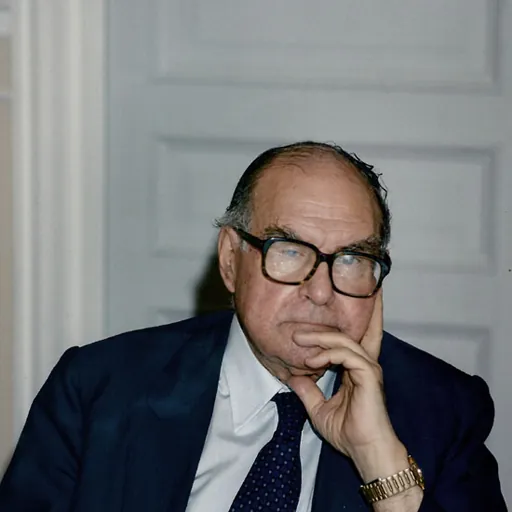
About Julián Marías
Lived 1914 – 2005 (aged 91). Julián Marías was a Spanish philosopher, writer, essayist, politician, university teacher and sociologist.
Julián Marías Aguilera (17 June 1914 – 15 December 2005) was a Spanish philosopher associated with the Generation of '36 movement. He was a pupil of the Spanish philosopher José Ortega y Gasset and member of the Madrid School.
Life and work Marías was born in the city of Valladolid, and moved to Madrid at the age of five. He went on to study philosophy at the Complutense University of Madrid, graduating in 1936. Within months of his graduation the Spanish Civil War broke out. During the conflict Marías sided with the Republicans, although his actual contributions were limited to propaganda articles and broadcasts.
After the end of the war in 1939, Marías was imprisoned for several months on false charges, and was unable to carry out university teaching activities after his release. His doctoral thesis was rejected due to the committee's animosity towards someone who was a disciple of Ortega. In 1940, his History of Philosophy was published — his first work published after the civil war — and although it ended up being a great publishing success, it led him to go through a period of financial difficulties due to his being banned from teaching by the Franco regime, and so Marías instead supported himself with private classes and translations.
In 1948 he co-founded, along with his former teacher José Ortega y Gasset, the Instituto de Humanidades (which he went on to head after the death of Ortega in 1955). Between the late 1940s and the 1970s, being unable to teach in Spain, Marías taught at numerous institutions in the United States, including Harvard University, Yale University, Wellesley College, the University of Oklahoma, and UCLA.
Marías wrote on a wide variety of subjects during his long career. A subject of particular interest was Miguel de Cervantes' Don Quixote. In 1964 he was elected into the Real Academia Española, and he won a Prince of Asturias award in 1996.
He is the father of novelist Javier Marías and art historian Fernando Marías, and married the sister of director Jesús Franco.
Works Juventud en el mundo antiguo. Crucero universitario por el Mediterráneo, Espasa-Calpe, Madrid, 1934 Historia de la filosofía, with a prologue by Xavier Zubiri, epilogue by José Ortega y Gasset, Revista de Occidente, Madrid 1941 (28th ed., 1976) La filosofía del Padre Gratry. La restauración de la Metafísica en el problema de Dios y de la persona, Escorial, Madrid 1941 Miguel de Unamuno, Espasa Calpe, Madrid, 1943 El tema del hombre, Revista de Occidente, Madrid, 1943 San Anselmo y el insensato y otros estudios de filosofía, Revista de Occidente, Madrid, 1944 Introducción a la filosofía, Revista de Occidente, Madrid, 1947 La filosofía española actual. Unamuno, Ortega, Morente, Zubiri, Espasa Calpe, Madrid, 1948 El método histórico de las generaciones, Revista de Occidente, Madrid, 1949 Ortega y tres antípodas. Un ejemplo de intriga intelectual, Revista de Occidente, Buenos Aires, 1950 Biografía de la Filosofía, Emecé, Buenos Aires, 1954 Ensayos de teoría, Barna, Barcelona, 1954 Idea de la Metafísica, Columba, Buenos Aires, 1954 La estructura social. Teoría y método, Sociedad de Estudios y Publicaciones, Madrid, 1955 Filosofía actual y existencialismo en España, Revista de Occidente, Madrid, 1955 El oficio del pensamiento, Biblioteca Nueva, Madrid, 1958 La Escuela de Madrid. Estudios de filosofía española, Emecé, Buenos Aires, 1959 Ortega. I. Circunstancia y vocación, Revista de Occidente, Madrid, 1960 Los españoles, Revista de Occidente, Madrid. 1962 La España posible en tiempo de Carlos III, Sociedad de Estudios y Publicaciones, Madrid, 1963 El tiempo que ni vuelve ni tropieza, Edhasa, Barcelona, 1964 Análisis de los Estados Unidos, Guadarrama, Madrid, 1968 Antropología metafísica. La estructura empírica de la vida humana, Revista de Occidente, Madrid, 1970 Visto y no visto. Crónicas de cine, Guadarrama, Madrid, 1970, 2 vols. Imagen de la India e Israel: una resurrección, Revista de Occidente, Madrid, 1973 Problemas del cristianismo, BAC, Madrid, 1979 La mujer en el siglo XX, Alianza, Madrid, 1980 Ortega. II. Las trayectorias, Alianza, Madrid, 1983 España inteligible. Razón histórica de las Españas, Alianza, Madrid, 1985 La mujer y su sombra, Alianza, Madrid, 1986 Ser español, Planeta, Barcelona, 1987 Una vida presente. Memorias, Alianza, Madrid, 1988–1989, 3 vols.: I (1914–1951), II (1951–1975), III (1975–1989). La felicidad humana, Alianza, Madrid 1989 Generaciones y constelaciones, Alianza, Madrid, 1989 Cervantes, clave española, Alianza, Madrid, 1990 Acerca de Ortega, Espasa Calpe, Madrid, 1991 La educación sentimental, Alianza, Madrid, 1992 Razón de la filosofía, Alianza, Madrid, 1993 Mapa del mundo personal, Alianza, Madrid 1993 El cine de Julián Marías. Escritos sobre cine, compilation edited by Fernando Alonso, Royal Books, Barcelona, 1994, 2 vols. Tratado de lo mejor, Alianza, Madrid, 1995 Persona, Alianza, Madrid, 1996 Sobre el cristianismo, Planeta Testimonio, Barcelona, 1997 El curso del tiempo, Tomos I y II, Alianza, 1998. 2 vols. Tratado sobre la convivencia, Martínez Roca, Barcelona 2000 Entre dos siglos, Alianza, Madrid, 2002 Obras, Revista de Occidente / Alianza Editorial, Madrid 1958–1970, 10 vols.
Selected works in translation Reason and Life: The Introduction to Philosophy, trans. Kenneth S. Reid and Edward Sarmiento (New Haven: Yale University Press, 1956). History of Philosophy, trans. Stanley Appelbaum and Clarence C. Strowbridge (New York: Dover Publications, 1966). Miguel de Unamuno, trans. Frances M. López-Morillas (Cambridge, Mass.: Harvard University Press, 1966). José Ortega y Gasset: Circumstance and Vocation, trans. Frances M. López-Morillas (Norman: University of Oklahoma Press, 1970). Metaphysical Anthropology: The Empirical Structure of Human Life, trans. Frances M. López-Morillas (University Park: The Pennsylvania State University Press, 1971). Philosophy as Dramatic Theory, trans. James Parsons (University Park: The Pennsylvania State University Press, 1971). Generations: A Historical Method, trans. Harold C. Raley (University: University of Alabama Press, 1971). America in the Fifties and Sixties: Julián Marías on the United States, trans. Blanche De Puy and Harold C. Raley (University Park: The Pennsylvania State University Press, 1971). A Biography of Philosophy, trans. Harold C. Raley (University: University of Alabama Press, 1987). The Structure of Society, trans. Harold C. Raley with an introduction by Robert K. Merton (University: University of Alabama Press, 1987). Understanding Spain, trans. Frances M. López-Morillas (Ann Arbor: University of Michigan Press, 1990). Gratry's Philosophy, trans. Mary L. O'Hara (Adelaide: ATF Press, 1991). The Christian Perspective, trans. Harold C. Raley (Houston: Halcyon Press, 2000). Persona (forthcoming).
Don’t just read it —
keep it.
Full-length biographies made to live with: read them, listen on the way to work, watch them tonight.
- E-book
- Audio
- Video
Instant download · yours to keep · every purchase keeps this site free
Important facts
People in Julián Marías's life
Named in this biography and alive at the same time





Related people
Same field, nearest in time



Contemporaries
People whose lives overlapped Julián Marías's


Frequently asked questions
Who was Julián Marías?
Spanish philosopher (1914-2005)
When was Julián Marías born?
Julián Marías was born on 17 June 1914 in Valladolid.
When did Julián Marías die?
Julián Marías died on 15 December 2005 in Madrid.
What was Julián Marías's occupation?
Julián Marías was a philosopher, writer, essayist, politician, university teacher and sociologist.
What nationality was Julián Marías?
Julián Marías was Spanish.
Sources & further reading
Cite this page
APA: Biography.guide. (2026). Julián Marías. https://biography.guide/julian-marias/
MLA: "Julián Marías." Biography.guide, https://biography.guide/julian-marias/.
Chicago: "Julián Marías." Biography.guide. https://biography.guide/julian-marias/.
Data last updated: 2026-09-23 · Spot an error? Report a correction.
Portrait: Wikimedia Commons · author & licence
Page generated 2026-09-27 05:06 UTC