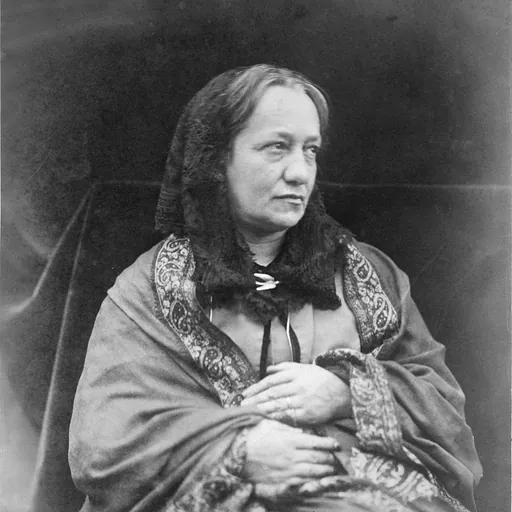
About Julia Margaret Cameron
Lived 1815 – 1879 (aged 63). Julia Margaret Cameron was a British photographer, artist and writer.
Julia Margaret Cameron (; 11 June 1815 – 26 January 1879) was an English photographer who is considered one of the most important portraitists of the 19th century. She is known for her soft-focus close-ups of famous Victorians and for illustrative images depicting characters from mythology, Christianity, and literature.
She was born in Calcutta, and after establishing herself among the Anglo-Indian upper-class, she moved to London where she made connections with the cultural elite. She then formed her own literary salon in the seaside village of Freshwater on the Isle of Wight.
Cameron took up photography at the age of 48, after her daughter gave her a camera as a present. She quickly produced a large body of portraits, and created allegorical images inspired by tableaux vivants, theatre, 15th-century Italian painters, and contemporary artists. She gathered much of her work in albums, including The Norman Album. She took around 900 photographs over a 12-year period.
Cameron's work was contentious. Critics derided her softly focused and unrefined images, and considered her illustrative photographs amateurish. However, her portraits of artists and scientists such as Henry Taylor, Charles Darwin and Sir John Herschel have been consistently praised. Her images have been described as "extraordinarily powerful" to Adeline Marie and James Peter Pattle.
James Pattle worked in India for the East India Company. His family had been involved with the Company for many years. He traced his line to a 17th-century ancestor living in Chancery Lane, London. Adeline's mother was a French aristocrat and the daughter of Chevalier Ambrose Pierre Antoine de l'Etang, who had been a page to Marie Antoinette and an officer in the Garde du Corps of King Louis XVI. After James died in Calcutta, he was shipped back to London in a barrel of rum for burial in Camberwell.
Julia was the fourth of ten children, three of whom died in infancy. Julia and six of her sisters They favoured Indian silks and shawls rather than the Victorian attire of other colonial women.
The sisters were sent to France as children to be educated, Julia living there with her maternal grandmother in Versailles from 1818 to 1834, after which she returned to India.
Julia's sisters all made advantageous matches. Older sister Adeline married Lt-General Colin Mackenzie. Sophia married Sir John Warrander Dalrymple. Louisa married Henry Vincent Bayley, a high court judge. Maria married Dr John Jackson, and among their children was Julia's godchild Julia Stephen. Sara (Sarah) married Sir Henry Thoby Prinsep, a director of the East India Company, and made their home at Little Holland House in Kensington, which became an important intellectual centre. Virginia Pattle married Charles Somers-Cocks, Viscount Eastnor (later 3rd Earl Somers). Their eldest daughter was Lady Henry Somerset, the temperance leader, while the younger, Lady Adeline Marie, became the Duchess of Bedford.
Marriage and social life
South Africa and Calcutta In 1835, after suffering several illnesses, Julia visited the Cape of Good Hope in South Africa with her parents to recover. In all, the Camerons raised 11 children, five of her own, five orphaned children of relatives, and an Irish girl named Mary Ryan whom they found begging on Putney Heath and whom Cameron used as a model in her photographs. Their son, Henry Herschel Hay Cameron, would also become a photographer. Julia often visited Little Holland House where her sister, Sara Prinsep, oversaw a literary and artistic salon "of Pre-Raphaelite painters, poets, and aristocrats with artistic pretensions". Benjamin Jowett echoed this when describing Cameron's reverence to these artists and poets after a later visit to Freshwater. The same salon-like atmosphere was present. "She is a sort of hero-worshipper, and the hero is not Mr Tennyson – he only occupies second place – but Henry Taylor." where they were neighbours of Taylor, In 1860, after an extended visit to Tennyson at Freshwater, Cameron bought a house next door. The family moved there, naming the property "Dimbola" after one of the coffee plantations in Ceylon.
Photography career Early career Cameron showed an interest in photography in the late 1850s and there are indications that she experimented with making photographs in the early 1860s.
Cameron converted a chicken coop into studio space. Later, in an unfinished autobiography, Annals of my Glasshouse, she wrote:I turned my coal-house into my dark room, and a glazed fowl house I had given my children became my glass house. The hens were liberated, I hope and believe not eaten. The profit of my boys upon new laid eggs was stopped, and all hands and hearts sympathised in my new labour, since the society of hens and chickens was soon changed for that of poets, prophets, painters and lovely maidens, who all in turn have immortalized the humble little farm erection. She presented a series of photographs, The Fruits of the Spirit, to the British Museum,
Concept of genius and beauty Cameron's portraits are partly the product of her intimacy and regard for the subject, but also intend to capture "particular qualities or essences—typically, genius in men and beauty in women". and "My aspirations are to ennoble Photography and to secure for it the character and uses of High Art by combining the real & Ideal & sacrificing nothing of Truth by all possible devotion to poetry and beauty." particularly the "long-necked, long-haired, immature beauty familiar in Pre-Raphaelite paintings".
Men Cameron's portraits of men were a kind of hero-worship. This series of images, influenced by Watts,
A few years later, George Bernard Shaw reviewed a posthumous exhibition of Cameron's, writing:While the portraits of Herschel, Tennyson and Carlyle beat hollow anything I have ever seen, right on the same wall, and virtually in the same frame, there are photographs of children with no clothes on, or else the underclothes by way of propriety, with palpably paper wings, most inartistically grouped and artlessly labelled as angels, saints or fairies. No-one would imagine that the artist who produced the marvellous Carlyle would have produced such childish trivialities. In the introduction to this collection, Fry wrote that Cameron's allegorical photographs "must all be judged as failures from an aesthetic viewpoint". Gernsheim's review echoed the sentiments of Shaw and Fry, criticising her allegorical and illustrative photos while praising her portraits:If the majority of Mrs. Cameron's subject pictures seem to us affected, ludicrous and amateurish, and appear in our opinion to be failures, how masterly, on the other hand, are her straightforward, truthful portraits, which are entirely free from false sentiment, and which compensate for the errors of taste in her studies.
In 2018, Cameron's Norman Album from 1869 was deemed by the UK government's advisory committee on the export of works of art to be of "outstanding aesthetic importance and significance to the study of the history of photography and, in particular, the work of Julia Margaret Cameron—one of the most significant photographers of the 19th century".
In 2019 Cameron was inducted into the International Photography Hall of Fame and Museum.
In 2026, English Heritage unveiled a Blue Plaque in Cameron's honour on 10 Chesham Place, Belgravia, London, where she lived from 1848 in a house designed by Thomas Cubitt.
Museum and Trust Dimbola on the Isle of Wight houses the Dimbola Museum and Galleries owned and run by the Julia Margaret Cameron Trust, a registered charity that promotes her life and work.
Retrospective exhibitions Major retrospectives include the Metropolitan Museum of Art in New York (2013); the Victoria and Albert Museum (2015) for a 200th anniversary (this travelled to Sydney, Australia); and the National Portrait Gallery (2018) placed her work in relationship to the work of her contemporaries, Lady Clementina Hawarden, Oscar Rejlander, and Lewis Carroll.
Retrospective exhibitions include: Metropolitan Museum of Art United States
Art Gallery of New South Wales Australia
Science Museum United Kingdom
Victoria and Albert Museum United Kingdom
Mitsubishi Ichigokan Museum Japan
Albums
List of selected publications
Cameron, J. M. P. (1875). Illustrations by Julia Margaret Cameron of Alfred Tennyson's Idylls of the King and other poems Cameron, J. M. P. (1889). Unfinished autobiography "Annals of my glass house" by Julia Margaret Cameron, written 1874, first published 1889 Cameron, J. M. (1975). The Herschel album: an album of photographs . London (2 St Martin's Place, WC2H 0HE): National Portrait Gallery Cameron, J. M., & Ford, C. (1975). The Cameron Collection: an album of photographs . Wokingham: Van Nostrand Reinhold for the National Portrait Gallery Cameron, J. M. P., & Weaver, M. (1986). Whisper of the muse: the Overstone album & other photographs . Malibu: J. Paul Getty Museum Cameron, J. M. P., & Rosen, J. (2024). Julia Margaret Cameron: The Colonial Shadows of Victorian Photography.Paul Mellon Centre for Studies in Britich Art, distributed by Yale University Press
Footnotes
Don’t just read it —
keep it.
Full-length biographies made to live with: read them, listen on the way to work, watch them tonight.
- E-book
- Audio
- Video
Instant download · yours to keep · every purchase keeps this site free
Important facts
more
Julia Pattle, Cameron, Julia Margaret, 1815-1879People in Julia Margaret Cameron's life
Named in this biography and alive at the same time





Related people
Same field, nearest in time


Contemporaries
People whose lives overlapped Julia Margaret Cameron's



Frequently asked questions
Who was Julia Margaret Cameron?
British photographer (1815–1879)
When was Julia Margaret Cameron born?
Julia Margaret Cameron was born on 11 June 1815 in Kolkata, Garden Reach.
When did Julia Margaret Cameron die?
Julia Margaret Cameron died on 26 January 1879 in Kalutara.
What was Julia Margaret Cameron's occupation?
Julia Margaret Cameron was a photographer, artist and writer.
What nationality was Julia Margaret Cameron?
Julia Margaret Cameron was British.
Sources & further reading
· Wikipedia: Julia Margaret Cameron
· DBpedia: Julia Margaret Cameron
Cite this page
APA: Biography.guide. (2026). Julia Margaret Cameron. https://biography.guide/julia-margaret-cameron/
MLA: "Julia Margaret Cameron." Biography.guide, https://biography.guide/julia-margaret-cameron/.
Chicago: "Julia Margaret Cameron." Biography.guide. https://biography.guide/julia-margaret-cameron/.
Data last updated: 2026-09-21 · Spot an error? Report a correction.
Portrait: Wikimedia Commons · author & licence
Page generated 2026-09-27 04:59 UTC