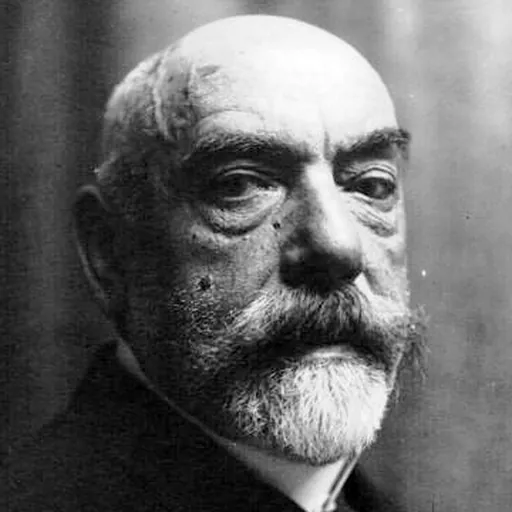
About Jules Coutan
Lived 1848 – 1939 (aged 90). Jules Coutan was a French sculptor.
Jose C. Paz tomb, La Recoleta Cemetery, Buenos Aires, Argentina
Jules-Félix Coutan (; 22 September 1848 – 23 February 1939) was a French sculptor and educator.
Life As a student at the École des Beaux-Arts, Coutan was awarded the Prix de Rome in 1872; after his return to Paris he executed the fountain group France Bearing the Torch of Civilization for the Exposition Universelle (1889), one of the two prominent sculptural commissions for the exposition grounds. Later he taught at the École des Beaux-Arts from 1900, where he expressed his disdain for the researches of Rodin (as ) and the Impressionist sculptors who followed him. He was elected to the Académie des Beaux-Arts in 1905.
Coutan is best known in the United States for the sculptural group above the entrance to Grand Central Terminal in New York City. For Grand Central Terminal, Coutan was contracted to provide a quarter-size scale plaster model of the three-figure allegorical Transportation group, which he developed from 1911 through 1914. (Coutan never visited the U.S.) The carving was performed by the William Bradley & Son of Long Island City.
The small bronzes, some stamped by the founders Thiebaut Frères, that represented a constant source of income for Coutan and a genre typical of his output, appear with some frequency on the art market.
Among Coutan's students were Hippolyte Lefèbvre, Raymond Delamarre, Louis-Eugène Tauzin, Henri Proszynski and the Argentine sculptor Rogelio Yrurtia.
Work
fountain group France Bearing the Torch of Civilization for the Exposition Universelle (1889) caryatids for the Opéra-Comique, Paris, 1899 reliefs Science and Labor for the Pont de Passy (now the Pont de Bir-Hakeim), Paris bas-reliefs for the polychrome terra-cotta facade in the Square Félix-Desruelles, with architect Charles Risler, for Sèvres Porcelain, circa 1900 figure of La France de la Renaissance for the Pont Alexandre III, circa 1900 high relief, The Eagle Hunters for the facade of the Muséum national d'histoire naturelle in Paris; also the plaster model at the Musée d'Orsay (1893–1900); bronze cast (1900), installed Glory of Commerce group for Grand Central Terminal, NYC, 1914 the bust of Georges-Eugène Haussmann at the Père Lachaise Cemetery Franco-Prussian War Memorial, Poitiers angel figures for the José C. Paz tomb, La Recoleta Cemetery, Buenos Aires, Argentina monument of Carlos Pellegrini Buenos Aires, Argentina
Don’t just read it —
keep it.
Full-length biographies made to live with: read them, listen on the way to work, watch them tonight.
- E-book
- Audio
- Video
Instant download · yours to keep · every purchase keeps this site free
Important facts
People in Jules Coutan's life
Named in this biography and alive at the same time




Related people
Same field, nearest in time



Contemporaries
People whose lives overlapped Jules Coutan's


Frequently asked questions
Who was Jules Coutan?
French sculptor (1848-1939)
When was Jules Coutan born?
Jules Coutan was born on 22 September 1848 in Paris.
When did Jules Coutan die?
Jules Coutan died on 23 February 1939 in Paris.
What was Jules Coutan's occupation?
Jules Coutan was a sculptor.
What nationality was Jules Coutan?
Jules Coutan was French.
Sources & further reading
Cite this page
APA: Biography.guide. (2026). Jules Coutan. https://biography.guide/jules-coutan/
MLA: "Jules Coutan." Biography.guide, https://biography.guide/jules-coutan/.
Chicago: "Jules Coutan." Biography.guide. https://biography.guide/jules-coutan/.
Data last updated: 2026-09-23 · Spot an error? Report a correction.
Portrait: Wikimedia Commons · author & licence
Page generated 2026-09-27 05:04 UTC