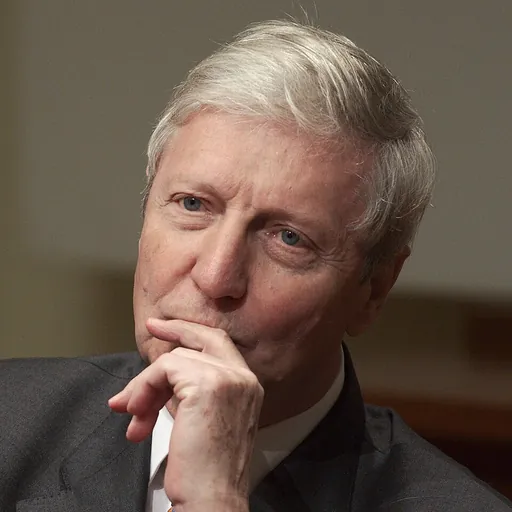
About Jules A. Hoffmann
Born 1941. Jules A. Hoffmann is a French and Luxembourgish biologist, immunologist, physician, university teacher and researcher.
Jules Alphonse Nicolas Hoffmann (; born 2 August 1941) is a Luxembourgish-French biologist. During his youth, growing up in Luxembourg, he developed a strong interest in insects under the influence of his father, Jos Hoffmann. This eventually resulted in the younger Hoffmann's dedication to the field of biology using insects as model organisms. He currently holds a faculty position at the University of Strasbourg. He is a research director and member of the board of administrators of the National Center of Scientific Research (CNRS) in Strasbourg, France. He was elected to the positions of Vice-President (2005–2006) and President (2007–2008) of the French Academy of Sciences.
Hoffmann and Bruno Lemaitre discovered the function of the fruit fly Toll gene in innate immunity. Its mammalian homologs, the Toll-like receptors, were discovered by Beutler. Toll-like receptors identify constituents of other organisms like fungi and bacteria, and trigger an immune response, explaining, for example, how septic shock can be triggered by bacterial remains.
In 2012, Hoffman was appointed as an Honorary Professor in the School of Biochemistry and Immunology at Trinity College Dublin.
Education Jules Hoffmann went to the Lycée de Garçons de Luxembourg before leaving to France. Hoffmann received undergraduate degrees in biology and chemistry at the University of Strasbourg, France. In 1969, he completed his Ph.D. in biology also at the University of Strasbourg under Pierre Joly in Laboratory of General Biology at the Institute of Zoology. by Lemaitre and Hoffmann in 1996 illuminated the possible existing innate immunity in Drosophila in response to fungal challenge. Later works identified that Toll transmembrane receptors are present in a wide variety of phyla and are conserved through evolution along with conservation of NF-κB activating cascades. and the Russian Academy of Sciences.
Hoffmann became a Commander of the Legion of Honour in 2012.
In 2015, Hoffmann signed the Mainau Declaration 2015 on Climate Change on the final day of the 65th Lindau Nobel Laureate Meeting. The declaration was signed by a total of 76 Nobel Laureates and handed to then-President of the French Republic, François Hollande, as part of the successful COP21 climate summit in Paris.
Controversy
Bruno Lemaitre, a research associate in the Hoffmann laboratory at the time when the major work on Drosophila innate immunity was conducted (for which Hoffmann was awarded the Nobel), claims he was inadequately recognized by Hoffmann as the instigator of and main contributor to the Nobel-winning work. Lemaitre now supervises his own laboratory at the École Polytechnique Fédérale de Lausanne in Switzerland.
Awards Hoffmann, Göran K. Hansson (chairman of the Nobel Committee for Physiology or Medicine) and Bruce Beutler
2003 Cancer Research Institute William B. Coley Award 2004 Robert Koch Prize 2007 Balzan Prize together with Bruce A. Beutler for Innate Immunity 2010 Lewis S. Rosenstiel Award (shared with Ruslan M. Medzhitov) 2010 Keio Medical Science Prize 2011 Gairdner Foundation International Award (shared with Shizuo Akira) 2011 Shaw Prize (shared with Bruce A. Beutler and Ruslan M. Medzhitov) 2011 CNRS Gold medal 2011 Nobel Prize in Physiology or Medicine (shared with Bruce Beutler and Ralph M. Steinman)
Don’t just read it —
keep it.
Full-length biographies made to live with: read them, listen on the way to work, watch them tonight.
- E-book
- Audio
- Video
Instant download · yours to keep · every purchase keeps this site free
Important facts
People in Jules A. Hoffmann's life
Named in this biography and alive at the same time




Related people
Same field, nearest in time

Contemporaries
People whose lives overlapped Jules A. Hoffmann's


Frequently asked questions
Who is Jules A. Hoffmann?
French biologist
When was Jules A. Hoffmann born?
Jules A. Hoffmann was born on 2 August 1941 in Echternach.
What is Jules A. Hoffmann's occupation?
Jules A. Hoffmann is a biologist, immunologist, physician, university teacher and researcher.
What nationality is Jules A. Hoffmann?
Jules A. Hoffmann is French and Luxembourgish.
Sources & further reading
· Wikipedia: Jules A. Hoffmann
Cite this page
APA: Biography.guide. (2026). Jules A. Hoffmann. https://biography.guide/jules-a-hoffmann/
MLA: "Jules A. Hoffmann." Biography.guide, https://biography.guide/jules-a-hoffmann/.
Chicago: "Jules A. Hoffmann." Biography.guide. https://biography.guide/jules-a-hoffmann/.
Data last updated: 2026-09-21 · Spot an error? Report a correction.
Portrait: Wikimedia Commons · author & licence
Page generated 2026-09-27 04:59 UTC