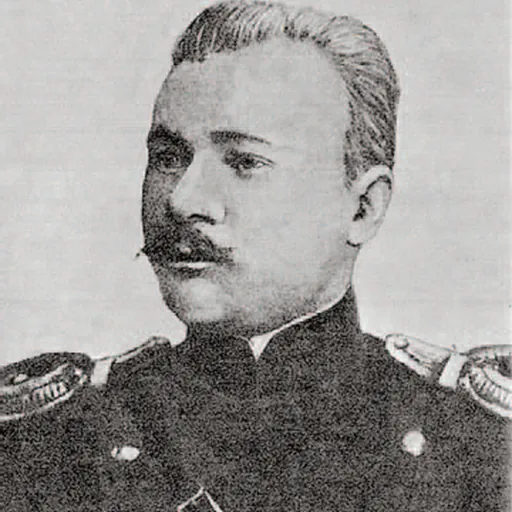
About Jukums Vācietis
Lived 1873 – 1938 (aged 64). Jukums Vācietis was a Russian military officer, historian, university teacher, colonel and docent.
Jukums Vācietis (; – 28 July 1938) was a Latvian and Soviet military commander. He was a rare example of a notable Soviet leader who was not a member of the Communist Party (or of any other political party), until his demise during the Great Purge in the 1930s.
Early life Jukums Vācietis's family were Latvian labourers. From about the age of six, he worked as a shepherd and as a labourer, while he was a pupil at the Šķēde Parish School. From 1889–1891 he studied at the Ministry of Kuldīga school. At the same time, he worked in a match factory.
Military career Vācietis started his military career in Imperial Russia in 1891, and reached the rank of second lieutenant after graduating from infantry cadet school in 1895. In 1914, at the start of World War I, he saw combat as a battalion commander in Poland and East Prussia, and was wounded several times. After hospital treatment, he was promoted to the rank of colonel. From July to September 1918, Vācietis commanded the Eastern Front, which he created out of scattered units fighting for the Bolsheviks in Siberia against the White Army and the Czechoslovak Legion. During his two months as commander of the front, the Red Army scored its first major victory of the Russian Civil War by recapturing Kazan. |
In summer 1919 Vācietis proposed that the Eastern Front should halt military operations having reached the Urals, so that troops could be transferred to the south for the campaign against General Denikin, and the Don Cossacks, but Kamenev insisted that they could spare troops for the southern front and still advance past the Urals into Siberia. He was proved right, and on 3 July 1919, Kamenev replaced Vācietis as commander-in-chief of the Red Army. On 8 July 1919, Vācietis was arrested under the accusation of membership in a counter-revolutionary reactionary White Guardist organization, but was soon released when the charge was proved false. Trotsky suspected that "dissatisfied with his removal from the post of Commander-in-Chief, he had engaged in reckless talk with officers close to him." He also believed that Stalin was behind Vācietis's arrest.
In 1922 Vācietis became a professor of the RKKA Military Academy (future Frunze Military Academy). During this time, he wrote several books, most notable among them being 'Latvian Riflemen's Historical Importance'. In 1935 Vācietis was assigned a personal rank of Komandarm 2nd rank.
On 29 November 1937, during the height of Stalin's Great Purge, Vācietis was arrested by the NKVD as a member of the alleged "Latvian Fascist Organization within the RKKA". On 28 July 1938, he was sentenced to death for "espionage and belonging to a counterrevolutionary terrorist organization" and shot the same day. Vācietis was rehabilitated (posthumously exonerated) in 1957.
Family He was married to Margarita Adolfina Ottilia Kerger (1882–no earlier than 1970). They had three children: daughters Irina-Ottilia Eliza (May 27, 1905–?) and Vera (1911–?), and a son, Joachim (July 19, 1909–late 1930s). His wife and children were Lutheran. In 1939, she and her daughters repatriated to Germany, while their son remained in Latvia; that branch of the family continues to this day. After the Second World War, she and her daughters moved to the United States, where she died.
Literature
Don’t just read it —
keep it.
Full-length biographies made to live with: read them, listen on the way to work, watch them tonight.
- E-book
- Audio
- Video
Instant download · yours to keep · every purchase keeps this site free
Important facts
Related people
Same field, nearest in time




Contemporaries
People whose lives overlapped Jukums Vācietis's


Frequently asked questions
Who was Jukums Vācietis?
Soviet army commander (1873-1938)
When was Jukums Vācietis born?
Jukums Vācietis was born on 11 November 1873 in Jaunlutriņi.
When did Jukums Vācietis die?
Jukums Vācietis died on 28 July 1938 in Moscow.
What was Jukums Vācietis's occupation?
Jukums Vācietis was a military officer, historian, university teacher, colonel and docent.
What nationality was Jukums Vācietis?
Jukums Vācietis was Russian.
Sources & further reading
Cite this page
APA: Biography.guide. (2026). Jukums Vācietis. https://biography.guide/jukums-vacietis/
MLA: "Jukums Vācietis." Biography.guide, https://biography.guide/jukums-vacietis/.
Chicago: "Jukums Vācietis." Biography.guide. https://biography.guide/jukums-vacietis/.
Data last updated: 2026-09-23 · Spot an error? Report a correction.
Portrait: Wikimedia Commons · author & licence
Page generated 2026-09-27 05:07 UTC