
About Juan José Torres
Lived 1920 – 1976 (aged 56). Juan José Torres was a Bolivian military officer, diplomat and politician.
Juan José Torres González (5 March 1920 – 2 June 1976) was a Bolivian socialist politician and military leader who served as the 50th president of Bolivia from 1970 to 1971, when he was ousted in a coup that resulted in the dictatorship of Hugo Banzer. He was popularly known as "J.J." (Jota-Jota). He went into exile in Argentina. Torres was assassinated in 1976 in Buenos Aires, likely by agents associated with the Argentine regime of Jorge Rafael Videla. It has also been alleged that it was done with acquiescence of Hugo Banzer as part of Operation Condor.
Early life Torres was born in Cochabamba to a poor Aymara-Mestizo family and joined the army in 1941. He served as military attache to Brazil from 1964 and as ambassador to Uruguay from 1965 to 1966, when he was appointed Labor Minister.
He became the reform-minded Alfredo Ovando's right-hand man and commander-in-chief of the armed forces when the latter came to power as a result of a coup d'état in September 1969. Torres became one of the more left-leaning officers in the Bolivian military, urging Ovando to enact more far-reaching reforms and to stand up to the more conservative officers. As a member of the nationalist and reformist movement of the army, he denounced capitalism because he believed it perpetuates the country's underdevelopment and dependence on foreign countries. In 1969, he had been one of the main protagonists in the nationalization of the Gulf Oil and had participated in the occupation of the company's headquarters in La Paz. On October 6, 1970, an anti-government coup d'état took place, led by right-wing military commanders. Much blood was shed on the streets of various major cities, with military garrisons fighting each other on behalf of one camp or the other. Eventually, President Ovando sought asylum in a foreign embassy, believing all hope was lost. But the leftist military forces re-asserted themselves under the combative leadership of general Torres, and eventually triumphed. Worn out by 13 grueling months in office, Ovando agreed to leave the presidency in the hands of his friend, general Torres. The latter was sworn in and went on to govern the country for 10 difficult and tumultuous months.
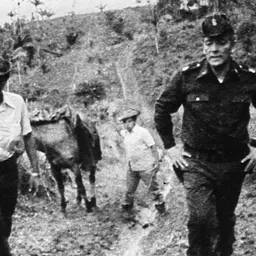
Presidency General Torres with a group of friends, including then Colonel Hernán Terrazas Céspedes in the back. Though most military leaders throughout Latin American history have been associated with right-wing politics, Torres - like his contemporaries Juan Velasco in Peru and Omar Torrijos in Panama - was decidedly left wing. He was known as a man of the people and was popular in some sectors of the Bolivian society. His mestizo and even native-Andean features enhanced his standing with the poorer sectors of society. Despite Torres' best intentions, his marked leftward drift did not stabilize the country. He called an Asamblea del Pueblo, or People's Assembly, in which representatives of specific "proletarian" sectors of society were represented (miners, unionized teachers, students, peasants). The Assembly was imbued with all the powers of a working parliament, even though opponents of the government tended to call it a gathering of "virtual soviets". Torres also allowed the legendary (and Trotskyist-oriented) labor leader, Juan Lechín, to resume his post as head of the Central Obrera Boliviana/Bolivian Workers' Union (COB) and to operate without a single restraint. To his surprise, Lechín proceeded to cripple the government with strikes.
In his first speech as Head of State, he specified the direction of his government: "We will promote the alliance of the armed forces with the people and build nationality on four pillars: workers, academics, peasants and the military. We will not separate the people from their armed arm and impose a nationalist-revolutionary government that will not surrender, will defend natural resources, if necessary at the cost of its own life." It established a People's Assembly, similar to a soviet, which met in Parliament; expropriated the sugar industry; began negotiations with the Chilean government of Salvador Allende in order to obtain Bolivian access to the sea; granted an amnesty for those former rebels who had not been murdered after their capture (including Régis Debray); increased the university budget and called for the closure of the United States Strategic Communications Centre (known as Guantanamito).
In 1970, Torres attended a conference of the Non-Aligned Movement, a first for a Bolivian leader.
He nationalized some American-owned property, such as the Matilde zinc mine, and ordered the US Peace Corps out of the country.
His government was quickly subjected to external pressure. US Ambassador Ernest V. Siracusa (who participated in the coup d'état against Jacobo Arbenz in Guatemala in 1954, then was expelled from Peru in 1968, accused of being a CIA man) ordered him to change his policy, threatening him with financial blockage. The World Bank and the Inter-American Development Bank refused to grant Bolivia the loans necessary to pursue industrial development work. But his government was not stable, because it was supported only by a minority of the army and the country's middle class. The wealthy classes, part of the army, the right wing of the MNR and the Phalangist party plotted against him. When he cut military spending to finance education, this increased resentment within the army. His body was left under a bridge about 100 kilometers east of Buenos Aires.
In 1983, his body was repatriated to Bolivia.
Don’t just read it —
keep it.
Full-length biographies made to live with: read them, listen on the way to work, watch them tonight.
- E-book
- Audio
- Video
Instant download · yours to keep · every purchase keeps this site free
Important facts
People in Juan José Torres's life
Named in this biography and alive at the same time


Related people
Same field, nearest in time



Contemporaries
People whose lives overlapped Juan José Torres's



Frequently asked questions
Who was Juan José Torres?
61th Bolivian president (1920-1976)
When was Juan José Torres born?
Juan José Torres was born on 5 March 1920 in Cochabamba.
When did Juan José Torres die?
Juan José Torres died on 2 June 1976 in San Andrés de Giles.
What was Juan José Torres's occupation?
Juan José Torres was a military officer, diplomat and politician.
What nationality was Juan José Torres?
Juan José Torres was Bolivian.
Sources & further reading
Cite this page
APA: Biography.guide. (2026). Juan José Torres. https://biography.guide/juan-jose-torres/
MLA: "Juan José Torres." Biography.guide, https://biography.guide/juan-jose-torres/.
Chicago: "Juan José Torres." Biography.guide. https://biography.guide/juan-jose-torres/.
Data last updated: 2026-09-20 · Spot an error? Report a correction.
Page generated 2026-09-27 05:30 UTC