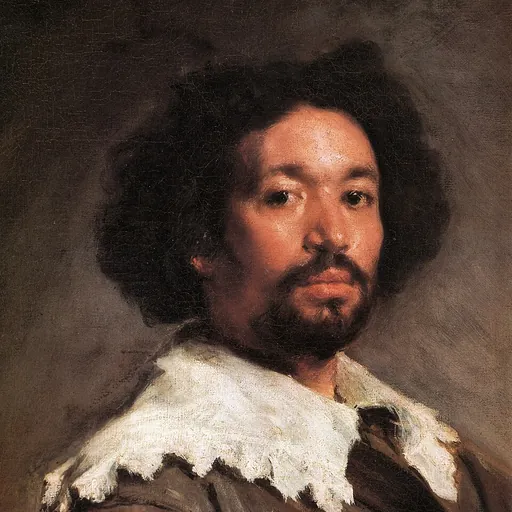
About Juan de Pareja
Lived 1606 – 1670 (aged 63–64). Juan de Pareja was a Spanish painter, artist and scrivener.
Juan de Pareja ( – ) was a Spanish painter. Born enslaved, he is known primarily as a member of the household and workshop of painter Diego Velázquez, who freed him in 1650. His 1661 work The Calling of Saint Matthew (sometimes also referred to as The Vocation of Saint Matthew) is on display at the Museo del Prado in Madrid, Spain.
Biography Juan de Pareja was a Spaniard born into slavery in Southern Spain, probably in Antequera in Malaga province around 1610. Little is known on his background although Antonio Palomino describes him as being "of mixed parentage and unusual color."
The first known reference to Juan de Pareja as a painter is in a letter addressed to Pedro Galindo, attorney of the city of Seville, written on 12 May 1630, in which Juan de Pareja requests permission to move to Madrid in order to continue his studies together with his brother Jusepe. The authenticity of this document is questioned since within it he claims to be a free man and does not once mention Velázquez.
It is unknown at what time he began serving Diego Velázquez. In 1642 he signed as a witness in a power of attorney for Velázquez in a lawsuit against scribes in the criminal court. He was also a witness in October and December 1647, for two other powers of attorney to manage his assets in Seville granted by Velázquez and his wife Juana Pacheco. He would again sign a similar document in 1653 for Francisca Velázquez, daughter of the painter.
In 1649 he accompanied Velázquez on his second trip to Italy. This is where Velázquez painted his famous painting Portrait of Juan de Pareja, currently in the Metropolitan Museum of Art of New York. The painting was exhibited in the Pantheon of Rome in March 1650 during the festivities in honor of the Patron of the Virtuosos of the Pantheon, which Velázquez had recently joined. On 23 November, while still in Rome, Velázquez granted him a letter of freedom, which would come into effect after four years on the condition that he did not escape or commit any criminal act in that period. The document of his manumission, discovered by Jennifer Montagu, is held in the Archivio di Stato in Rome.
From then on until his death in Madrid he worked as an independent painter, demonstrating knowledge acquired in Velazquez's workshop, where he likely had wider responsibilities than Palomino suggests, as well as his knowledge of various other Spanish and Italian painters.
In fiction In 1965, Elizabeth Borton de Treviño published a fictionalized autobiography entitled I, Juan de Pareja, that presents imagined details into the lives of both painters.
Works Portrait of Agustín Moreto (1648–53), oil on canvas, Lazaro Galdiano Foundation, Madrid, Spain Portrait of a Monk (1651), oil on canvas, Hermitage Museum, Saint Petersburg, Russia The Flight into Egypt (1658), John and Mable Ringling Museum of Art, Sarasota, Florida The Calling of Saint Matthew (also known as The Vocation of Saint Matthew) (1661), oil on canvas, Museo del Prado, Madrid, Spain Saints John the Evangelist and Orontius, Augustine Collection, Madrid, Spain The Lady of Guadalupe, Augustine Collection, Madrid, Spain Portrait of the Architect José Ratés Dalmau, oil on canvas (116 x 97 cm), Museu de Belles Arts de València, Spain Portrait of Philip IV, King of Spain (c.1656), oil on canvas, Columbia Museum of Art, United States El bautismo de Cristo (1667), Museo de Huesca/Museo del Prado, Huesca, Spain Dog with a Candle and Lilies (c.1660s), oil on canvas, Indianapolis Museum of Art, United States
Works depicting Pareja Portrait of Juan de Pareja (1648), by Diego Velázquez, Metropolitan Museum of Art, United States Portrait of Juan de Pareja, the Assistant to Velázquez (1960), by Salvador Dalí, Minneapolis Institute of Arts, United States The Calling of Saint Matthew by Juan de Pareja, who painted himself as the leftmost figure (1661), oil on canvas, Museo del Prado, Madrid, Spain
Gallery
Don’t just read it —
keep it.
Full-length biographies made to live with: read them, listen on the way to work, watch them tonight.
- E-book
- Audio
- Video
Instant download · yours to keep · every purchase keeps this site free
Important facts
more
Pareja, Juan Pareja, J. PerejaPeople in Juan de Pareja's life
Named in this biography and alive at the same time

Related people
Same field, nearest in time
Contemporaries
People whose lives overlapped Juan de Pareja's






Frequently asked questions
Who was Juan de Pareja?
Spanish painter (1606-1670)
When was Juan de Pareja born?
Juan de Pareja was born in 1606 in Antequera.
When did Juan de Pareja die?
Juan de Pareja died in 1670 in Madrid.
What was Juan de Pareja's occupation?
Juan de Pareja was a painter, artist and scrivener.
What nationality was Juan de Pareja?
Juan de Pareja was Spanish.
Sources & further reading
Cite this page
APA: Biography.guide. (2026). Juan de Pareja. https://biography.guide/juan-de-pareja/
MLA: "Juan de Pareja." Biography.guide, https://biography.guide/juan-de-pareja/.
Chicago: "Juan de Pareja." Biography.guide. https://biography.guide/juan-de-pareja/.
Data last updated: 2026-09-22 · Spot an error? Report a correction.
Portrait: Wikimedia Commons · author & licence
Page generated 2026-09-27 05:03 UTC