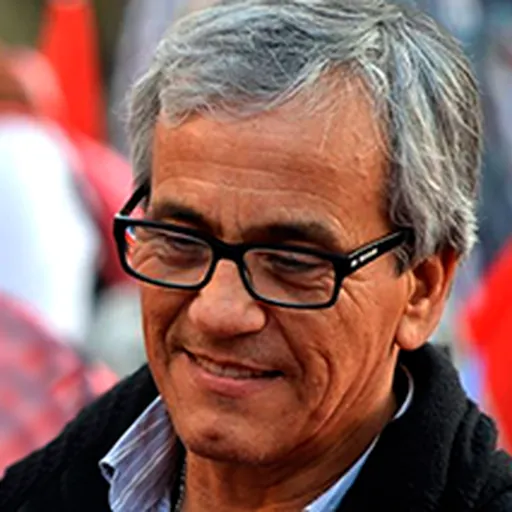
About Juan Castillo
Born 1957. Juan Castillo is an Uruguayan politician and trade unionist.
Juan Alberto Castillo (born 27 November 1957) is a Uruguayan trade unionist, maritime worker, and politician who has served as the Minister of Labour and Social Welfare since March 2025, in the cabinet of President Yamandú Orsi.
A longtime leader within the Uruguayan labour movement, Castillo began his career as a dredging operator in the Port of Montevideo and rose to become a key figure in the country's main trade union federation, the PIT-CNT, serving as its General Coordinator for over a decade.
Castillo served as the Secretary General of the Communist Party of Uruguay from 2017 until 2025 and was a Senator of the Republic from 2017 to 2020. He previously held the position of National Director of Labour under President Tabaré Vázquez and was one of the vice presidents of the Broad Front coalition. His political career has been defined and his influence within both the Communist Party and the Uruguayan labour movement.
During his tenure as Minister, Castillo has focused on mediating between trade unions and the government, reducing informal labour, strengthening collective bargaining, and addressing workplace accidents. Ideologically a Marxist-Leninist, he has also supported proposals for a wealth tax to fund social programs and has advocated for advance notice of corporate restructurings to protect domestic jobs.
Early life Castillo was born in La Paz, Canelones in 1957. He attended School No. 164 in Jardines de Manga until the second grade and completed the rest of his primary education at the School No. 106 in Parque Artigas, Las Piedras. Castillo's parents were supporters of Uruguay's traditional parties.
He attended the University of Labour of Uruguay (UTU) in Las Piedras for his initial training as a lathe operator-mechanic, then continued at the Naval Industries School in Montevideo for his advanced studies, graduating in 1976 as a Naval Mechanic and Machinist. He was a member of the Representative Board of the Inter-Union Plenary of Workers – National Convention of Workers (PIT-CNT) and its Executive Secretariat, holding various roles including Secretary of Organisation, Propaganda, and International Relations. Beginning in 1999, he served as General Coordinator of the PIT-CNT.
In 2008, Castillo became increasingly involved in internal debates within the Broad Front ahead of the 2009 general election. That year he was mentioned as a potential candidate for the presidency of the coalition, though he stated that any decision regarding such a role would have to be determined by the Communist Party of Uruguay.
At the election, Castillo was elected as a senator but didn't take his seat, stating that he believed he would have more influence from the labour movement to defend workers than he would have in a similar capacity in Parliament.
In 2011, Castillo was one of four candidates running for President of the Broad Front, representing the PCU. The other candidates were Ernesto Agazzi (MPP), Mónica Xavier (PS), and Enrique Rubio (VA). He left his position as coordinator of the PIT-CNT in 2012 to assume one of the vice presidencies of the Broad Front.
National Director of Labour (2015–2017) Following the 2014 general election, Castillo was appointed National Director of Labour under President Tabaré Vázquez. The position placed him in charge of overseeing labour relations and negotiations between unions and employers. On 1 March 2015, he was formally appointed into the position by decree of President Vázquez. Shortly after his appointment, he met with representatives of both unions and business groups to discuss ongoing labour issues, including proposals related to weekly working hours. The PIT-CNT had called for changes to the government's wage negotiation strategy, including a more accelerated increase to the minimum wage reaching 15,000 pesos by 2018, "special treatment" for wages below that threshold, and a redistribution of wealth whereby "business profits be a little smaller so that wages can be a little better."
In 2017, Castillo found himself at the center of a political controversy. When the government declared education an essential service during a teachers' strike and therefore not allowed to strike—a measure opposed by both the Communist Party and trade unions—he placed his position "at the disposal" of the government rather than resigning outright. He assumed the position on 18 June, and resigned from his position as National Director of Labour on 20 June to focus on the Secretary General position. Castillo stated that while it wasn't prohibited to hold both positions at once, there was a conflict of interest, stating that "There is an ethical issue of being at the head of the Labour Directorate, which requires maintaining a balance between workers and employers, while being Secretary General of the Party." The decision for him to take the seat was approved by the Party's Central Committee. He clarified that his succession was part of a planned arrangement and was not related to ongoing judicial proceedings involving the legislator who previously occupied the seat, Michelle Suárez. He lost his seat at the 2019 general election.
Minister of Labour and Social Welfare (2025–present) On 1 March 2025, Juan Castillo was appointed Minister of Labour and Social Welfare as part of the newly inaugurated cabinet of President Yamandú Orsi. Shortly after taking office in March 2025, he outlined a strategic plan focused on reducing informal labour, increasing the minimum wage, strengthening collective bargaining, and addressing workplace accidents.
In June 2025, Castillo was elected Vice-President of the 113th International Labour Conference, where he represented Uruguay in international labour discussions.
In October 2025, following blockades at access points to the port of Montevideo triggered by a worker's dismissal, Castillo convened representatives from the Single Union of Cargo Transport (Sutcra) and the affected companies at the Ministry of Labour and Social Welfare (MTSS) headquarters. The union subsequently decided to lift its blockade and return to work, allowing discussions to proceed. By late 2025, he reported that over 50% of the councils had reached agreements, with negotiations proceeding within the established deadlines.
In August 2025, Castillo oversaw the launch of the first edition of the "Uruguay Impulsa: Work and Training" program, an initiative aimed at generating job and training opportunities for over 5,000 people across the country. Speaking at the event, he highlighted the high public demand for employment, noting that more than 162,000 individuals had applied, and emphasised the program's dual focus on temporary work and professional training to support participants' future integration into the formal labour market. He described the news as surprising, noting that the MTSS had received no prior warning from the company and had even recently been informed of its plans to expand and hire more workers. However despite winning, Castillo announced that he would not take the position, and instead became the Secretary of International Relations for the PCU. Castillo stated that he would not be able to fulfill the duties as Secretary General due to his role as a minister. He defended a proposal by the MTSS requiring companies to provide advance notice to authorities before undertaking major restructurings or closures, arguing that such measures would give the government additional tools to respond to potential job losses.
Political philosophy In a 2011 interview with El País, when asked whether the collapse of the Soviet Union and other communist states demonstrated that socialism was a fundamentally flawed economic system, Castillo responded that "I'm not just talking about an economic system. Communism goes beyond that, it's a way of life. This doesn't mean I defend tooth and nail that the entire economy must be state-owned. What I defend is a system that doesn't exploit man, a system where you don't have to go out and work 14 hours a day to take home a shitty 14,000 pesos a month; where I don't have to see a son leave the country to be able to work. Neither can it be said that capitalism is a success. Just as I have to assume and recognise the failure of the Soviet socialist system, don't try to sell me that capitalism is a success. How many millions of unemployed are there? How many children are dying every minute from hunger or lack of water? How many are being bombed right now, at this moment, in the name of peace?" He has argued that much of this wealth is built on the exploitation of workers and condemned the lifestyles of those living in mansions with high walls and security, calling attention to the country's economic inequality. When questioned about the lack of transparency in the Venezuelan election, he argued that opposition candidate Edmundo González "proclaimed himself president and also did not show the electoral records." He condemned the operation as "an attack with weapons and with military personnel inside a sovereign country, kidnapping the president of the republic and his wife," arguing that it violated "the principle of self-determination" and undermined the concept of Latin America as a "zone of peace."
Personal life Castillo is married and has three sons. In a 2011 interview with El País, he spoke about his eldest son, who had emigrated to Spain four years earlier seeking work after growing frustrated with low wages in Uruguay, including a minimum wage job at a gas station. Castillo recounted that his son had asked him to use his political connections, which included relationships with President Vázquez and other high-ranking officials, to help him find employment, a request Castillo declined because he believed it would be perceived as political favoritism. He stated that on the left, such favoritism "has always been looked down upon, and you have to be consistent," adding that he thought his son never fully understood his reasoning.
He has also stated that he avoided shopping malls and movie theaters due to past incidents. In the same 2011 interview with El País, he recounted an episode years earlier at the Punta Carretas shopping center, where he was waiting in line at a movie theatre with his family and a man exiting the theater shouted a homophobic slurs at him. Castillo then "went for him right away" and had to be restrained by bystanders.
Don’t just read it —
keep it.
Full-length biographies made to live with: read them, listen on the way to work, watch them tonight.
- E-book
- Audio
- Video
Instant download · yours to keep · every purchase keeps this site free
Important facts
People in Juan Castillo's life
Named in this biography and alive at the same time



Related people
Same field, nearest in time




Contemporaries
People whose lives overlapped Juan Castillo's


Frequently asked questions
Who is Juan Castillo?
Uruguayan trade unionist and politician
When was Juan Castillo born?
Juan Castillo was born on 29 November 1957 in La Paz.
What is Juan Castillo's occupation?
Juan Castillo is a politician and trade unionist.
What nationality is Juan Castillo?
Juan Castillo is Uruguayan.
Sources & further reading
· DBpedia: Juan Castillo (Uruguayan politician)
Cite this page
APA: Biography.guide. (2026). Juan Castillo. https://biography.guide/juan-castillo-politician/
MLA: "Juan Castillo." Biography.guide, https://biography.guide/juan-castillo-politician/.
Chicago: "Juan Castillo." Biography.guide. https://biography.guide/juan-castillo-politician/.
Data last updated: 2026-09-20 · Spot an error? Report a correction.
Portrait: Wikimedia Commons · author & licence
Page generated 2026-09-27 04:58 UTC