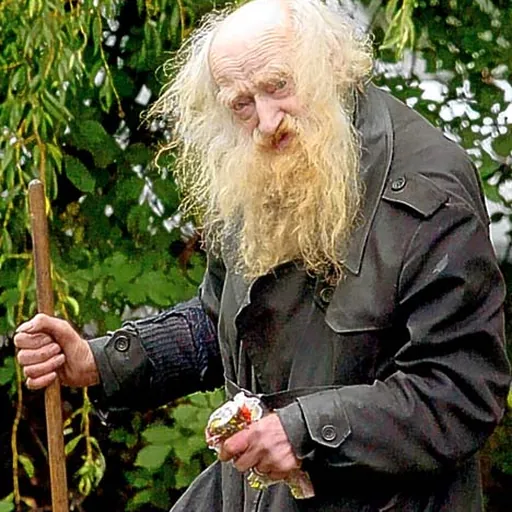
Józef Stawinoga
British hermit
About Józef Stawinoga
Lived 1920 – 2007 (aged 86). Józef Stawinoga was a hermit.
Józef Stawinoga (15 December 1920 – 28 October 2007), also known as Fred and incorrectly reported as Josef, was a homeless Polish man who lived in a tent on the Wolverhampton Ring Road in the West Midlands, England, for nearly 40 years.
Early life Stawinoga was born in Krążkowy, near Kępno, Poland. Little is known about his early life, but he was thought to have been involved in the 1939 Soviet invasion of Poland, before emigrating to the UK in the 1940s. Correspondence with his nephew Roland Stawinoga, the grandson of Józef's father, Robert Stawinoga, however, revealed that he served for the German armed forces in Africa under General Rommel; after the defeat at El-Alamein in November 1942, he became an English prisoner of war in Egypt. Roland Stawinoga said, "Someone noticed that he spoke good Polish and that he had a Polish mother, so he was allowed to join the Polish army in England. That was how he survived, but he had suffered mental problems because of his experiences in the war."
Wolverhampton After the war Stawinoga lived in Wolverhampton, finding work and a place to live—and an Austrian wife who left him after a year, according to Juliusz Leonowicz, who identified himself as Stawinoga's friend. Official records show that Stawinoga married Hermine Weiss in Wolverhampton in 1952.
It has been reported that he had worked for some time at the Stewarts & Lloyds steelworks in Bilston. One day, however, he did not turn up to work and the next his colleagues knew "... he was pushing a pram with all his possessions and had grown an ankle-length beard."
It seems, therefore, that, at a date that may be 1954 he opted out of society for unknown reasons, left his job, and became homeless. By the 1970s he had moved into a tent on the central grass reservation of the town's inner ring road. The council tolerated his presence, as he was claustrophobic, and he became something of a local character. A series of replacement tents was erected by the authorities over his original plastic sheeting; in April 2003 this involved "an operation involving the army, the police, social services and environmental health".
Stawinoga had been adopted, over the last decade of his life, by the local Hindu community who believed his lack of possessions echoed that of some holy men in India. A group devoted to him on the social networking site Facebook had over 6,500 members and he was awarded an honorary degree by Wolverhampton Polytechnic.
After Stawinoga's death his friend Leonowicz said that he had been told that the hermit had been a member of the SS during World War II. Such rumours were later dispelled, however, by the Simon Wiesenthal Center, the international Jewish human rights organisation. A spokesman from the Israeli office of the organisation, Dr Efraim Zuroff, said there was "no evidence of his service with the Germans" adding "Poles were not allowed to serve in the SS. It is simply not true." This was further confirmed by Major Antony Rudzki, a member of the Polish community in Wolverhampton, who demobilised Stawinoga in Wrottesley Park after the war.
On 6 March 2008 it was reported that Stawinoga had left thousands of pounds' worth of pension money that had been untouched. Wolverhampton Council traced the rightful heirs to Stawinoga's estate, two women and one man from Vienna, Austria, but their identities were not released. A BBC1 programme, Heir Hunters, broadcast on 21 July 2008, showed a search for heirs to his estate which had been listed on bona vacantia. The programme located the family in Germany but they were already making a claim themselves.
The three children of Stawinoga's sister Angela, who died in 2006, stood to inherit his estate. Stawinoga's nephew Robert told the Express & Star that his uncle had visited his family at the start of 1960 when they lived in Wiesbaden. He said, "Josef's sister Angela moved to Yugoslavia, now Croatia, after the war and got married. Her three children Donata, Renata and Armin Anic are the next of kin. Donata and Armin live in Croatia while Renata, aged 60, lives in Munich."
Don’t just read it —
keep it.
Full-length biographies made to live with: read them, listen on the way to work, watch them tonight.
- E-book
- Audio
- Video
Instant download · yours to keep · every purchase keeps this site free
Important facts
People in Józef Stawinoga's life
Named in this biography and alive at the same time



Related people
Same field, nearest in time





Contemporaries
People whose lives overlapped Józef Stawinoga's



Frequently asked questions
Who was Józef Stawinoga?
British hermit
When was Józef Stawinoga born?
Józef Stawinoga was born on 15 December 1920 in Krążkowy.
When did Józef Stawinoga die?
Józef Stawinoga died on 28 October 2007 in Wolverhampton.
What was Józef Stawinoga's occupation?
Józef Stawinoga was a hermit.
Sources & further reading
Cite this page
APA: Biography.guide. (2026). Józef Stawinoga. https://biography.guide/jozef-stawinoga/
MLA: "Józef Stawinoga." Biography.guide, https://biography.guide/jozef-stawinoga/.
Chicago: "Józef Stawinoga." Biography.guide. https://biography.guide/jozef-stawinoga/.
Data last updated: 2026-09-23 · Spot an error? Report a correction.
Portrait: Wikimedia Commons · author & licence
Page generated 2026-09-27 05:05 UTC