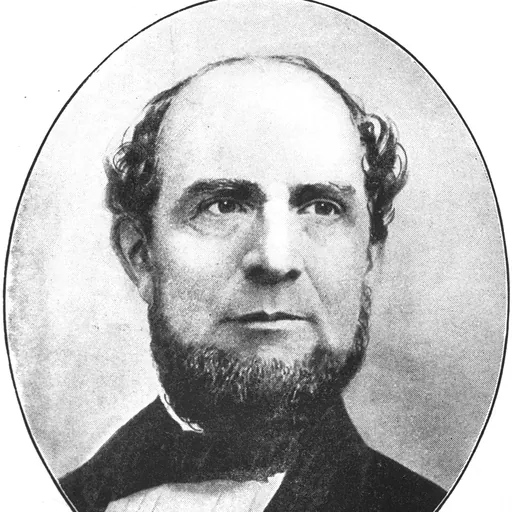
About Joseph Wightman
Lived 1812 – 1885 (aged 72). Joseph Wightman was an American lawyer and politician.
Joseph Milner Wightman (October 19, 1812 – January 25, 1885) was an American politician who, from 1861 to 1863, served as the seventeenth Mayor of Boston, Massachusetts.
Early years Wightman was born the son of an immigrant tailor on October 19, 1812. His father died when he was 10; when he was 14 years old, Wightman became a machinist's apprentice.
When he was 16, and still serving as an apprentice, Wightman made use of the Mechanic Apprentices' Library borrowing books on Mathematics and other subjects, so that he could study at night after his working hours. Through his use of the library, Wightman acquired a working knowledge of mensuration, chemistry and electrical engineering.
Wightman was able to benefit from these educational pursuits because one of his employers, Timothy Claxton, was an early innovator and supporter in providing educational opportunities for the working class.
Codman and Claxton's partnership lasted for only three years, after which time Timothy Claxton went into business for himself for three and a quarter years, after which he went into business with Wightman.
In the summer of 1835, Mr. Claxton's business was destroyed by a fire. Since Claxton was fully insured, he was able to rebuild, and, at that time, he went into partnership with Wightman, who Claxton described as his "right hand man".
On October 6, 1836, he married Berthia Morse (born 1812, the daughter of Aaron Morse and Sarah Johnson) in Boston, Mass. They had seven children (Mary Ellen, Joseph Claxton, Henry Morse (January 5, 1840, to April 3, 1885), Bethia M., Sarah Ernestine, Gertrude E. and Florence Ada).
In 1837, Claxton returned to his native country of England, Wightman took over the company, and the firm of Claxton and Wightman became the firm of Joseph M. Wightman, Wightman began to supply educational institutions with a large number of educational scientific instruments.
Early public service
City water supply improvement
In 1845 Wightman was the chairman of a citizens committee that worked to improve water delivery into the City of Boston, this resulted in the development of the Cochituate Water Works.
Boston public schools From 1846 to 1855 Wightman served as a member of the Boston Primary School Committee. On September 5, 1848, he was elected Chairman of the Executive Committee of the Boston Primary School Committee, (in place of Mr. Joseph Wentworth Ingraham who had died). Wightman served as Chairman of the Executive Committee of the Boston Primary School Committee until that committee was dissolved on January 2, 1855.
Wightman was also elected as a member of the Grammar School Committee (at the time there were two separate school committees one for the Primary schools and one for the Grammar Schools) Public school students would first attend a primary school for three years and then they would attend a grammar school.
Interests lead Wightman into politics
It has been said that Wightman's interest in the city's water supply and in improving education along with Nathan B. Chamberlain, developed the device used by William T.G. Morton to demonstrate the use of ether at Massachusetts General Hospital on October 16, 1846. This was one of the first successful demonstration of ether anesthesia (although his demonstration came after those of Dr. Crawford Long's in Georgia, Morton's demonstration was the first that was widely publicized).
Mayor of Boston Wightman first ran for the office of Mayor in 1859, in that contest he received 4,208 votes out of 11,421 cast, however he lost to Frederic W. Lincoln Jr., who received 5,932 votes. In his second try Wightman was elected Boston's first Democratic Party Mayor on December 13, 1860. Wightman received 8,834 votes in his election bid vs. that of his closest competitor Republican Party candidate, former Alderman Moses Kimball, who received 5,674 votes.
Wightman again ran for reelection in 1862, Mayor Wightman was re-nominated by the People's Union Party on November 22, 1862, however on December 8, 1862, he lost to his predecessor Frederic W. Lincoln Jr. in his second reelection bid. Wightman received 5,287 votes to Lincoln's 6,352. Wightman's tenure as Boston's 17th Mayor ended on January 5, 1863, when Mayor Lincoln was sworn in as the 18th Mayor of the City of Boston. He laid the cornerstone
Tremont Temple anti-slavery disturbance
On January 24, 1861, the Massachusetts Anti-Slavery Society was holding its annual meeting at Tremont Temple in Boston. A group of anti-abolitionists attacked the meeting. The police protection that had been granted to the meeting was inadequate to prevent rioting. Mayor Wightman had entered the hall with a group of policemen and members of the Board of Aldermen, upon entering the meeting place Mayor Wightman announced that the trustees of the building had asked him to dissolve the meeting, the trustees, who were in attendance, denied that they asked for the meeting to be dissolved and asked Mayor Wightman to read their letter, the letter was actually shown to be a request to protect the assembly. Mayor Wightman promised the chairman of the meeting Edmund Quincy that he would protect the evening session with fifty policemen, but he later had the meeting doors closed and blocked by police. Mayor Wightman ended the meeting withdrew his offer of police protection and ordered the hall closed, Initially, the United States Quartermaster in Boston, Captain George A. Kensel, was told to prepare for 100 prisoners, however when The State of Maine, the ship holding the prisoners, arrived it had on board 155 political prisoners and over 600 military prisoners for the fort. In early November 1861 Mayor Wightman visited the fort and decided that immediate steps had to be taken to alleviate the situation.
Local newspapers had urged that local citizens donate items to assist the prisoners at the fort. Mayor Wightman endorsed giving aid to the prisoners at the fort.
Mayor Wightman arranged for stores be delivered from Evans House a charity that had been established to assist Union servicemen. The Mayor's actions were met with mixed reaction from the local Press. The Boston Daily Advertiser and The Boston Transcript attacked Wightman. The Boston Evening Traveler, in opposing Wightman's reelection, called his distribution of supplies to the fort, aid to the "traitors at Fort Warren". However The Boston Post and The Boston Journal supported Wightman. The Boston Post said that Wightman had acted out of a charity and The Boston Journal supported Wightman in an editorial titled "The Transcript on Humanity".
City Hospital
In 1857 Wightman was chairman of the special committee on the Free City Hospital.
During his term, on September 9, 1861, ground was broken for the construction of the City Hospital.
Mayor Wightman's tenure Wightman's tenure of Mayor was said to concentrate on alleviating the wants of the Union Soldiers in the field. While he was Mayor Wightman successfully supplied funds for the fitting out of, and providing sustenance to, the soldiers in the field.
Wightman also arranged to remit, through him, funds from the soldiers pay to their families.
Run for Congress
In 1866 Wightman ran for the 40th United States Congress as the Democratic Party candidate for the Massachusetts' fourth Congressional district. Wightman ran as a friend of the working man and the working men were urged to vote for Wightman. However, in the election the vote of the working men went to the Republican candidate Samuel Hooper.
Other positions held Wightman was involved for many years in the civic affairs of the Commonwealth of Massachusetts and the City of Boston, serving in elected and unelected public and private offices.
Wightman was, in 1851, a member of the Massachusetts Great and General Court (Legislature) representing Boston in the Massachusetts state House of Representatives.
In April 1856 Wightman became a member of the Board of Aldermen for the City of Boston. serving as Chairman of the Board of Aldermen in 1858.
From 1858 until 1862 (when he resigned upon assuming the duties of Mayor)
In 1860 Wightman was a delegate to the Fourth National Quarantine and Sanitary Convention held from June 14 to June 16 at Mechanics' Hall, Boston. The last of a series of meetings held to promote sanitary science. During the convention Wightman served as a member of the "Business Committee" Wightman was also on two committees for 1860–1861 for "Arrangements for the Ensuing Year", and on the "Permanent Organization of the Association". (However, as a result of the outbreak of the American Civil War the convention never assembled again.)
On February 13, 1868, Wightman was elected by the Boston City Council to serve a two-year term as a Commissioner of the Cochituate Water Board. At the Water Board's April 6, 1868, organizational meeting Withgman was appointed to the Standing Committee of the Water Registrar's Department and to the Special Auditing Committee.
Wightman served as Chairman
Later years
In his later years Wightman suffered legal trouble. In 1874 he was imprisoned for debt. In a letter to The Boston Journal dated August 12, 1874, Wightman explained that these were debts that he did not himself incur. Wightman explained in his letter that in 1864 he became a stock holder in the Franklin Coal Company. Wightman wrote that in June 1865 against his wishes or knowledge he was made a director of that company. In 1866 the company became insolvent, Wightman was arrested and imprisoned and forced to pay that part of the company's debt (judgment and costs amounting to $14,866.50) owed to Eby, Byres & Co.
Admission as an attorney In January 1875 Wightman was admitted to the Massachusetts Bar.
Death and burial Wightman died on January 25, 1885, and was interred in Mount Auburn Cemetery in Cambridge, Massachusetts. His wife Berthia (Bertha) (Morse) died in 1901 and was interred next to him.
Books Select Experiments in Natural Philosophy ... Published by Joseph M. Wightman, (1853). Annals of the Boston Primary School Committee: From Its First Establishment in 1818, to Its Dissolution in 1855 Published by G. C. Rand & Avery, city printers, (1860).
Don’t just read it —
keep it.
Full-length biographies made to live with: read them, listen on the way to work, watch them tonight.
- E-book
- Audio
- Video
Instant download · yours to keep · every purchase keeps this site free
Important facts
People in Joseph Wightman's life
Named in this biography and alive at the same time



Related people
Same field, nearest in time




Contemporaries
People whose lives overlapped Joseph Wightman's




Frequently asked questions
Who was Joseph Wightman?
American politician
When was Joseph Wightman born?
Joseph Wightman was born on 19 October 1812 in Boston.
When did Joseph Wightman die?
Joseph Wightman died on 25 January 1885.
What was Joseph Wightman's occupation?
Joseph Wightman was a lawyer and politician.
What nationality was Joseph Wightman?
Joseph Wightman was American.
Sources & further reading
Cite this page
APA: Biography.guide. (2026). Joseph Wightman. https://biography.guide/joseph-wightman-lawyer/
MLA: "Joseph Wightman." Biography.guide, https://biography.guide/joseph-wightman-lawyer/.
Chicago: "Joseph Wightman." Biography.guide. https://biography.guide/joseph-wightman-lawyer/.
Data last updated: 2026-09-23 · Spot an error? Report a correction.
Portrait: Wikimedia Commons · author & licence
Page generated 2026-09-27 05:06 UTC