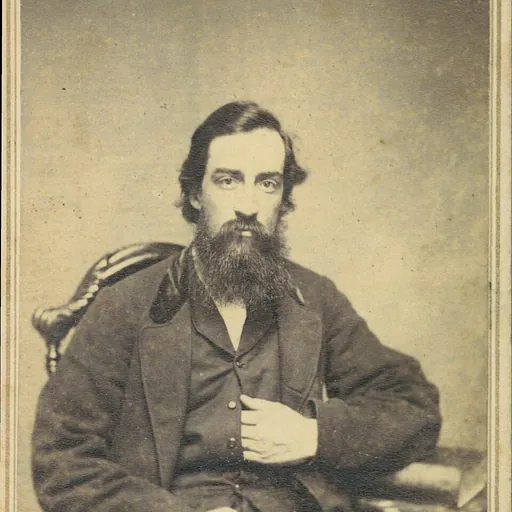
Joseph Smith III
Eldest surviving son of Joseph Smith Jr and Prophet-President in Community of Christ
About Joseph Smith III
Lived 1832 – 1914 (aged 82). Joseph Smith III was an American writer.
Biography Childhood
Joseph Smith III was born in Kirtland, Ohio, on November 6, 1832, to Joseph Smith Jr, and Emma Hale Smith. He moved with his parents to Far West, Missouri, in 1838, where his father was arrested partially as a result of the events in the 1838 Mormon War. Young Joseph was able to stay overnight with his father in prison on several occasions. It was later alleged by fellow prisoner and church apostle Lyman Wight that during one of these visits, his father laid his hands upon Joseph III's head and said, "You are my successor when I depart." While his father was still imprisoned in 1839, Joseph III left Missouri with his mother and siblings and moved to Quincy, Illinois, and later to the new settlement of Nauvoo. The elder Smith escaped custody later that year and rejoined the family.
At Nauvoo, the Latter Day Saints created a militia known as the Nauvoo Legion and soon afterward, 500 of the town's boys created their own junior version of the militia. Joseph III became general of the junior militia whose motto was, "our fathers we respect, our mothers we'll protect."
According to later reminiscences, Joseph III was blessed by his father at a special council meeting of church officials held on the second floor of the Smith family's Red Brick Store in Nauvoo. By some accounts, participants also included Hyrum Smith, John Taylor, Willard Richards, Newel K. Whitney, Reynolds Cahoon, Alpheus Cutler, Ebenezer Robinson, George J. Adams, W. W. Phelps, and John M. Bernhisel. Joseph III's father reportedly seated him in a chair and Whitney anointed his head with oil. Then the elder Smith reportedly pronounced a special blessing upon his son's head that suggested that Joseph III would succeed him as church president if he lived righteously.
Reorganization of the church In the late 1840s and early 1850s, the bulk of the Latter Day Saints either aligned themselves with Young and emigrated to Utah or they remained in the Midwest and looked to Strang as church president. Strang gave indications that he believed that a son of Joseph Smith would one day lead the church and made overtures to the Smith family. Emma and her sons, however, remained aloof. Many midwestern Latter Day Saints were adamantly opposed to plural marriage and when Strang began to openly practice the doctrine in 1849, several key leaders, including Jason W. Briggs and Zenas H. Gurley, Sr. broke with his leadership. Later, when Strang was mortally wounded by assassins, he refused to name a successor, and when he died he left his church leaderless.
The midwestern Saints began to call for the need to establish a "New Organization" of the church and many believed that Joseph III should be its head. Latter Day Saints repeatedly visited Smith and asked him to take up his father's mantle, but his reply was that he would only assume the church presidency if he were inspired by God to do so. Finally, in 1860, Smith said that he had received this inspiration and at a conference in Amboy, Illinois on April 6, 1860, he was sustained as president of the RLDS Church. Smith III stated at the conference:
At the time both this organization and Young's Utah-based church claimed to be the true Church of Jesus Christ of Latter Day Saints.
President of the church
As church president, Smith acted as what biographer Roger D. Launius has called a "pragmatic prophet." Many of RLDS Church followers were dissidents from what they felt were the excesses of a theocracy established by Smith's father, and which they also felt were continued under Young in Utah Territory. From the start, Smith attempted to steer a middle course. Smith taught that the later and more controversial teachings of Smith's father such as baptism for the dead, the divinity of the Book of Abraham, and the concepts of "eternal progression" and the "plurality of gods," were never officially accepted, were misinterpreted, or should simply not be emphasized. Smith repeatedly taught that his father did not teach or practice plural marriage and that this practice was an invention of Young and his followers. Smith also resisted calls from his followers to announce a new gathering place or to quickly "redeem" and build up "Zion" (Independence, Missouri).
In the 1860s and 1870s, Smith began to rebuild the structure of the church, establishing a new First Presidency, Council of Twelve Apostles, seven quorums of the Seventy, and a Presiding Bishopric. Zenas H. Gurley, Sr. became President of the Council of Twelve. Smith presented a revelation which called William Marks, former presiding officer of the church's central stake, to be his first counselor in the reorganized First Presidency. After Marks died, Smith called W. W. Blair and his brother, David Hyrum Smith, to be his counselors in the First Presidency.
In 1866, Smith moved from Nauvoo to Plano, Illinois, where the church's printing house had been established. He personally took over the editorship of The Saint's Herald, and Plano became the headquarters of the church. Meanwhile, Latter Day Saints adhering to the reorganization established a colony in Lamoni, Iowa, where they attempted to practice the "Law of Consecration" or "Order of Enoch." In 1881, Smith decided to move to Lamoni which became the new headquarters of the church. Although the practice of the Order of Enoch proved a failure, the town of Lamoni continued to grow. The church established a college there which became Graceland University.
Under Smith's presidency, the RLDS Church gained clear legal title to the Kirtland Temple in the 1880 Kirtland Temple Suit. However, the RLDS Church failed in its bid to acquire legal title to the Temple Lot in the Temple Lot Case of the late 1890s. The trial court in both cases declared that the RLDS Church was the legal rightful successor to the original Latter Day Saint church founded in 1830 by Smith's father (it failed to gain the Temple Lot because the owners at the time appealed on the grounds that the RLDS Church waited too long to act, but the earlier rightful successor decision was upheld). Rather than focusing on the practical ownership results of the cases, Smith emphasized these court judgements for the remainder of his life as legal validation of the RLDS Church's claims.
Redemption of Zion In Smith's final years, members of the church began to move to Independence, Missouri, which Joseph Smith had designated as the "center place" of the "City of Zion." Many Latter Day Saints had wanted to return to this theologically important ground since their expulsion in 1839. In 1906, at the age of 73, Smith moved to Independence and entered a state of semi-retirement. His eldest son, Frederick Madison Smith, remained in Lamoni and took over active leadership of the church. Finally, on December 10, 1914, at the age of 82, Smith suffered a heart seizure in his home and died. He had been president of the church for more than fifty years and he was admired and mourned by thousands.
Teachings on plural marriage
Joseph Smith III was an ardent opponent of the practice of plural marriage throughout his life. For most of his career, Smith denied that his father had been involved in the practice and insisted that it had originated with Brigham Young. Smith served many missions to the western United States where he met with and interviewed associates and women claiming to be widows of his father, who attempted to present him with evidence to the contrary. In the end, Smith concluded that he was "not positive nor sure that [his father] was innocent" and that if, indeed, the elder Smith had been involved, it was still a false practice. However, many members of the Community of Christ, and some of the groups that were formerly associated with it are still not convinced that Joseph Smith III's father did indeed engage in plural marriage, and feel that the evidence that he did so is largely flawed.
Family chart
Don’t just read it —
keep it.
Full-length biographies made to live with: read them, listen on the way to work, watch them tonight.
- E-book
- Audio
- Video
Instant download · yours to keep · every purchase keeps this site free
Important facts
People in Joseph Smith III's life
Named in this biography and alive at the same time


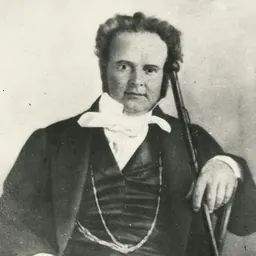


Related people
Same field, nearest in time

Contemporaries
People whose lives overlapped Joseph Smith III's


Frequently asked questions
Who was Joseph Smith III?
eldest surviving son of Joseph Smith Jr and Prophet-President in Community of Christ
When was Joseph Smith III born?
Joseph Smith III was born on 6 November 1832 in Kirtland.
When did Joseph Smith III die?
Joseph Smith III died on 10 December 1914 in Independence.
What was Joseph Smith III's occupation?
Joseph Smith III was a writer.
What nationality was Joseph Smith III?
Joseph Smith III was American.
Sources & further reading
Cite this page
APA: Biography.guide. (2026). Joseph Smith III. https://biography.guide/joseph-smith-iii/
MLA: "Joseph Smith III." Biography.guide, https://biography.guide/joseph-smith-iii/.
Chicago: "Joseph Smith III." Biography.guide. https://biography.guide/joseph-smith-iii/.
Data last updated: 2026-09-21 · Spot an error? Report a correction.
Portrait: Wikimedia Commons · author & licence
Page generated 2026-09-27 05:01 UTC