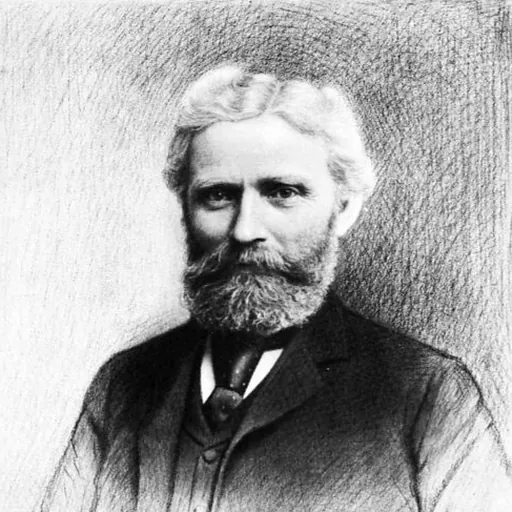
Joseph Smith Harris
American surveyor, civil engineer and railroad executive
About Joseph Smith Harris
Lived 1836 – 1910 (aged 74). Joseph Smith Harris was an American engineer, civil engineer, surveyor, railway worker and civil engineering.
Joseph Smith Harris (April 29, 1836 – June 1, 1910) was an American surveyor, civil engineer, and railroad executive. Largely self-taught, he worked on several projects for the United States Government, including the United States Coast Survey′s hydrographic survey of the Mississippi Sound in 1854–1856 and the Northwest Boundary Survey of 1857–1861. He worked his way through a considerable number of adventures to become president of the Reading Railroad, which he brought back from its 1893 bankruptcy.
Family and early life Harris was born on his family's farm in East Whiteland Township, Chester County, Pennsylvania; the house has burned down, but the barn and spring house still stand on what is now the Chester Valley Golf Club. His father, Stephen Harris (September 4, 1798 – November 18, 1851), was the local physician; his mother was Marianne Smith (April 2, 1805 – March 12, 1890). Stephen Harris's brothers (Joseph's uncles) included Thomas Harris and John Harris, who became career military officers. Joseph's paternal grandfather, William Harris (1757 – 1812), had been a Continental Army officer in the American Revolutionary War and thereafter, as well as a member of the Pennsylvania General Assembly. A great-grandfather (on his mother's side) was Persifor Frazer, a figure in the American Revolution who had some prominence in Chester County.
When Joseph was a youth, his father, Stephen, realized that he was dying and that his untimely death would likely leave his family destitute. Looking to prolong his life and also leave his wife with a means of supporting herself, in 1850 Stephen Harris sold his farm and moved his family to Philadelphia, Pennsylvania. His place as the local physician was taken by Septimus Augustus Ogier. In time, the family opened a boarding house, one of the few business occupations available to respectable women of the time. Their younger brother, John Campbell (Cam) Harris, also graduated from Central. at home in Germantown, Pennsylvania, in 1910.
U.S. Coast Survey In 1853, even before graduating from Central High School, Harris took a job as a topographer for the Easton and Water Gap Railroad (which became the North Pennsylvania Rail Road Company later that year), then under construction. He took time off from this job to return to Philadelphia to take his final examinations.
The trip south was not without its hardships: Harris suffered from diarrhea on the Mississippi River and within a few days of his arrival at New Orleans, Louisiana, he contracted typhoid fever, which nearly killed him. Luckily, he was able to stay with an uncle who was a physician, and who nursed him back to health. After a month in bed, Harris proceeded to the Phoenix, then at Mobile, Alabama, arriving in January 1855. Stephen Harris was put in command of Phoenix in May 1855. The work of the surveyors was made difficult by the large populations of insects—everything from mosquitoes to flying cockroaches—that inhabited the coastal swamps and marshes, by the dearth of clean water, by the arrest of some of the crew after a brawl, and by hurricanes, all of which are described in Harris's autobiography.
During his year on the Phoenix, Harris and his crew performed triangulation along the coast from Pascagoula, Mississippi, to the entrance to Lake Pontchartrain, a distance of about . With the arrival of winter, the commanders left the Phoenix; when the weather turned colder, Harris was required to lay up the vessel for the remainder of the winter. He returned to U.S. Coast Survey headquarters to complete some drafting and other engineering work, and resigned from the Survey in the spring of 1856.
Harris took a similar position with the Kentucky Geological Survey, but he resigned after one month in July 1856 and returned to the Gulf of Mexico to complete his earlier work. In March 1857, Harris was hired as an astronomer for the Northwest Boundary Survey.
Northwest Boundary Survey In 1846, the United Kingdom and the United States signed the Oregon Treaty, agreeing to settle the Oregon boundary dispute by drawing the western Canadian–American border along the 49th parallel, which was largely mountainous wilderness at the time. After some delays, British and American Boundary Commissions were established in 1856 and formed a joint commission.
Uncas, under Harris′s command, left New York City for the U.S. Gulf Coast on February 28, 1862. Damage from a gale forced the ship to head for Hampton Roads, Virginia, for repairs and fuel; she arrived in time to witness the Battle of Hampton Roads between the United States Navy monitor and the Confederate States Navy ram CSS Virginia (formerly the U.S. Navy steam frigate ). Because of the damage Uncas sustained during the gale, Harris was ordered to transfer his equipment and crew to her sister ship, , for the remainder of the voyage to the Gulf Coast. Sachem left Hampton Roads on March 18, 1862, and stopped at Port Royal, South Carolina, for coal on March 24. There, Harris was rebuffed by the Navy supply department and was instead ordered, under threat of facing a firing squad, to support an expedition to Edisto Island. Harris declined, repeatedly stating that he was under Coast Survey orders to proceed to Ship Island, Mississippi, and report to Commodore David Farragut. Only through the personal intervention of Commodore Samuel Francis Du Pont was Sachem finally coaled and allowed to depart Port Royal. Following another coaling stop at Key West, Florida (during which four men mutinied and refused orders to pass coal to the vessel), Harris continued on to Ship Island, where he arrived on April 9, 1862, to discover that the fleet had left the day before and gone to the mouth of the Mississippi River. Sachem proceeded to the Mississippi River and arrived on April 10, 1862, when Harris turned over command of the small steamer to Ferdinand Gerdes, who had arrived a few days earlier.
Survey of the Mississippi River below Forts Jackson and St. Philip to prepare for the bombardment of the forts by Porter's mortar fleet. Plan done by the U.S. Coast Survey. In April 1862, Harris and the other surveyors marked navigable channels in the river and established survey markers on the shore to serve as control points for indirect mortar fire into the forts defending the approaches to New Orleans. They also placed buoys in the river to mark where the mortar boats should anchor. Their work was performed under fire from the forts and from Confederate gunboats. On April 18, 1862, Union mortar boats began firing on Fort Jackson in what may be the first combat use of "blind" firing (i.e., indirect fire) of artillery based on aiming the weapons from a known, surveyed location at a target with known survey coordinate points. Not all of the firing was blind, however. Currents in the river sometimes caused the gunboats to swing at anchor, thus changing their orientation and causing their shells to go astray. Harris spent most of one day up the mast of one of the mortar boats, looking over the trees, noting the location of mortar shell explosions, and calling down rudder commands to cause the boats to vary their headings slightly in order to adjust their firing direction. thumb Plan of Fort Jackson showing damage done by the mortar bombardment and gunboats from April 18th to 24th, 1862; surveyed by J.S. Harris. The forts having been weakened by the bombardment, the naval flotilla forced its way past them on April 24 in the Battle of Forts Jackson and St. Philip) and proceeded upriver to capture New Orleans. The effectiveness of the bombardment of Fort Jackson has been disputed (Commander David Dixon Porter, in command of the mortar boats, had a reputation for bragging, exaggeration, and embellishment of facts in his reports and correspondence), but the Confederate casualties and the subsequent mutiny of the troops manning the forts are well documented.
The original U.S. Coast Survey map of the damage done to Fort Jackson by the mortar and gunboat bombardment of 1862. This document is in the possession of the Library of Congress, but scanned in lower resolution than the "Official Records" version. Commander Porter wrote to Alexander Dallas Bache, superintendent of the Coast Survey, concerning the battle of Forts St. Philip and Jackson:
Following the fall of New Orleans, Harris participated in further surveys along the Gulf Coast, leading up to the Battle of Mobile Bay on August 5, 1864. By mid-1864, his usefulness to the war effort had been exhausted, as the portion of the coastline with which he was familiar was in Union hands. He again left the Survey and returned north, where he re-joined the Northwest Boundary Survey, which was then performing its office work.
Railroad career Harris returned to railroad work around 1864, entering private practice as a civil and mining engineer and also joining his older brother Stephen in the Schuylkill Company of Pottsville, Pennsylvania. The two worked together doing survey work for the Lehigh Valley Rail Road and the Pennsylvania Rail Road Company. He oversaw the reorganization of the shattered company, beginning by stabilizing the railroad and its Coal and Iron Company. A new corporation, the Reading Company, was formed to buy the assets of its bankrupt predecessor, and Harris was its first president.
Harris was a member of the American Philosophical Society (elected 1887 ) and the Pennsylvania Historical Society. He became a trustee of the University of Pennsylvania in 1889 and was awarded a D.Sc. by Franklin & Marshall College in 1903. He died at home in Germantown in 1910.
Descendants Joseph and Delia Harris had five children: George Brodhead Harris (1868–1952). He married Elizabeth Holbert. Frances Brodhead Harris (1870–1925). She married Reynolds Driver Brown. Clinton Gardner Harris (1872–1910). He did not marry. Madeline Vaughan ("Sally") Harris (1873–1966). She married Henry Ingersoll Brown, brother of Reynolds D. Brown.
Don’t just read it —
keep it.
Full-length biographies made to live with: read them, listen on the way to work, watch them tonight.
- E-book
- Audio
- Video
Instant download · yours to keep · every purchase keeps this site free
Important facts
People in Joseph Smith Harris's life
Named in this biography and alive at the same time




Related people
Same field, nearest in time

Contemporaries
People whose lives overlapped Joseph Smith Harris's



Frequently asked questions
Who was Joseph Smith Harris?
American surveyor, civil engineer and railroad executive
When was Joseph Smith Harris born?
Joseph Smith Harris was born on 29 April 1836 in East Whiteland Township.
When did Joseph Smith Harris die?
Joseph Smith Harris died on 1 June 1910 in Germantown.
What was Joseph Smith Harris's occupation?
Joseph Smith Harris was an engineer, civil engineer, surveyor, railway worker and civil engineering.
What nationality was Joseph Smith Harris?
Joseph Smith Harris was American.
Sources & further reading
· Wikipedia: Joseph Smith Harris
· DBpedia: Joseph Smith Harris
Cite this page
APA: Biography.guide. (2026). Joseph Smith Harris. https://biography.guide/joseph-smith-harris/
MLA: "Joseph Smith Harris." Biography.guide, https://biography.guide/joseph-smith-harris/.
Chicago: "Joseph Smith Harris." Biography.guide. https://biography.guide/joseph-smith-harris/.
Data last updated: 2026-09-22 · Spot an error? Report a correction.
Page generated 2026-09-27 05:10 UTC