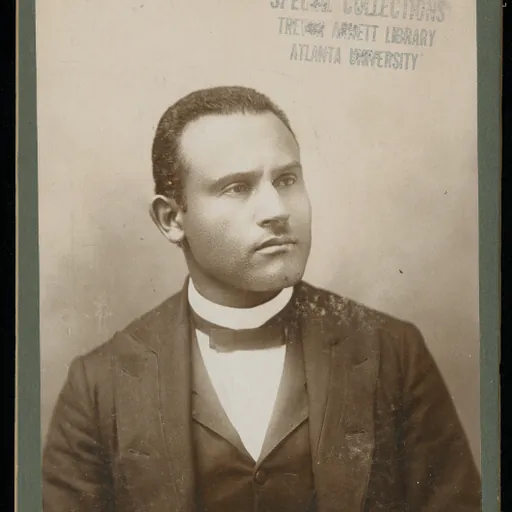
About Joseph Seamon Cotter, Sr.
Lived 1861 – 1949 (aged 88). Joseph Seamon Cotter, Sr. was an American poet and writer.
Joseph Seamon Cotter Sr. (February 2, 1861 – March 14, 1949) was an American poet, writer, playwright, and community leader raised in Louisville, Kentucky (but born in Nelson County, Kentucky). Cotter was one of the earliest African-American playwrights to be published. He was known as "Kentucky's first Negro poet with real creative ability."
Personal life Cotter grew up in a family of mixed racial heritage. His father, Michael J. Cotter, was a white man of Scots-Irish ancestry, and his mother, Martha Vaughn, was a freeborn black woman of mixed heritage (one of several children born to an African slave mother and an English-Cherokee father).
Education After completing the third grade, Cotter dropped out to help support his family. Cotter worked in manual labor and various odd jobs until the age of 22, where he joined the first and newly created Louisville night school for black students. Cotter attended night school for ten months, earning his high school diploma and teaching credentials. One of his teachers was Rev. Alexander Walters, who had a large influence on him.
According to Metzger (1989): "There is little specific information about either the extent of Cotter's education—it seems certain that he never attended college or completed a degree-granting program—or his professional life as an educator. Although some writers had felt that Cotter must have attended college, his love of writing and of literature might just have well stemmed from the many books that his mother had read to him as a child. And although Cotter's contributions to black education are now seen as extremely important, at the time he was working, few details of such work were preserved for later study. What is now certain is that Cotter became a respected writer, although when he first began to write is not clear."
Literary contributions Cotter's literary contributions include nine published works. Among these works are 4 volumes of poetry: A Rhyming (1895); Links of Friendship (1898); A White Song and a Black One (1909); and Collected Poems (1938). Cotter's other publications include: Sequel to "The Pied Piper of Hamelin," and Other Poems (1939), a collection of poetry and prose; Negroes and Others at Work and Play (1947); Caleb, the Degenerate; A Play in Four Acts: A Study of the Types, Customs, and Needs of the American Negro (1903); and 2 collections of prose, Negro Tales (1912), and Twenty-fifth Anniversary of the Founding of Colored Parkland or "Little Africa," Louisville, Ky., 1891–1916 (1934).
Cotter also often contributed to periodicals such as the Louisville Courier-Journal (from 1884), National Baptist Magazine (1894–1908), Voice of the Negro (1904–07), Southern Teachers Advocate (Kentucky; 1905–06), and Alexander's Magazine (1909).
According to William S. Ward, "…[Cotter's] writings have never won him high recognition, but he has fared rather well at the hands of black historians." Cotter's writing is known to utilize both dialect and standard English to advocate race advancement, "to be gained by a mixture of race pride, humility, hard work, education, and a positive, optimistic outlook." Historian Joan R. Sherman also notes that a common theme seen in Cotter's writing, from his earliest poems to The Negro's Ten Commandments (1947), is that "he consistently advocated this gospel:
(5) Read not thyself out of toiling with the hands, and toil not thyself out of reading; for reading makes one akin to the ox. Therefore he who simply dreams is dying, and he who dreams not is already dead.
(7) Learn thou the worth of a dollar and how to keep it from damning thee.
(9) Socially thou shalt go no nearer thy brother than he comes to thee. Aversion in him should slay the thought of advance in thee.
(10) If thou hast a mind to live by being honest, industrious, frugal and self-sacrificing, remain in the South where thou shalt surely reap thy character's worth; but if thou hast a mind to die through sloth, ignorance and folly, get thee far from it, for the burden of burying such is becoming intolerable."
Don’t just read it —
keep it.
Full-length biographies made to live with: read them, listen on the way to work, watch them tonight.
- E-book
- Audio
- Video
Instant download · yours to keep · every purchase keeps this site free
Important facts
People in Joseph Seamon Cotter, Sr.'s life
Named in this biography and alive at the same time
Related people
Same field, nearest in time

Contemporaries
People whose lives overlapped Joseph Seamon Cotter, Sr.'s



Frequently asked questions
Who was Joseph Seamon Cotter, Sr.?
African-American writer (1861-1949)
When was Joseph Seamon Cotter, Sr. born?
Joseph Seamon Cotter, Sr. was born on 2 February 1861 in Bardstown.
When did Joseph Seamon Cotter, Sr. die?
Joseph Seamon Cotter, Sr. died on 14 March 1949.
What was Joseph Seamon Cotter, Sr.'s occupation?
Joseph Seamon Cotter, Sr. was a poet and writer.
What nationality was Joseph Seamon Cotter, Sr.?
Joseph Seamon Cotter, Sr. was American.
Sources & further reading
· Wikipedia: Joseph Seamon Cotter, Sr.
· DBpedia: Joseph Seamon Cotter Sr.
Cite this page
APA: Biography.guide. (2026). Joseph Seamon Cotter, Sr.. https://biography.guide/joseph-seamon-cotter-sr/
MLA: "Joseph Seamon Cotter, Sr.." Biography.guide, https://biography.guide/joseph-seamon-cotter-sr/.
Chicago: "Joseph Seamon Cotter, Sr.." Biography.guide. https://biography.guide/joseph-seamon-cotter-sr/.
Data last updated: 2026-09-24 · Spot an error? Report a correction.
Portrait: Wikimedia Commons · author & licence
Page generated 2026-09-27 05:08 UTC