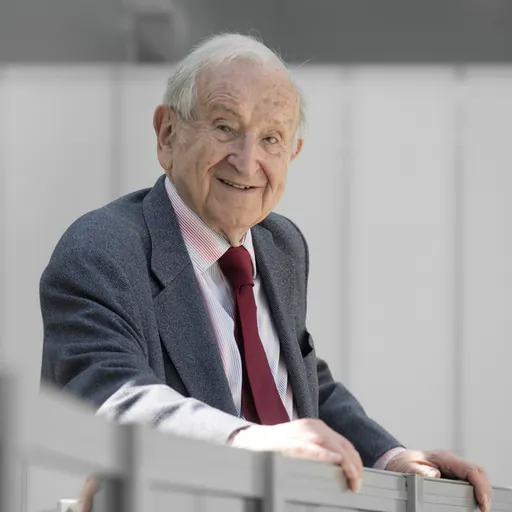
Joseph Rykwert
British architectural historian and writer
About Joseph Rykwert
Lived 1926 – 2024 (aged 97–98). Joseph Rykwert was a British architectural historian, architecture critic, architect, architectural theoretician and university teacher.
Joseph Rykwert (5 April 1926 – 17 or 18 October 2024) was a British architectural historian and writer. He was the Paul Philippe Cret Professor of Architecture at the University of Pennsylvania, and one of the foremost architectural historians and critics of his generation. He spent most of his working life in the United Kingdom and the United States. He taught the history and theory of architecture at several institutions in Europe and North America. Rykwert is the author of many influential works on architecture, including The Idea of a Town, On Adam's House in Paradise (1972), The Dancing Column (1996) and The Seduction of Place (2000). All of his books have been translated into several languages.
Biography The son of Elizabeth Melup and Szymon Rykwert, Rykwert was born in Warsaw in 1926 and moved to England in 1939, on the eve of the Second World War. Rykwert was educated at Charterhouse and then at the Bartlett School of Architecture (University College, London) and the Architectural Association in London. He was appointed Commander of the Order of the British Empire (CBE) in the 2014 Birthday Honours for services to architecture. In May 2016, he received an honorary degree in pedagogy at the University of Bologna.
Personal life and death After a marriage to Jane Morton ended in divorce, Rykwert married Anne Engel (died 2015) in 1972. He had one son. Rykwert died at his home in London in October 2024, at the age of 98.
Works Rykwert's preoccupations were multifold, but some particular themes stand out. His work is fundamentally concerned with the origin of architectural ideas and, having experienced displacement himself at an early age, with our sense of 'place'. In The Idea of a Town: The Anthropology of Urban Form in Rome, Italy and the Ancient World (first published in 1963 and in two subsequent editions), rather than accept the archaeologists’ viewpoint of the ancient city as an outcome of practical settlement needs, Rykwert broke new ground in understanding the ancient town as a product of sacred and symbolic rituals. The book served as a timely critique of post-war New Town developments. In On Adam’s House in Paradise: The Idea of the Primitive Hut in Architectural History (1972 and subsequent editions) Rykwert examined the persistent idea that architecture could be returned to a lost state of accord with nature, an accord symbolised by the fabled idea that Adam had built a house in Eden. In The First Moderns: The Architects of the Eighteenth Century (1980), Rykwert traced the origins of many modern ideas that are commonly assumed to be recent inventions (such as optics and perspective). The book is not a conventional history of style, but rather one of ideas and culture. Frances Yates explained this novelty of approach in The Times Literary Supplement: ‘The range of Rykwert's learning is enormous. History of gardens, Chinese influences, festival architecture, all contribute to the overflowing wealth. Great figures in the history of thought and science — Bacon, Newton, Vico — are seen from new angles....This is no superficial history of styles, no conventional history of ideas. It invigorates both through the attempt at a new kind of history of architecture.’ In The Dancing Column: On Order in Architecture (1996) Rykwert turned his attention to the origins of the architectural Orders, and more recently in The Seduction of Place: The History and Future of Cities (2000) to the question of how to make successful urban spaces and forms in cities today.
Throughout his career Rykwert had been preoccupied with the work of the Renaissance architect Leon Battista Alberti. In 1955 Rykwert published an annotated edition of Leoni's 1756 translation of Alberti's treatise, entitled The Ten Books of Architecture, by L.B. Alberti, and this was followed in 1989 with a new translation from Latin, entitled On the Art of Building in Ten Books (published with Robert Tavernor and Neil Leach). In 1994 Rykwert co-curated (with Robert Tavernor and Anne Rykwert) an international exhibition on Alberti's work, held at the Palazzo Te in Mantua. Alberti's overlapping interest in architectural theory and practice, and his conception of the architect as a philosopher and student of many arts, led Rykwert to identify him as representing the model architect for an age where the role of the designer is in danger of being reduced to that of a businessman or technocrat. The conception of architecture as a product of inter-related disciplines and as a sister to other visual arts informs Rykwert's latest book, The Judicious Eye: Architecture Against the Other Arts, published in 2008.
Joseph Rykwert married his second wife, Anne, during his time in Essex, and she was a collaborator on notable works including the international Alberti exhibition and a book on the Adam brothers. Rykwert's teaching has influenced several generations of architects and historians. Sir James Stirling commented on The First Moderns, for example, that it was: ‘An erudite lead into my favourite period (early nineteenth century) with amazing revelations on the architectural heroes of the time.’ Many of Rykwert's former pupils have gone on to have significant careers in their own right, such as Daniel Libeskind, Shams Naga, Eric Parry, Alberto Pérez-Gómez, Mohsen Mostafavi, Robert Tavernor, Vaughan Hart, John Macarthur, and David Leatherbarrow. Many university departments of architecture in the United Kingdom or America employ members of staff who were taught by Rykwert.
Unlike many architectural historians before him, Joseph Rykwert had not been concerned with architectural style or the classical language per se, but rather with the meaning of a particular design that should always find its own appropriate expression. Throughout his work he had been concerned with professional architectural practice as much as with history and theory, and with the ways in which buildings are actually designed and made.
Publications (selection) The Golden House (1947) The Ten Books of Architecture, by L.B. Alberti (annotated edn of Leoni's translation of 1756 (1955) Church Building (1966) On Adam's House in Paradise: The Idea of the Primitive Hut in Architectural History (Museum of Modern Art, first edition, 1972) The Idea of a Town: The Anthropology of Urban Form in Rome, Italy, and The Ancient World (first edition, 1963) The First Moderns: The Architects of the Eighteenth Century (1980) The Necessity of Artifice (1982) The Brothers Adam (with Anne Rykwert, 1985) Leon Battista Alberti's On the Art of Building in Ten Books translated by Joseph Rykwert, Robert Tavernor and Neil Leach (1991) The Dancing Column: On Order in Architecture (1996) The Seduction of Place: The History and Future of Cities (2000) Body and Building: Essays on the Changing Relation of Body and Architecture edited by George Dodds and Robert Tavernor (2002) Structure and Meaning in Human Settlements (Editor, with Tony Atkin, 2005) The Judicious Eye: Architecture Against the Other Arts (2008)
Don’t just read it —
keep it.
Full-length biographies made to live with: read them, listen on the way to work, watch them tonight.
- E-book
- Audio
- Video
Instant download · yours to keep · every purchase keeps this site free
Important facts
People in Joseph Rykwert's life
Named in this biography and alive at the same time






Related people
Same field, nearest in time




Contemporaries
People whose lives overlapped Joseph Rykwert's

Frequently asked questions
Who was Joseph Rykwert?
British architectural historian and writer (1926–2024)
When was Joseph Rykwert born?
Joseph Rykwert was born in 1926 in Warsaw.
When did Joseph Rykwert die?
Joseph Rykwert died on 18 October 2024 in London.
What was Joseph Rykwert's occupation?
Joseph Rykwert was an architectural historian, architecture critic, architect, architectural theoretician and university teacher.
What nationality was Joseph Rykwert?
Joseph Rykwert was British.
Sources & further reading
Cite this page
APA: Biography.guide. (2026). Joseph Rykwert. https://biography.guide/joseph-rykwert/
MLA: "Joseph Rykwert." Biography.guide, https://biography.guide/joseph-rykwert/.
Chicago: "Joseph Rykwert." Biography.guide. https://biography.guide/joseph-rykwert/.
Data last updated: 2026-09-22 · Spot an error? Report a correction.
Portrait: Wikimedia Commons · author & licence
Page generated 2026-09-27 05:03 UTC