
About Joseph Moir
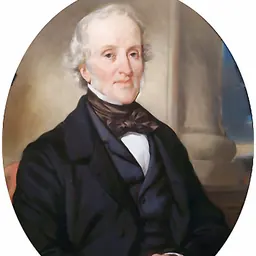
Lived 1809 – 1874 (aged 64–65). Joseph Moir was an Australian businessperson.
Joseph James Moir (1809–1874) was a prominent builder, ironmonger, citizen and shot manufacturer in 19th century Tasmania. He is best known for building the Taroona Shot Tower, but also built St Mark's Anglican Church, Pontville, issued tokens in his own name during a currency shortage in the colony, and served as an alderman on Hobart City Council.
Life and family
Joseph Moir was born in the Scottish Border town of Kelso in 1809, where he learned his trade as a builder. In 1829, he emigrated with his elder brother John (c. 1807–1876) to the colony of Van Diemen's Land (as Tasmania was then known), sailing on the North Briton from Leith to Hobart via The Cape of Good Hope. His sister Mary (c. 1804–1866) followed her brothers to Hobart in 1832. In 1843, Moir returned to Kelso, where he married Elizabeth Paxton (c. 1822–1875), returning with her to Hobart in early 1844. He had at least five children with Elizabeth: Jane Josephine (b. 1846), Mary Sophia Stanley (b. 1848, died in 1853, aged 5 ), John Augustus (b. 1851), Joseph Paxton (b. 1853) and James George Wood (b. 1855). In January 1872, John Augustus (aged 20) drowned with two others in an accident when their boat capsized on the River Huon.
Work
Builder and Ironmonger
Moir began his colonial life as a builder, constructing houses and churches around Hobert, and acquiring land and property (including three blocks of land in his first four years in Hobart). He established a reputation for notable buildings such as St Mark's Anglican Church, Pontville, and was appointed to civic positions: Clerk of Public Works for the colony in 1834, then Commissioner under Hobart's 1846 Paving and Lighting Bill.
In 1849 he visited Britain once more in pursuit of new business ventures, returning with textile manufacturing machines and ironmongery goods. With the latter, he soon established a successful ironmongers in Hobart at Economy House, Murray Street, advertising that he had "relinquished the business of Builder carried on by him for twenty years in Hobart" and had "arrived from England, per Eliza, with a large assortment of general Ironmongery suitable for this market, all having been selected by himself... from the principal manufacturers... of a quality hitherto unknown in the Colonies" and concluding that he could "recommend them with confidence, and at such prices as he hopes will secure the patronage of the public." Economy House was run by Moir until his death, when his son Joseph took over, finally selling the business in 1884. Moir's ironmongers issued a one penny token (dated 1850, when the business was established), probably around 1860. The reverse identifies Economy House as his workplace, with Murray Street spelt as Murry Street.
Shot Tower
Moir moved with his family to "Queenborough Glens" in 1862, a house at Taroona, along the Browns River Road seven miles south of Hobart, built on 39 acres of land which he had purchased in 1855. The walls were 1 m (3 ft) thick at the bottom and under half a centimetre (1/6 in) thick at the top. The tower had an internal timber spiral staircase, and an external gallery at the top.
Lead shot was produced by dropping molten lead through a colander at the top of the tower: as it fell and cooled, the lead formed into spherical droplets, which solidified when they hit a trough of water at the bottom of the tower.
Death and legacy Moir died at Queenborough Glens on 11 March 1874, after a long illness. Hobart's Mercury newspaper suggested that Moir "never fully recovered from the shock caused by the drowning of his son" John in 1872. His widow Elizabeth died 16 months later in 1875, while his son Joseph Paxton lived until 1933 and his research on "Stone implements of the Tasmanian natives" was published by the Royal Anthropological Institute in 1900.
Summing up his career, Joseph Moir's obituary described him as "one of our most enterprising colonists ...[and] one of the most valuable and useful aldermen the city has had", adding that Moir's enterprising spirit was "illustrated in a most remarkable manner" in the shot tower he built.
Don’t just read it —
keep it.
Full-length biographies made to live with: read them, listen on the way to work, watch them tonight.
- E-book
- Audio
- Video
Instant download · yours to keep · every purchase keeps this site free
Important facts
People in Joseph Moir's life
Named in this biography and alive at the same time

Related people
Same field, nearest in time


Contemporaries
People whose lives overlapped Joseph Moir's




Frequently asked questions
Who was Joseph Moir?
Australian builder
When was Joseph Moir born?
Joseph Moir was born in 1809.
When did Joseph Moir die?
Joseph Moir died in 1874.
What was Joseph Moir's occupation?
Joseph Moir was a businessperson.
What nationality was Joseph Moir?
Joseph Moir was Australian.
Sources & further reading
Cite this page
APA: Biography.guide. (2026). Joseph Moir. https://biography.guide/joseph-moir/
MLA: "Joseph Moir." Biography.guide, https://biography.guide/joseph-moir/.
Chicago: "Joseph Moir." Biography.guide. https://biography.guide/joseph-moir/.
Data last updated: 2026-09-20 · Spot an error? Report a correction.
Page generated 2026-09-27 05:22 UTC