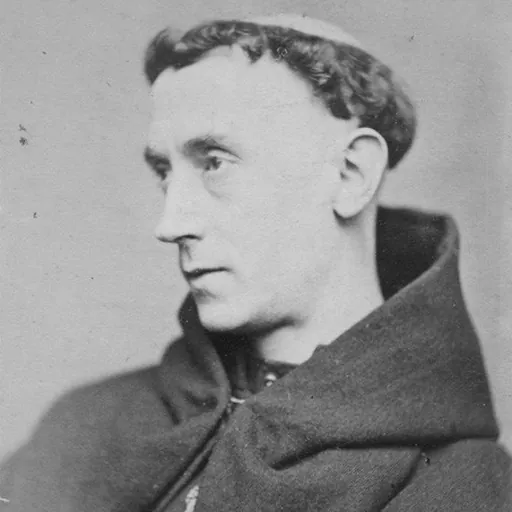
About Joseph Leycester Lyne
Lived 1837 – 1908 (aged 70). Joseph Leycester Lyne was a British theologian and anglican benedictine monk.
Joseph Leycester Lyne, known by his religious name as Father Ignatius of Jesus ( – ), was an Anglican Benedictine monk. He commenced a movement to reintroduce monasticism into the Church of England.
Early life Lyne was born in Trinity Square, in the parish of All Hallows-by-the-Tower, London, on 23 November 1837. He was the second son of seven children of Francis Lyne, merchant of the City of London, by his wife Louisa Genevieve (d. 1877), daughter of George Hanmer Leycester, of White Place, near Maidenhead, Berkshire, who came of the well-known Cheshire family, the Leycesters of Tabley. In October 1847 Lyne entered St Paul's School, London, under Herbert Kynaston. In 1852 he suffered corporal punishment for a breach of discipline. In Plymouth, Lyne formed two friendships which were very important in his future career; these two friends were Edward Bouverie Pusey and Priscilla Lydia Sellon. According to Bertouch, these two were "the ghostly foster-parents of the monk's vocation, or at any rate of its consummation".
From 1866 to 1868 he preached regularly at St Bartholomew's Moor Lane Church and other London churches. His conduct was so extravagant, however, that he was suspended, from officiating or preaching in the Diocese of London, by Bishop Archibald Tait;
In 1869 Lyne purchased land near Capel-y-ffin in the Black Mountains, Wales, and built Llanthony Abbey, four miles further up the valley from Llanthony Priory. The cost of the building, which remained incomplete, was defrayed by friends and the pecuniary returns of Lyne's mission preaching. Accounts of miracles and supernatural visitations enhanced the local prestige of the monastery, of which Ignatius constituted himself abbot. But the life of the community never ran smoothly. Few joined the order; in many cases those who joined soon fell away. From 1890 to 1891, he made a missionary tour through Canada and the United States where he was cordially invited to preach in the churches of many denominations; but his zeal for heresy-hunting was not appreciated by the Episcopal Church of America. But Kilvert also described in his 15 July 1870 diary entry that Lyne's' brother, Clavering Lyne, told him about "some of the extraordinary visions which had appeared to Ignatius, particularly about the ghosts which come crowding round him and which will never answer though he often speaks to them. Also about the fire in the monastery chapel at Norwich, that strange unearthly fire which Father Ignatius put out by throwing himself into it and making the sign of the cross." An example cited by Hilliard was an incident, published on 17 September 1864 in the Norfolk News, (In 1868 Hughes became a popular guest speaker at Protestant platforms in London and other places, where he scandalised his audiences with revelations of the "semi-Popish and improper practices" of Ignatius and other ritualists.) At a different meeting in London, two Norwich youths "made frightful charges, utterly unfit for publication, against a monk" which Hilliard wrote were a reference to Brother Augustine. (Father Asaph Harris lived on until 1960.) The Caldey Benedictines collectively submitted to Rome in 1913 and the Llanthony monastery eventually passed into the hands of Eric Gill, the sculptor and typographer.
The monastery has a later religious association in that it was, for two years or so, the home of the controversial Carmelite friar and writer Father Brocard Sewell, who withdrew there after he had written to The Times questioning Catholic teaching on birth control and criticising the encyclical Humanae Vitae; as things turned out, no sanction was ever imposed on Fr Sewell either by the Prior Provincial of his Order or the local bishop. Sewell considered his stance a matter of conscience and subsequently published a book The Vatican Oracle (1970) detailing his views.
Fr Ignatius's abbey church, which was never completed, fell into disrepair before the Gill family arrived and the roof was removed during the 1930s. In 1967 responsibility for its upkeep was transferred to a new ecumenical body, the Father Ignatius Memorial Trust, of which Fr Brocard Sewell was a founder member. Extensive restoration work was subsequently carried out on both the surviving abbey walls and Ignatius's grave within. As the structure was fundamentally unsound, this work has been only partially successful, and at the time of writing (April 2018) public access is denied.
The Father Ignatius Memorial Trust also cares for the statue of the Blessed Virgin commemorating her alleged apparitions at the monastery in August and September 1880, as well as the memorial Calvary opposite the site of the related ‘holy bush’. A considerable collection of archives and artefacts has been assembled under the auspices of the Trust, most of which is housed at the Abergavenny Museum; the tabernacle which formerly stood on the high altar of the abbey church and various pictures are cared for by the present owners of the monastery but are not normally on view.
Ignatius's effort to revive monasticism in England bore little fruit. His persuasive oratory and his courage in the face of persecution were combined with extravagance of conduct and an impatience of authority which rendered him unable to work even with sympathisers. The Order of St Benedict founded by Ignatius was not a revival of the Rule of Saint Benedict; Ignatius was independent and erratic, his rules were eclectic.
Works or publications
Notes and references
Don’t just read it —
keep it.
Full-length biographies made to live with: read them, listen on the way to work, watch them tonight.
- E-book
- Audio
- Video
Instant download · yours to keep · every purchase keeps this site free
Important facts
People in Joseph Leycester Lyne's life
Named in this biography and alive at the same time


Related people
Same field, nearest in time


Contemporaries
People whose lives overlapped Joseph Leycester Lyne's



Frequently asked questions
Who was Joseph Leycester Lyne?
Anglican Benedictine monk
When was Joseph Leycester Lyne born?
Joseph Leycester Lyne was born on 23 November 1837 in London.
When did Joseph Leycester Lyne die?
Joseph Leycester Lyne died on 16 October 1908.
What was Joseph Leycester Lyne's occupation?
Joseph Leycester Lyne was a theologian and anglican benedictine monk.
What nationality was Joseph Leycester Lyne?
Joseph Leycester Lyne was British.
Sources & further reading
· Wikipedia: Joseph Leycester Lyne
· DBpedia: Joseph Leycester Lyne
Cite this page
APA: Biography.guide. (2026). Joseph Leycester Lyne. https://biography.guide/joseph-leycester-lyne/
MLA: "Joseph Leycester Lyne." Biography.guide, https://biography.guide/joseph-leycester-lyne/.
Chicago: "Joseph Leycester Lyne." Biography.guide. https://biography.guide/joseph-leycester-lyne/.
Data last updated: 2026-09-22 · Spot an error? Report a correction.
Portrait: Wikimedia Commons · author & licence
Page generated 2026-09-27 05:01 UTC