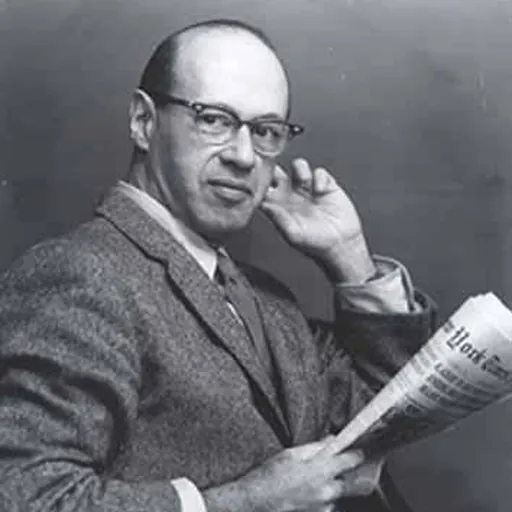
About Joseph Hirsch
Lived 1910 – 1981 (aged 71). Joseph Hirsch was an American painter, printmaker, illustrator, muralist and designer.
Joseph Hirsch (1910–1981) was an American painter, illustrator, muralist and teacher. Social commentary was the backbone of Hirsch's art, especially works depicting civic corruption and racial injustice.
His works are in the Metropolitan Museum of Art, the Museum of Modern Art, the Whitney Museum of American Art, the Smithsonian American Art Museum, and many other museums.
Early life and education The son of physician Charles S. Hirsch and Fannie Wittenberg, he was of German-Jewish heritage and grew up in Philadelphia, Pennsylvania. A 1935 Woolley Fellowship from the Institute of International Education enabled him to travel throughout Europe for more than a year, and he returned to the United States in November 1936, by way of Egypt, Asia and the Pacific Ocean.
Career In the late 1930s, Hirsch worked in Philadelphia as an artist in the easel painting division of the Works Project Administration. In 1942–1943, he was embedded as an artist/war correspondent with naval airmen in Florida, then with the U.S. Navy Medical Corps in the South Pacific. In 1944, he was embedded with the U.S. Army Medical Corps in North Africa and Italy.
Hirsh often used an intimate scene to suggest the enormous emotion of a subject: The Lynch Family (1946) depicts a young black mother holding a baby, distraught at the murder of her husband. following the July 1946 lynching of two black men and their wives in Monroe, Georgia. The Burden (1947) depicts an overwhelmed American GI installing white cross gravemarkers in a military cemetery, while in the background a second GI unloads yet another jeep-full. Hirsch's poster for the original 1949 Broadway production of Arthur Miller's Death of a Salesman depicts a beaten-down Willy Loman trudging onward with his heavy suitcases.
Hirsch occasionally explored Christian themes. His version of The Crucifixion (1945) is a closeup view from behind, and focuses on the busy workman preparing to nail Jesus's hand to the cross. The Journey (ca.1948), painted as a Christmas card for Hallmark Cards, depicts the Flight into Egypt, and presents Mary and Joseph in modern dress on the back of a donkey—with Joseph holding a trombone!
In his mature period, the 1960s and 1970s, Hirsch used a series of layered planes to compose a painting. Typically, these planes were parallel to the picture plane, with depth suggested by receding figures, rather than through lines of perspective. These paintings appear to be snapshots, capturing people in mid-action, not posing. Dartmouth College (Spring 1966), and Brigham Young University (1971). but, as the end of its second year approached, he sold his house on Cape Cod to extend his family's stay in Paris. Instead, the museum moved Nine Men, a painting by Diego Rivera, and one by George Grosz into a separate room, and asked museumgoers to judge the Communist influence for themselves. The Hirschs did not return to the United States until 1955. and the National Academy of Design. He exhibited seventeen canvases in a 1942 Museum of Modern Art exhibition—Americans 1942: 18 Artists from 9 States (MoMA, January 21 to March 8, 1942), and exhibited in eleven other MoMA exhibitions. One of Hirsch's war paintings was included in the Artists for Victory exhibition, that began at the Corcoran Gallery of Art in late 1944, and toured the country.
PAFA awarded Hirsch the 1934 Walter Lippincott Prize (best figure painting exhibited by an American artist) for Masseur Tom, a life-size full-length portrait of an imposing Turkish masseur. Masseur Tom also won him the 1934 Third Hallgarten Prize (best figure painting exhibited by an American artist under age 30) from NAD. The Library of Congress twice awarded him the Joseph Pennell Purchase Prize for lithography: 1944 for Lunch Hour, The Art Institute of Chicago awarded him the 1951 Blair Prize for Nine Men. The Metropolitan Museum of Art held its first annual exhibition in 1951, and awarded him Fourth Prize for Nine Men, the only non-abstract painting among the winners. The Childe Hassam Purchase Fund of the American Academy of Arts and Letters purchased four of his paintings, beginning with The Burden in 1955. NAD awarded him the Altman Prize (best figure painting exhibited by an American artist) three times: 1959 for The Book, 1966 for [work], and 1978 for Tuba. The Carnegie Museum of Art awarded him the 1947 Carnegie Second Prize for The Iceman, and the 1968 Carnegie Prize for [work].
Hirsch was runner-up for the 1935 Rome Prize. He was elected to the National Institute of Arts and Letters in 1967. The Hirsch family moved to France in 1949, and the couple divorced soon after their return to the United States in 1955. They had one son together, Frederic. Depicts a corpse-strewn battlefield by night. Two Men (1937), Museum of Modern Art, New York City. Exhibited at the 1939 New York World's Fair. Hercules Killing the Hydra (ca.1937), Smithsonian American Art Museum, Washington, D.C. Depicts a policeman beating striking workers with a billy club. Street Scene (1938), Fred Jones Jr. Museum of Art, University of Oklahoma—Norman. Depicts 4 men huddled together on a steam grate in the snow. Portrait of an Old Man (1939), Museum of Fine Arts, Boston, Massachusetts Hero (Man with Poppies) (ca.1939-40), Smithsonian American Art Museum, Washington, D.C. Depicts a uniformed World War I veteran selling Memorial Day poppies on a city sidewalk. Air Raid (ca.1940), Metropolitan Museum of Art, New York City The Senator (1941), Whitney Museum of American Art, New York City The Prisoner (1942), Whitney Museum of American Art, New York City Lunch Hour (1942), lithograph, Library of Congress, Washington, D.C. Awarded the 1944 Pennell Purchase Prize, and still in the LOC's permanent collection. Portrait of Somerset Maugham (1942). Exhibited at MoMA, 1942. Honorable mention, Art Institute of Chicago, 1942 annual exhibition. The Crucifixion (1945), Butler Institute of American Art, Youngstown Ohio The Survivor (1945), Columbus Museum of Art, Columbus, Ohio Winter (1945), Hood Museum of Art, Dartmouth College, Hanover, New Hampshire Banquet (1945), lithograph, Carnegie Museum of Art, Pittsburgh, Pennsylvania The Lynch Family (1946), Nelson-Atkins Museum of Art, Kansas City, Missouri The Burden (1947), American Academy of Arts and Letters, New York City The Journey (ca.1948), Hallmark Art Collection, Kansas City, Missouri Nine Men (1949), Smithsonian American Art Museum, Washington, D.C. Awarded the 1951 Blair Prize from the Art Institute of Chicago; and the 1951 4th Prize from the Metropolitan Museum of Art. Clown with Mask (1949), Hirshhorn Museum and Sculpture Garden, Washington, D.C. Patriobats (1949), Hirshhorn Museum and Sculpture Garden, Washington, D.C. Birthday (1949–50), Hirshhorn Museum and Sculpture Garden, Washington, D.C. The Widow (1952–53), Addison Gallery of American Art, Phillips Academy, Andover, Massachusetts The Shower (1953), Addison Gallery of American Art, Phillips Academy, Andover, Massachusetts The Room (1958), Metropolitan Museum of Art, New York City The Naked Man (ca.1959-60), Smithsonian American Art Museum, Washington, D.C. Depicts a naked draftee carrying his newly-issued uniforms and boots. Guerillas (ca.1960), Harry S. Truman Presidential Library and Museum, Independence, Missouri Doorway (ca.1961), American Academy of Arts and Letters, New York City Motorcycles (ca.1963), American Academy of Arts and Letters, New York City Broth (ca.1964), Smithsonian American Art Museum, Washington, D.C. Deposition (1967), Cranbrook Art Museum, Bloomfield Hills, Michigan Tuba (1971), National Academy of Design, New York City Daniel (Belshazzar's Feast) (ca.1976-77), Montgomery Museum of Fine Arts, Montgomery, Alabama Father Killer Whale and Daughter (no date), Whitney Museum of American Art, New York City
World War II U.S. Naval Historical Center, Washington, D.C. Transportation, Latest Mode (ca.1943) Blasting Mosquito Infested Swamps (ca.1943) Heave Away (ca.1943) Mercy Ship (ca.1943) Satisfaction Plus (ca.1943) Making the Buoy (ca.1943) Back from Patrol (ca.1943) Eyes of the Fleet (ca.1943) Ready on the Line (ca.1943) Onto the Ramp (ca.1943) Man of the Hour (ca.1943)
U.S. Army Center of Military History, Washington, D.C. Company in the Parlor (1944). A makeshift hospital set up in the ruins of a church. High Visibility Wrap (1944) Night Shift (1944) Field Examination (1944) Hospital for Allied Wounded (1944) After the Fascist Fair (1944) Bringing in the Ammo (1944) Italian Rush Hour (1944) Nurse in Newfoundland (1944) All Aboard Home (1944)
Murals History of the Amalgamated Clothing Workers of America (1938), ACWA Office Building, Philadelphia, Pennsylvania. An enormous mural – 11 ft x 65 ft (3.6 m x 19.8 m) – covering 3 walls of the lobby, Hirsch painted it on his own in 5 weeks. The building has been converted into apartments, the lobby is now a City Fitness gym, and the mural is hidden behind mirrors. 3-part mural: Child Labor, Adoption, Child Education (1938–39), Courtroom C, Family Court Building, Philadelphia, Pennsylvania
Don’t just read it —
keep it.
Full-length biographies made to live with: read them, listen on the way to work, watch them tonight.
- E-book
- Audio
- Video
Instant download · yours to keep · every purchase keeps this site free
Important facts
Family & relationships
People in Joseph Hirsch's life
Named in this biography and alive at the same time




Related people
Same field, nearest in time
Contemporaries
People whose lives overlapped Joseph Hirsch's





Frequently asked questions
Who was Joseph Hirsch?
American artist (1910-1981)
When was Joseph Hirsch born?
Joseph Hirsch was born on 25 April 1910 in Philadelphia.
When did Joseph Hirsch die?
Joseph Hirsch died on 21 September 1981 in Manhattan.
What was Joseph Hirsch's occupation?
Joseph Hirsch was a painter, printmaker, illustrator, muralist and designer.
What nationality was Joseph Hirsch?
Joseph Hirsch was American.
Sources & further reading
Cite this page
APA: Biography.guide. (2026). Joseph Hirsch. https://biography.guide/joseph-hirsch/
MLA: "Joseph Hirsch." Biography.guide, https://biography.guide/joseph-hirsch/.
Chicago: "Joseph Hirsch." Biography.guide. https://biography.guide/joseph-hirsch/.
Data last updated: 2026-09-22 · Spot an error? Report a correction.
Portrait: Wikimedia Commons · author & licence
Page generated 2026-09-27 05:01 UTC