
About Joseph Fowles
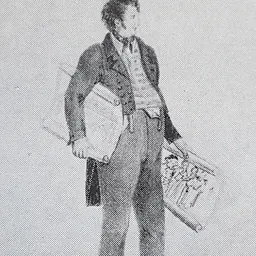
Lived 1810 – 1878 (aged 67–68). Joseph Fowles was an Australian draftsperson, engraver, artist, painter, publisher and farmer.
Joseph Fowles (24 December 1809 – 25 June 1878) was an Australian artist and educator, perhaps best remembered for his publication "Sydney in 1848", a series of etchings depicting Sydney’s streets and buildings in that year.
Early life and arrival
Voyage Fowles was an artist but not much is known of his early life apart from what can be gleaned from the journal of his voyage to New South Wales held in the Mitchell Library, Sydney. During the voyage he painted on deck and his illustrated journal includes islands and ports of call en route.
He arrived in Sydney on 31 August 1838 via Hobart as an unassisted cabin passenger aboard the "Fortune" with his wife Sarah and partner Emily Collyer.
Life in Sydney His journal states that leased a property at Hunters Hill owned by Mary Reiby known as Figtree Farm. Here on the farm he produced fruit and vegetables and obtained timber sold at market in Sydney. The Fowles family lived at Hunters Hill into the 1840s during which time his wife Sarah returned to England and Fowles took up with his companion Emily Lambrigg Collyer. They were to have seven children.
Career as an artist
Marine painter Fowles opened a studio in Harrington Street in Sydney’s Rocks in the 1840s and gained a reputation as a marine painter. At the first public exhibition of art in the colony in 1847 presented by the Society for the Promotion of Fine Arts in Australia he exhibited 7 works featuring maritime subjects: five were of ships and one “Kangaroos” his first documented animal painting.
The Sydney Morning Herald described him as a marine painter successful in capturing the likeness of ships in his work.
Fowles exhibited three further maritime paintings in the same exhibition in 1849.
Etchings and drawings of Sydney
Sydney in 1848 The major artistic work of Joseph Fowles career was a series of etchings depicting the town of Sydney in 1848. Sydney had been transformed in the years following Fowles arrival and he set himself the task of conveying the bustling new city in a series of streetscape etchings identifying administrative, commercial, religious and residential buildings of the city.
Fowles believed Sydney’s stature as a city had not been recognised in Britain. The purpose of this project was to change any such perceptions to the contrary as he outlined in the serial installments appearing in the press and in the print publication:
“The principal object of this Work is to remove the erroneous and discreditable notions current in England concerning this City, in common with everything else connected with the Colony. We shall endeavour to represent Sydney as it really is – to exhibit its spacious Gas-lit Streets, crowded by an active thriving Population – its Public Edifices, and its sumptuous Shops, which boldly claim a comparison with those of London itself”
The work remains an important source for Sydney’s early history. Sydney residences including Bungarrabee (Eastern Creek) and Emu Hall (Penrith). Street scenes included a portrait of publican Stephen Butts on a white horse, outside his fashionable terrace house in Macquarie Street. The latter work signalled Fowles’ other artistic phase as an animal portraitist, especially horses.
Equine and Animal subjects Fowles penchant for painting horses was related to his love of horse racing. He painted commissioned works as well as contributing to exhibitions in the 1850s and 1860s. He established a successful business selling portraits of champion racehorses.
Despite a financial setback in which the stables sent him into insolvency he remained well connected in the racing industry affiliated with Homebush Jockey Club and the Tattersall’s Club.
He became drawing master for the Board of National Education forerunner of the New South Wales Department of Education. Fowles published instructional manuals for drawing for students and teachers such as the “Sydney Drawing Book” that underpinned the curriculum in NSW government schools into the 1880s.
It was said that through Fowles efforts drawing was being taught at every government school in New South Wales at the comparatively early date of 1869.
Gallery
Don’t just read it —
keep it.
Full-length biographies made to live with: read them, listen on the way to work, watch them tonight.
- E-book
- Audio
- Video
Instant download · yours to keep · every purchase keeps this site free
Important facts
Related people
Same field, nearest in time

Contemporaries
People whose lives overlapped Joseph Fowles's






Frequently asked questions
Who was Joseph Fowles?
Australian artist and educator (1809-1878)
When was Joseph Fowles born?
Joseph Fowles was born in 1810 in Somerset.
When did Joseph Fowles die?
Joseph Fowles died on 25 June 1878 in Sydney.
What was Joseph Fowles's occupation?
Joseph Fowles was a draftsperson, engraver, artist, painter, publisher and farmer.
What nationality was Joseph Fowles?
Joseph Fowles was Australian.
Sources & further reading
Cite this page
APA: Biography.guide. (2026). Joseph Fowles. https://biography.guide/joseph-fowles/
MLA: "Joseph Fowles." Biography.guide, https://biography.guide/joseph-fowles/.
Chicago: "Joseph Fowles." Biography.guide. https://biography.guide/joseph-fowles/.
Data last updated: 2026-09-20 · Spot an error? Report a correction.
Page generated 2026-09-27 05:18 UTC